| Frazzini Genealogy |
DiVecchia Genealogy |
Site Home |
| Aliquippa's
Beginnings by Denver Walton |
http://www.bchistory.org/beavercounty/BeaverCountyCommunities/Aliquippa/AliquipBeginsMSP92.html |
History of Beaver County, Pennsylvania and Its Centennial Celebration |
http://books.google.com/books |
| The Library of Congress - American Memory | http://memory.loc.gov/ammem/index.html (in the search field, type in Aliquippa) |
A Tale of Two Logstowns |
http://www.aliquippapa.gov/aliquippa_history.php |
| From http://www.bchistory.org/beavercounty/BeaverCountyCommunities/Aliquippa/Aliquippa.html |
Aliquippa, the county's most populous borough, seemingly grew overnight from the merger of three small villages, each with a history of its own. While a relatively new community compared to others in the county, Aliquippa's traditions go back to the very beginning of colonial habitation in Beaver County. In the years before the Revolution, two Indian traders, successively, chose the fertile fields across the river from the old Indian village of Logstown to make a home. Alexander McKee, the first resident, built a cabin around 1769, but evidently did not stay too long. In 1771, John Gibson surveyed 300 acres, built a cabin, and planted crops, becoming the first colonial farmer in the county, although the same land along the river had been farmed by the Indians for many years. Logstown, the Delaware Indian village, was across the river in Baden, but somehow the name was transferred to the stream on the west side of the Ohio. In turn, the small village near the stream mouth became known as Logstown Bottom. The Reverend Andrew McDonald lived here when he became pastor of White Oak Flats Church in 1810. White Oak Flats was a large level area in the hills west of Logstown, and the site of an early Presbyterian Church, which for a long time was known by the same name. (It was later called Mt. Carmel.) The Flats were bisected by Brodhead's Road in 1778, when the supply trail from Pittsburgh to Fort McIntosh (Beaver) was cut through the wilderness. Later, a road from the fertile Raccoon Creek valley to the Ohio River intersected the military trail, and a village grew up at the crossroads. In time the village became known as New Sheffield. In 1877, while the Pittsburgh and Lake Erie Railroad was laying track through Logstown Bottom, a post office was established in the village. A new name, Woodlawn, was suggested by Mattie McDonald and adopted. The P. & L.E. built an amusement area north of Woodlawn, and named it Aliquippa Park. Soon an adjacent village had its own station, called Aliquippa. A shovel factory and other manufacturers located here and a town site was laid out, incorporated in 1894 as Aliquippa Borough. In the next decade or so, Aliquippa developed into a fair sized industrial town, while Woodlawn village, a few miles to the south, languished as a rural community, although the Woodlawn Academy and a Presbyterian church had been established near the station. Everything changed, however, in 1906, when construction began for the huge Aliquippa works of the Jones and Laughlin Steel Company. Old Logstown disappeared while a new business district was constructed in the valley and plans of houses sprung up on every surrounding hill. In 1926, Woodlawn, already the largest community in Beaver County, annexed New Sheffield from Hopewell Township, along with the land in between. In 1928, a merger was effected by a referendum of the voters with Aliquippa Borough, and the new borough retained the name of the smaller partner to better identify with the name of the steel works. (There is no historical evidence connecting the Indian Queen Aliquippa with the location of the borough. This was one of several Indian names selected arbitrarily by the P. & L.E. Railroad in 1878 for stations along the route. Others were Shannopin, now South Heights, and Monaca.) Aliquippa's leaders were perplexed by the problems created by the automobile and the mobility it gave to people. The younger generations have chosen to build homes in neighboring suburban townships. The Franklin Avenue business district declined as shoppers found it more convenient to drive to the outlying shopping centers than to cope with traffic and parking problems downtown. The old borough of Aliquippa became known as West Aliquippa (the second time it was named by the railroad.) In the 1960's J. & L. filled in Crow's Island, on the river side of town, and constructed a huge new steel producing facility there. The old town seems destined to be completely swallowed up by the mill, as many houses and buildings have been demolished. New Sheffield has become the center of the community as many churches and businesses have relocated there, and also contains the borough's only elementary school. In the last 15 years. most of the J. & L. Steel works has been shut down or demolished in along the Ohio in Aliquippa. The commissioners of Beaver County plan to use a large portion of that site to relocate the county jail. The Franklin Avenue business district is basically non-existent today. Its main purpose now is a throughway for Aliquippa residents to route 51, leading to Ambridge, South Heights, or Monaca. |
| From http://bchistory.org/beavercounty/beavercountytopical/media/BCNewspapersMSum79/BCNewspapersMSum79.html |
|
Return to Milestones Vol. 5, No. 3 A HISTORY OF NEWSPAPERS IN BEAVER COUNTYby CHRISTY LYNN BLACKBURN Milestones Vol 5, No. 3--Summer 1979 Throughout the history of, Beaver County there have been approximately 122 different newspapers, many of them short-lived, which have been published in the towns of Aliquippa, (formerly known as Woodlawn), Ambridge, Baden, Beaver, Beaver Falls, Fallston, Freedom, Hookstown, Midland, Monaca, New Brighton, New Galilee, and Rochester. The earliest known publication was the Minerva of Beavertown, issued every Saturday by John Berry. It was a four-page sheet first published November 4, 1807, and sold at two dollars per year. The motto of the paper was: "This folio of four pages; happy work! What is it but a map of busy life, its fluctuations and its vast concerns." In the center of the headline was a crude representation of the goddess whose name it bears. The first two pages were taken up with European news. The other two pages carried various items such as property notices, criminals wanted, and political attachments. It is believed that the Minerva was continued in 1812 under the name of the Western Cabinet because both papers were the same in size, type, and general make-up. The Western Cabinet was also printed in Beaver by Joseph W. White. Its motto was: "The basis of our political system is the right of the people to make and to alter the constitution of Government -- Washington." No record exists of how long it was published, however, it was succeeded by the Crisis, which bore the same features as its predecessor. Three papers were started in Beaver between May and June, 1813. They were the Crisis, the Beaver Gazette, and the Crisis and Beaver Gazette. The Crisis was started on May 22, 1813, by J. and A. Logan. The last issue known was dated April 30, 1814. The Beaver Gazette was begun by A. Logan on June 8, 1813 until March 15, 1817. Its motto was'. "Free but not Licentious." The Crisis and Beaver Gazette, began June 10, 1813, was published also by A. Logan. On September 1, 1818, James Logan, brother of A. Logan, began publication of the Western Argus. Over the years until 1878, the Western Argus went through five name changes and approximately 16 different owners. The journalism of this time showed an increase of local or home-town news, greater emphasis on crime and sex news, and the appearance of human-interest stories. Politics still played an important role in these early-day newspapers. One article published in 1845 on the front page of the Beaver Argus read, "New Remedy for Toothache." It went on to state that India Rubber melted by candle on a piece of wire, should be placed while warm into the hollow tooth. This keeps air from the exposed nerve and kills the pain. In 1874, a nine-column folio titled the Beaver Times was established as a Republican weekly by Michael Weyand. A daily edition, the Beaver Daily Times, was started in 1911. In October, 1902, a Mergenthaler Linotype was installed in the Times' office. This was the second in the county to be installed and it eased the tedious work of setting type by hand. Meanwhile, a whole slew of Democratic papers came into existence, starting with the Beaver Republican in 1826. This paper was started by Andrew Logan and soon fell into the hands of his brother, James Logan, the same prominent gentleman who began publication of the Western Argus. Other Democratic papers include the Democratic Watchman (1835), the Aurora (1836), the Beaver River Gazette (1834), and the Western Star (1843). Over the years the Western Star changed owners who in turn changed the name. Among some of the name changes were The Local (1865), the Conservative (1871), the Democrat (1874, the Beaver County Post (1876), the Commoner (1877), and the Star (1879). In 1887, John A. Mellon, at that time editor and publisher of the Beaver Falls Globe, bought the Star and consolidated the two papers under the name of the Globe-Star which continued until 1891. Other towns in Beaver County were also establishing papers during this time. New Brighton and Fallston had the Fallston and Brighton Gazette (1835-1838) and the Beaver Falls Union and Beaver County Advocate (1838-1839). Other papers include the New Brighton Record (1854), the New Brighton Times (1857), the New Brighton Herald (1869), the Beaver County Press (1871), and the Beaver Valley News (1874). The Beaver Valley News was established in 1874 by Major David Critchlow and Francis Smith Reader. In 1877, F. S. Reader, editor of the paper, bought out the Major's interest and by 1883, the Beaver Valley News became the first daily paper in Beaver County. In January, 1901, the Beaver Valley News installed the first Mergenthaler Linotype in the county. The News was a Republican paper having both a daily and weekly edition printed in a six-column quarto. Its editor, F. S. Reader, was at that time the longest in both active service and continuous work as editor in the county. Rochester housed two publications in the 1800's. The first was the Commoner (1897), edited by R. W. Stiffey. The other Rochester paper was the Beaver Falls Chronicle (1839), edited by J. Washington White. The motto was: "Our country, right or wrong." The reading material of this four-page paper would be comparable to many of today's weeklies. In 1840 the paper was moved to Beaver Falls where its name was changed to the Beaver County Palladium. It was the first paper published in Beaver Falls and the editorship now belonged to E. Burke Fisher. The paper was discontinued in the fall of 1841, soon after John B. Early took over as editor after a financial matter concerning the paper. There is no other record of a newspaper in Beaver Falls until 1875, when John T. Porter started the Beaver Falls Courier. Eventually, after several ownerships and name changes, it became the Beaver Falls Tribune with John H. Telford as editor. The paper continued publication until 1928, merging with the News to form the Beaver Falls News-Tribune. It was bought out by the Beaver County Times in 1979. At the present time, the Beaver County Times is the immediate area's largest and most widely read newspaper. Its predecessor, the Beaver Daily Times, was published from 1911 to 1946, as mentioned earlier. In 1946, the Daily Times was sold to S. W. Calkins of Uniontown. Calkins previously edited the Evening Times in Aliquippa (1943-1946). The name of the paper was changed on October 16, 1946, to the Beaver Valley Times. Later in 1957, the name was again changed to the Beaver County Times. In 1959, the Times expanded following the acquisition of the Ambridge Daily Citizen and the Ambridge News-Herald from the McNees family of Ambridge. Technology has changed so much since the primitive Beaver Times of 1874. The old flatbed press is now a high-speed, full-color rotary press. Instead of setting type by hand it improved by being cast by machine from hot metal, which in turn has been replaced by computer-set cold type. Today the news is quickly reported, both local and national, and it is illustrated with pictures. On April 2, 1978, the Beaver County Times expanded its daily edition to include a weekly Sunday edition to continue to serve its readers and advertisers. Today the Times is Beaver County's only daily newspaper. Weekly and monthly publications include the News in Aliquippa, the Midland News in Midland, and the Western Advertiser in Beaver Falls, as well as the many publications sent out by the local businesses and industries. The changes that journalism has gone through over the years would be quite obvious to anyone who could take the time to read some of the county's early newspapers. Early editions beginning with the Western Argus are available on microfilm for viewing at either the Penn State Beaver Campus Library in Monaca or the B. F. Jones Memorial Library in Aliquippa. There is no limit to the wealth of historical information found in newspapers of the past. We must continue to preserve the past so that we may aid in the knowledge of the future. BIBLIOGRAPHY Bausman, Rev. Joseph H. History of Beaver County, Pennsylvania. Vol. 1. Buffalo: Knickerbocker Press, 1904. pp. 450-473. Rossell, Glenora E. Pennsylvania Newspapers, A Bibliography and Union List. Pennsylvania Library Associ6tion, 1969. Mott, Frank Luther. American Journalism, A History: 1690-1960. New York: The MacMillan Company. 1962. pp. 215-326. Beaver Falls Area Centennial, Historical Salute to the Centuries. . . 1868-1968. The Tribune Printing Company, 1968. p. 156. Beaver County Times. First Sunday Paper A Birthday Edition. April 2, 1978. p. A-10. |
| From http://www.bchistory.org/beavercounty/BeaverCountyTopical/Ethnichistoryandcustoms/EthnicAliquippaMSSpr78/EthnicAliquipMSSp78.html |
|
Shortly after the beginning of the present century, the Jones and Laughlin Steel Company started construction of a huge steel-making plant along the Ohio River in Hopewell Township. Adjacent to the new plant were two communities, the tiny Borough of Aliquippa, site of a popular amusement park on the Pittsburgh and Lake Erie Railroad, and the even smaller village of Woodlawn. In time, the communities were to grow and eventually merge to form the largest borough in Beaver County. But the history of the area in these intervening years was colored by a population factor missing from most of the early communities but common to steel and mining towns - the arrival of many immigrant workers from Southern and Eastern Europe, and of blacks from the impoverished southern states. The "Aliquippa Works" of J & L bordered Aliquippa Borough (later called West Aliquippa) without changing it drastically, but the pastoral Woodlawn Village was transformed, in a few years, to a huge residential and business complex, housing and serving the needs of more than ten thousand steel workers and their families. In the two decades following construction of the steel plant, Aliquippa and Woodlawn were rivals for the honors of being the leading steel community. As the towns developed, local officials believed that the lack of political unity hampered solutions to many community problems.- Finally, a plan for consolidation of the two boroughs was discussed. The proposal of a merger was presented to the citizens and approved. Thus, in January of 1928, the merger of Woodlawn and Aliquippa became a reality, the latter becoming the name of both. Long before the merger of the two Boroughs, ethnic groups already had made their mark upon the area. Aliquippa had been referred to as the textbook example of the "melting pot" theory. This theory is a concept of assimilation through a process of modification of the characteristics of the immigrant to accord with prevalent American types, psychology, customs, and institutions usually by superimposing American manners plus American ideas upon those of the immigrant. Revisionist historians have challenged this melting pot theory. One such historian, Bayard Rustin, put their position succinctly when he wrote, "there never was a melting pot; there is not now a melting pot; there never will be a melting pot-, and if there were, it would be such a tasteless soup that we would have to go back and start all over." This revisionist view does not seem to be completely applicable to Aliquippa. The community's ethnic groups have been assimilated into the American cultural ideal, but not at the expense of their heritage. They haven't forgotten their culture and traditions. The people have held fast to their folkways and in many cases have adopted customs, foods, expressions and holidays of other groups. The Serbian and Croatian groups sponsor orchestra and dance groups composed of the adolescent members of their nationalities who perpetuate the use of traditional folk instruments, tunes and dances. The Orthodox Churches still celebrate Christmas on January 7, complete with traditional foods and customs and music. One of the major ethnic events is the Observance by Italians in Aliquippa of the San Rocco Festival each year in August. While the San Rocco Festival is distinctly Italian in origin, it is celebrated and looked forward to by all residents of Aliquippa. The ethnicity of the area is further illustrated by the annual nationality fair days, first held during the Bicentennial year. It is tempting to sugarcoat the story of ethnic groups in Aliquippa, but the process of assimilation has been marked by a certain degree of turmoil, hate, violence, and bigotry. There is a complex duality involved in the story of ethnic groups in Aliquippa. Steve Twomey in a recent article, "Education: The Task Was To Make Americans" probably stated it best: "For the natives of English descent," Twomey writes, "the desire was almost overwhelming to mold the foreigners into the American character.... Yet many .... felt that such mass indoctrination violated the spirit of another great American ideal -- that no one should be forced to accept beliefs.... "Likewise, the immigrants were torn by conflicting forces. Many wanted desperately to become Americans. They knew what ideals America stood for, and had, in fact, come here to partake of those ideals. "But for many other immigrants the links to the past, to the culture and traditions of the homeland, were equally strong. Often, in fact, these remembrances of another world were all they had to sustain them as they struggled in an alien environment." Who are these ethnic groups? When did they come? Why did they come? How were they received and treated? Table I provides ethnic groups as they are listed in the United States Census. There are over 30 ethnic groups represented. Table 11 (not included with this web version) give the number and percentage of foreign born for the period from 1920 to 1970, and the number of Blacks in Aliquippa. Table III (not included with this web version) is an attempt to show percentage of groups in relation to the total population as well as percent plus or minus from 1920 to 1970. The figures in Table I (not included with this web version) shows that the ethnic population and foreign born have long been a significant percentage of the total population of the town. 1930 marks the peak of ethnic population in terms of number of foreign born and those of foreign-born parents or of mixed parentage -- the latter having at least one foreign born parent. 1920, however, marks the peak in ethnic percentage of the total population The ethnic character of Aliquippa, though generally high, has been steadily decreasing since 1920 as a percentage of the total population. A number of tentative explanations may be given - one is the adoption of restrictive immigration quota laws in the 1920's which discriminated against central, eastern and southern Europeans; another is the improvement of conditions in some European countries by the acquisition of political independence after World War 1; still another is the possible restriction on immigration imposed by some European countries which previously provided the bulk of immigrants to America. The Negro population of Aliquippa on the other hand has increased steadily both in total number and percentage of the total population. It is particularly interesting to note that while the number of inhabitants in all groups declined between 1960 and 1970 the percentage of the black population in relation to the total population increased. When did the ethnic and black population begin to come into the area? The published United States Census for 1900 and 1910 does not provide ethnic or racial information for communities of less than 2,500. Both Woodlawn and Aliquippa had a population of 620 in 1900 and 1,743 in 1910. Woodlawn in 1910 had a population of only 1,396. That there was a significant number of ethnic people in the area by 1907 is attested to by a statement found in the House of Prayer Evangelical Lutheran Church in Aliquippa, Centennial Booklet in which is found the following comment: "The Logstown Community was now changing (sic 1907). The Jones and Laughlin Steel Company had established their mill, and European immigrants were settling in the area. Most of the members of the House of Prayer had moved to Woodlawn." Why did immigrants and blacks come to Aliquippa? Obviously the choice of Aliquippa by Jones and Laughlin Steel Corporation as the site of the new steel works in 1905 had much to do with it. The decade beginning in 1900 saw the influx of over one million immigrants annually into the United States. These immigrants were generally unskilled peasants coming to America in the search for jobs. They found jobs in the heaviest and hardest work in the mills, handling steel billets, loading trains in cinder pits; labor that demanded strength in large measure. The number of blacks seemed to remain small until after 1910. 1 base this assumption upon two things: first, the first black church, the Emmanual African M.E. Zion Church was not established until 1915. It wasn't at least until then that there were sufficient numbers to-, support a church; second, the outbreak of war in Europe in 1914 cut off immigration to the United States and northern industries turned to the southern black for a new supply of cheap unskilled labor. What was the reception given to the immigrants and blacks? David Chaimovitz in his study, "A Public Health Survey of Aliquippa" in 1946 described the housing situation and indicates that blacks were largely confined to Logstown and Plan 11 areas. The discrimination and its affects on the community are described when he wrote'. "The segregationalism though seemingly inevitable is truly depressing and unfortunate for it fosters misunderstanding and ill-feeling among people who in lieu of the common call which brought them to this country and to Aliquippa should be sympathetic of one another." The history of the Emmanuel African M.E. Zion Church makes an indirect reference to the existence of racism when it states: "Burned once, and the congregation was forced to move several times. The Church has had its struggles." This obviously is an understatement of the difficulties encountered by the blacks. The immigrant was not received much better by native residents. The following entry appeared in the secretary's book of the House of Prayer Evangelical Lutheran Church of Aliquippa, dated July 18, 1909: "On account of the foreigners making a picnic ground and gambling resort of the church property yard, and on account of the poor location of the church property, it being amongst the J & L foreigners houses, it was decided to sell the property." The immigrant and the black both found living conditions which can best be described as dilapidated. Paper was torn off walls, plaster sagging, windows broken, the ceilings low and damp, rooms dark, stuffy and unsanitary, with few openings for either light or air. The presence of the immigrants, brought an early change to the community during the 1920's: Aliquippa High School began to teach foreign languages other than Latin and French. Also many of the immigrants began to attend Americanization classes in night school at the Jones and Logstown Schools. These classes were established to provide information and assistance to those who wished to qualify for citizenship papers. The immigrant in Aliquippa while becoming assimilated into American Society continued to cling to his past. The Romanian immigrants, for example, founded the Emenescu Parochial School in Woodlawn. This was one of sixteen such schools in Aliquippa before 1920. The school was established to keep alive among their children Romanian customs, language and culture. Other groups did similar things. The Serbians first organized a church and school in 1912 and 1913 respectively. In 1914 St. Elijah Serbian Eastern Orthodox Church was founded. Greek and Romanian immigrants organized the Assumption Greek Orthodox Church. Adam Adamakis and other of Greek descent organized a Greek Orthodox Community which received a charter from the Beaver County Courts on January 13, 1919. Many other ethnic groups and blacks formed similar organizations, many of which are still active today. For example: the Croatian Social Club, Circle of Serbian Sisters, Sons of Italy, Lebanon Society, Slovak American Social Club, N.A.A.C.P. and many others too numerous to mention. Thrust into an alien culture, living through lean, early years under abominable conditions before improving his lot, the immigrant struggled and finally achieved a measure of success. He was able to combine with his new life the best of the new and the old world cultures demonstrated in the community observance of the San Rocco Festival and the nationality fair days. |
Beaver County PABeaver County, western Pennsylvania, U.S., bordered to the west by Ohio and West Virginia. It consists of a hilly region on the Allegheny Plateau drained by the Ohio and Beaver rivers. Other waterways include Ambridge Reservoir, Brush Creek, and Raccoon Creek, which runs through Raccoon Creek State Park.Beaver County was created in 1800. After founding utopian communities in nearby Butler county (1805) and in the state of Indiana (1814), George Rapp and his Pietist sect of Harmonists (Rappites) created an agricultural and manufacturing center called Economy (1825–1906). The thriving community dwindled in the late 19th century. The American Bridge Company bought the village in 1901 and later renamed it Ambridge (1906). Old Economy Village features several restored buildings from the early settlement. Aliquippa PAAliquippa was incorporated as a borough in 1892. It grew rapidly after 1900 with the establishment of steel mills in the area, and much of the working force was engaged in steel production until the contraction of the steel industry in the late 1970s and early '80s. Although some structural steel is still being produced, most of the steel making operations have been torn down, leaving the city with restricted employment opportunities and an aging population. Aliquippa consolidated in 1928. Pop. (1990) 13,374; (1998 est.) 12,448. Beaver County PA / Pennsylvania Article Courtesy Encyclopedia Britannica |
| INDIAN NAMES IN
BEAVER COUNTY
Our county has a rich Indian heritage. The Indians living in our valleys during the historic period were here only from about 1725 to 1758, but they left us a colorful legacy of place names. Here they are, with what is known of their origin. ALIQUIPPA Queen Aliquippa, queen of legend. Many residents of Aliquippa are convinced that their city was named for the Indian queen who once lived there, but the facts are different. The city of Aliquippa received its name from the Pittsburgh and Lake Erie Railroad who built an amusement park in what is now West Aliquippa in the 1880's and, in accordance to their policy, gave it the name of an Indian personality (others along the line were Shannopin, Kiasutha, and Monaca.) Aliquippa was a Seneca woman of some importance who lived near the forks of the Ohio. She met with George Washington in 1753 at the site of McKeesport. History records her as living near the mouth of Chartiers Creek; in New Castle, Delaware; and at Aughwick. There is no evidence that she ever lived at or visited the future site of the city of Aliquippa. BEAVER Beaver County, Beaver Borough, Beaver Falls, Big Beaver, South Beaver Township, Beaver River, Little Beaver Creek; the list goes on. There is much controversy as to the source of the name of Beaver Borough. A state historical marker in town attributes it to King Beaver (Tamaqui or Amockwi), a chief of the Delaware Indian tribe. Others claim it was named for the beaver, for which the river and other towns were named. In the historical Indian period, a village called Shingas Town was located here. Shingas was one of two brothers of King Beaver. Fort McIntosh was built
here
during the
Revolutionary War by General Lachlan McIntosh, long after the Indian
inhabitants had moved westward. The Beaver River was named
"Amahkwi-sipu" (there are many spelling variations of all Indian names)
which meant "beaver stream" to the Delawares and "Tankamahkwisipu" was
Little Beaver Creek. South Beaver Township, now much reduced in size,
was one of the six original townships of Beaver County in 1800. This is the name of a village on Lisbon Road (the "Tuscarawas Trail") on the border of Ohioville and South Beaver Township; a school district in northwestern Beaver County; and a road leading west from Chippewa Township through South Beaver (which does not go through Blackhawk village). The village came first and was probably named for its post office, established 1837. Blackhawk was a Sauk Indian Chief who led an insurrection ("Blackhawk's War") in Illinois in 1832. The newspapers of the time played up Blackhawk as a major adversary of president Andrew Jackson. The war didn't amount to much. And Blackhawk never set foot in Beaver County. CHIPPEWA Chippewa Township was the name chosen by its residents when South Beaver Township was divided in 1816. The Chippewa were a tribe principally located in the western Great Lakes region and were not known to have inhabited Western Pennsylvania in any significant numbers. One source gives the meaning of the name as "to roast until puckered up", referring to the puckered seam in their moccasins. Another claims that the name comes from the word "Chipwayonwok" which means "tailskins", referring to the nature of their dress. The Chippewa, like the Delawares and the Shawnees, were of the Algonquian lingistic stock. CONNOQUENESSING This beautiful Creek flows through northeastern Beaver County and enters the Beaver River just at the Beaver-Lawrence County line. Its name probably derives from the word "Gunachquenessink" which means "for a long way straight". Another source suggests that it comes from a chief named Conoquieson. Washington records crossing the Connoquenessing in 1753, at a place called "Murdering Town". In 1947, the Reader's Digest listed Connoquenessing as one of the ten most beautiful place names in America. CROW Little is known about the Indian chieftain known as Crow, who left his name on Crow's Run (New Sewickley to Conway), Crow's Run Road, of course, and Crow's Island in the Ohio River. There was a village known as Crow's Town (also called "Mingo Cabins") located in what is now Conway Yards. A significant Indian trail, taken by George Washington in 1753, followed Crow's Run northeast toward Venango. LOGSTOWN This name lives on as a section of northeastern Aliquippa, nearly erased by urban development and in Logstown Run, which flows under Franklin Avenue in Aliquippa. The original Logstown was across the river in what is now Harmony Township. Called "Chiningue" by the French (which means "beaver"), Logstown was one of the most important Indian towns in the state. Its name came from the log cabins in the village. The Iroquois claimed the land and were among the principal inhabitants of Logstown, along with the Delawares and Shawnees. An impressive number of historically important people lived at or near Logstown or visited here during its brief heyday. George Washington was here twice (1753 and 1770). Others included George Croghan, Christian Frederick Post, John Gibson, Alexander McKee, Conrad Weiser, and Captain Celeron de Bienville, who claimed the land for France. The leading Indian resident was the "Half-King" Tanacharison, who, along with his subordinate and successor, Monacatootha, supervised affairs among the Delawares and Shawnees. MONACA The town in the bend of the Ohio bears part of the name of Monacatootha, an Oneida warrior chief also known as Scaroyady. Monacatootha (which means "Great Arrow") was a representative of the Iroquois Confederacy with the authority to supervise affairs among the Delawares and Shawnees in that area. He met with Washington in Logstown in 1753. He was a strong friend of the English and campaigned against the French. Monaca Borough (formerly Philipsburgh until 1892) took its name from a P. & L E. Railroad station at the east end of town. OHIO Ohioville Borough, Ohioview village (in Industry Borough). The Ohio River flows from east to west through Beaver County, reaching its northernmost point at Rochester. Ohio is a Seneca name and is shown on the earliest French maps, translated as "La Belle Riviere", or "the beautiful river". Another author suggests the "Bloody River", which it certainly was in the years of the Indian wars. The name may be related to "Ohiopyle", which means "waters whitened by froth". The Delawares called the river "Kit-hanne", which means " great river", or "main stream". This is the origin of Kittanning. The Indians and the French considered the Allegheny and the Ohio to be one river. RACCOON Raccoon Creek, which flows from Washington County through Southside Beaver County, received its name from the Algonquian word "aroughcoune". The Delawares called it "Nachenumhanne" or "Raccoon stream". Colonel Brodhead reported in 1779 to George Washington the capture of two boys by the Indians along this stream, one of many Indian raids in the Raccoon valley. Raccoon Township was, of course, named or the creek. SEWICKLEY North Sewickley Township, New Sewickley Township, Big Sewickley Creek. This name is derived from one of the divisions of the Shawnee tribe. The original name could have been "Asswikales" or "Thewegila" depending on the source. The Sewickley division was one of the principal clans from which the head chief of the Shawnees was selected (the other was the Chillicothe clan). There were many Sewickley towns in Western Pennsylvania. The name came to Beaver County as Sewickley Township, one of the original townships in the land obtained from Allegheny County in 1800. SHENANGO Shenango Road passes through Chippewa Township and Big Beaver. The name is said to be a corruption of the word "Ochenango" which means "large bull thistles". Shenango may be related to the word "Chiningue", which the French used to describe Logstown, and which means "beaver". Most significantly, Shenango is one of the two rivers which meet in Lawrence County to form the Beaver River (the other is the Mahoning River). An important Indian trail followed the Shenango River to Kuskuski, a major Delaware town near New Castle, then down the Beaver to Shingas' Town. In a slightly different form, Chenango is the name of a river in New York. TAMAQUI This Delaware chieftain (also known as Amockwi) leaves his name on a housing project in Vanport Township, Tamaqui Village. King Beaver (Tamaqui means Beaver) was a leader of the Turkey clan ("Unilachtigo clan") of the Delawares and a friend of the Pennsylvania settlers. Brother of head chief Shingas, he was considered chief of many Delawares in the region around the Ohio and Beaver rivers. TUSCARAWAS An ancient Indian trail, "the Great Trail" or "Tuscarawas Trail" led from the forks of the Ohio, across the Beaver River and along the ridge now followed by Tuscarawas Road (and Lisbon Road) in Brighton Township. Tuscarawas was the name of an important Delaware village on the Tuscarawas River in central Ohio. This village was the headquarters of King Beaver, after he left the mouth of the Beaver following the fall of Fort Duquesne in 1758. The Great Trail was followed by Colonel Bouquet in 1764 and by General McIntosh in 1778 on his way to establish Fort Laurens. The name does not appear to be related to Tuscarora, an Indian tribe akin to the Iroquois. |
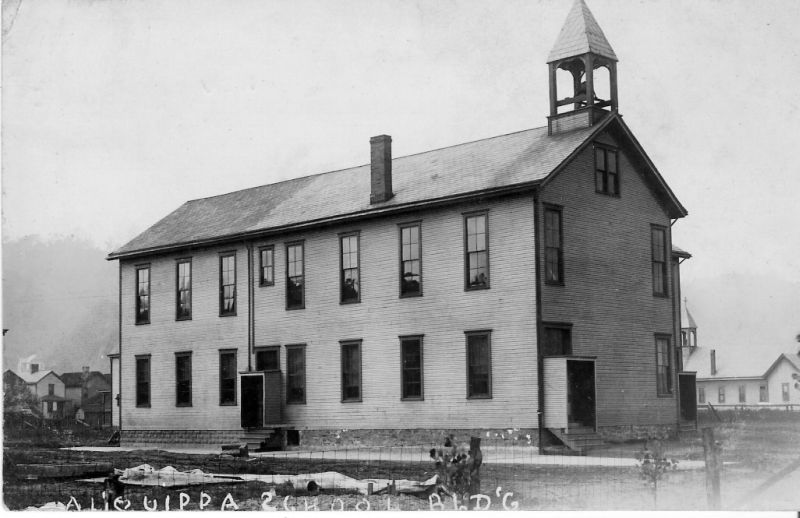 Elementary School Building, (West) Aliquippa |
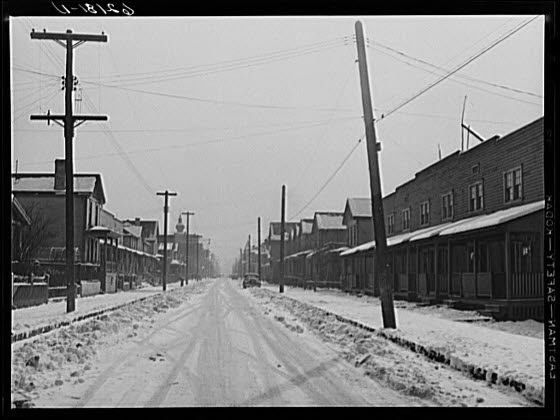 Main Avenue, West Aliquippa 1941 My father, his brother and their parents lived in the row houses on the right side of the street. They were in the unit with small vent above the double windows - 109½ Main Avenue http://www.loc.gov/pictures/item/fsa2000042845/PP/ Library of Congress Photo Collection, 1840-2000 Record Title: West Aliquippa, Pennsylvania State/Province: Pennsylvania Country: United States of America Year(s): 1941 Subject(s): United States--Pennsylvania--Beaver County--Aliquippa. Format: Safety film negatives. Medium: 1 negative : safety ; 3 1/4 x 3 1/4 inches or smaller. Created/Published: 1941 Jan. Collection: Farm Security Administration/Office of War Information Black-and-White Negatives Notes: Title and other information from caption card. Transfer; United States. Office of War Information. Overseas Picture Division. Film copy on SIS roll 9, frame 1554. http://www.loc.gov/pictures/item/fsa2000042845/PP/ |
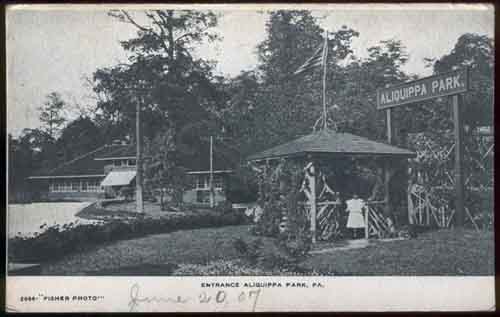 Aliquippa Park 1907 This is Aliquippa Park built by the Pittsburgh and Lake Erie Railroad. The building on the left (which I believe was a dance hall) eventually became the main office building for Jones & Laughlin Steel Corporation. It was moved about 3 miles and expanded to a two story building. |
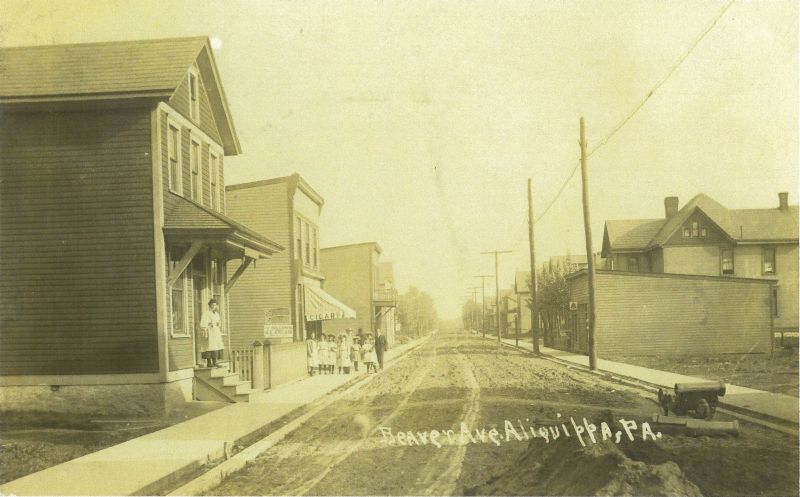
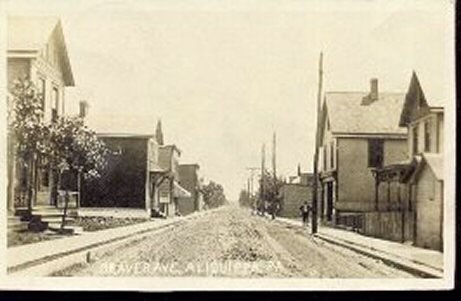 Beaver Ave, (West) Aliquippa |
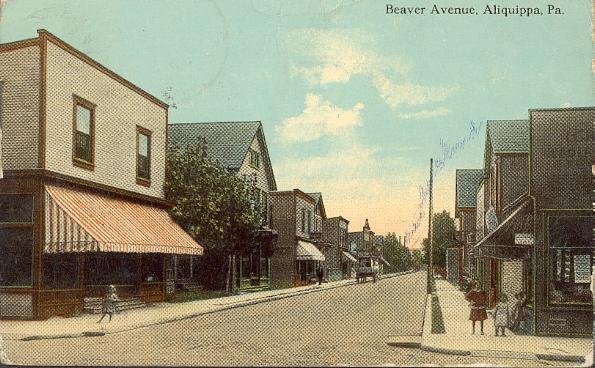 Beaver Ave, (West) Aliquippa I got this email:
Subject: West Aliquippa Date: Mon, 24 May 2010 14:58:03 -0400 Hi Mark, I've emailed you in the past on the Cepull's from West Aliquippa. If a picture of my grandfather (Christian Cepull)'s bicycle shop/service station ever turns up in your correspondence, I would deeply appreciate a forward. I believe he lived at 519 Third Street in West. The post cards and photos that you have posted came up in my search and I have enjoyed them, thank you and keep up the excellent work! -Bill Cepull wrcepull  yahoo.com yahoo.comMark's note: if you have an account on ancestry.com, here is more about Christian Czepull : http://trees.ancestry.com/tree/12108089/person/-333872828 |
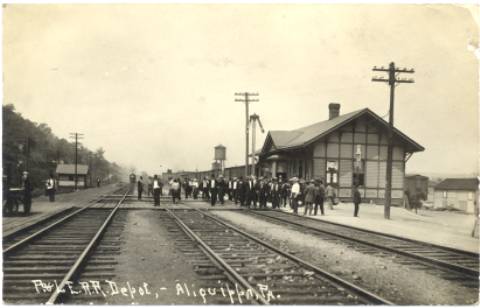 This is in what is now West Aliquippa. Look at the postcards below from Patricia (O'Connor) Crnkovich. |
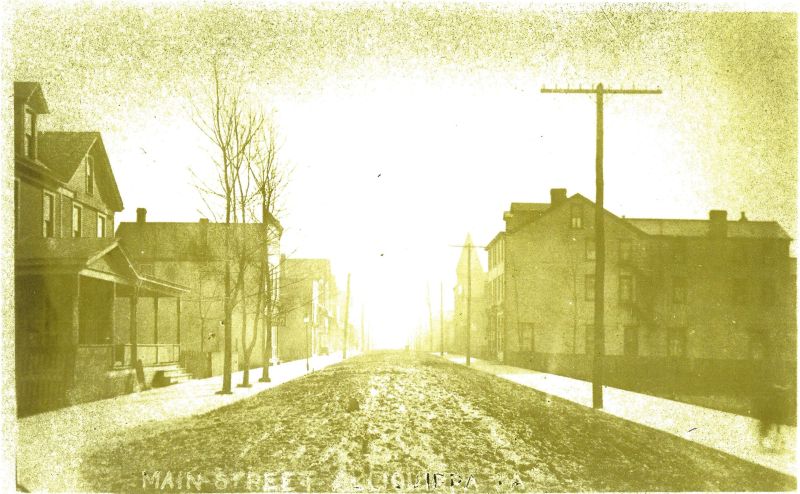
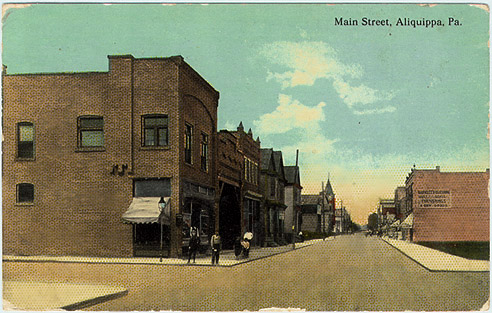 Main Street (Avenue), (West) Aliquippa |
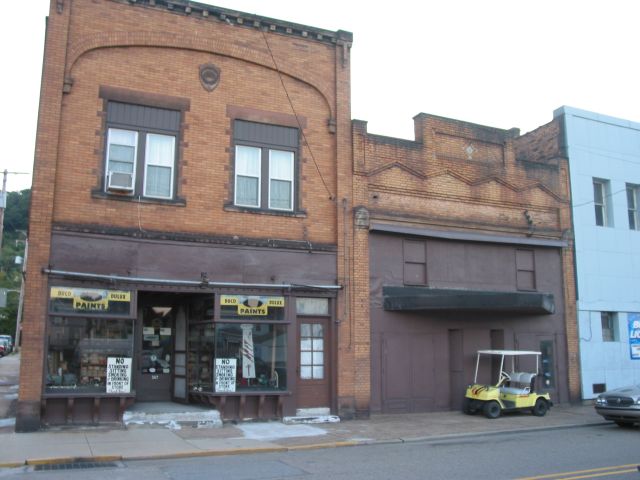 Main Avenue 2005 These are the two buildings on the left in the previous post card. Hardware store and movie theater. I asked Gino Piroli about the theater, he responded: It was the West Aliquippa theater, but was known as Abie's, the owner was Abie Rottenstein, it was unique. You went to the toilets which were located to the left (boys) and right (girls) of the screen so everyone knew when you went. My older brother Bill took me and my brother Dewey there in 1936 to see the movie "The Music goes Round". I'll ask around , there are still a few left from that time but we always called it Abie's. Ciao to you Gino |
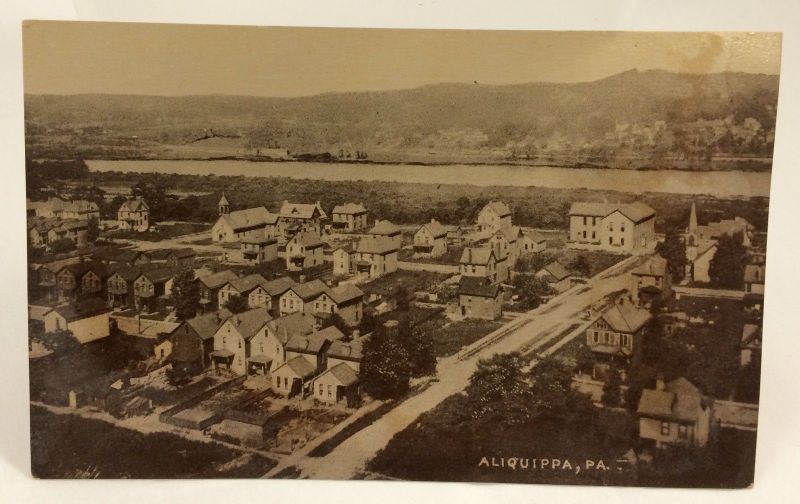
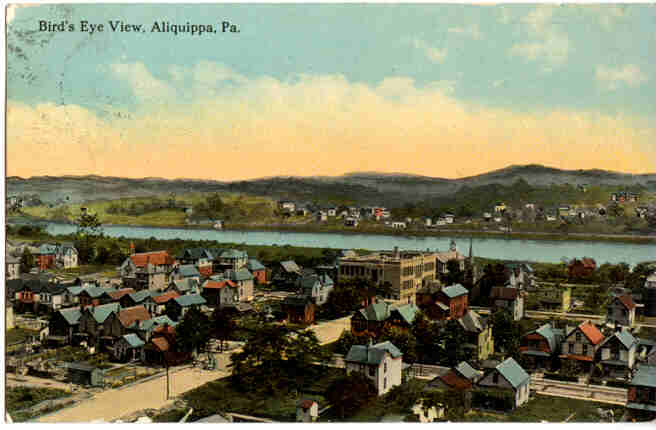 Bird's Eye View, (West) Aliquippa |
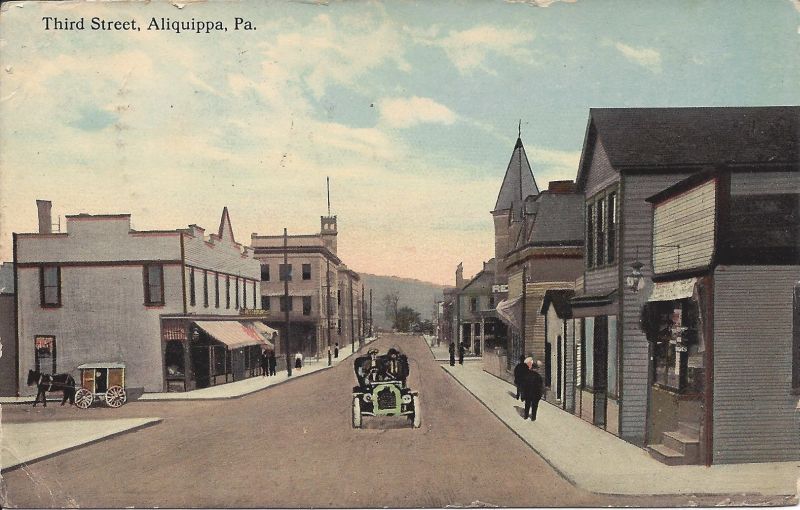 Third Street,
(West) Aliquippa
Sent to me by Patricia Crnkovich, Sep 2015 |
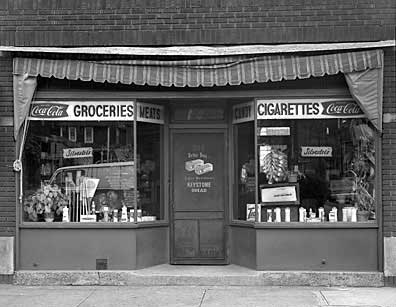 Silvestri's Grocery in West Aliquippa This photo sent to me by Dave DiPietro in Oct 2007. |
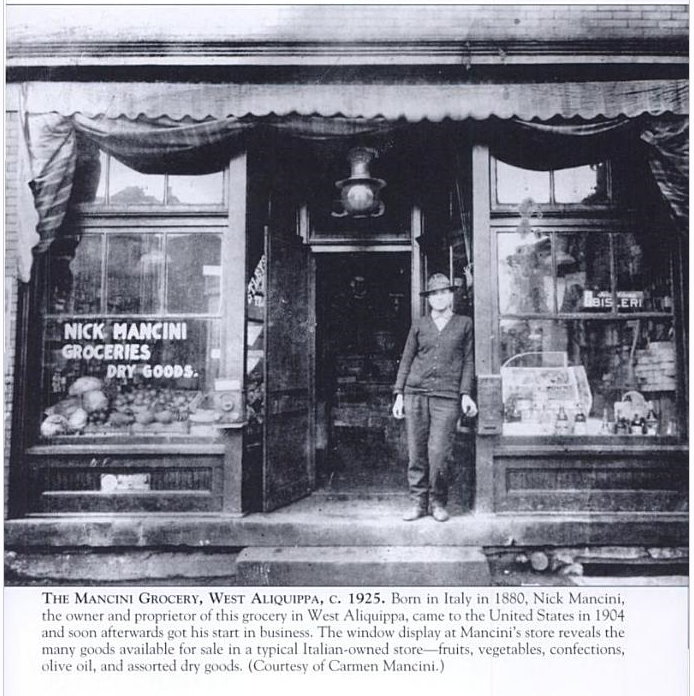 Photo from the book Italians of Pittsburgh and Western Pennsylvania By Nicholas P. Ciotola. My research shows that Nick arrived in the US on the Victoria about 13 March 1900 - information from the 1900 manifest. The 1921 and 1923 naturalization documents say he arrived in 13-18 Mar 1899 on the America. Book excerpt found on Google Books. In Oct of 2012 and Jan of 2014, I got emails from Carmen Mancini, Nick's son. Carmen sent me another copy of the above photo and wrote "Attached is a photo of my Father, Nicola Mancini who immigrated from Sant'Eufemia in 1900. He is standing in front of his grocery store which is 519 Beaver Ave. Many paesanos entered his address when coming to this country. This photo was on display at the Heinz History Center and later was published in the book "Images of America, Italians of Pittsburgh and Western Pennsylvania". It is also in a book by James J. Messina, "Grit, Smoke and Steam"." Carmen told me more about the family and I added it to my Family Tree data base. He added: "My father with his first wife, Maddelana, had a grocery store at 519 Beaver Avenue and then they moved to 432 Beaver Avenue and that was the store on the corner. So there were 2 store locations both on Beaver Avenue only a half block apart. Maddelana passed away and then my father married Anna, who was my mother. My father, Nick, was almost 40 years older than my mother. I was 13 years old when my father passed away in 1958." In Dec of 2013, Nick's great-grandniece, Krista Mancini Baker, was in SEaM and the priest at the church, Parrocchia S. Bartolomeo Apostolo, Mons. Giuseppe Liberatoscioli, researched more family information back to the early 1700's. |
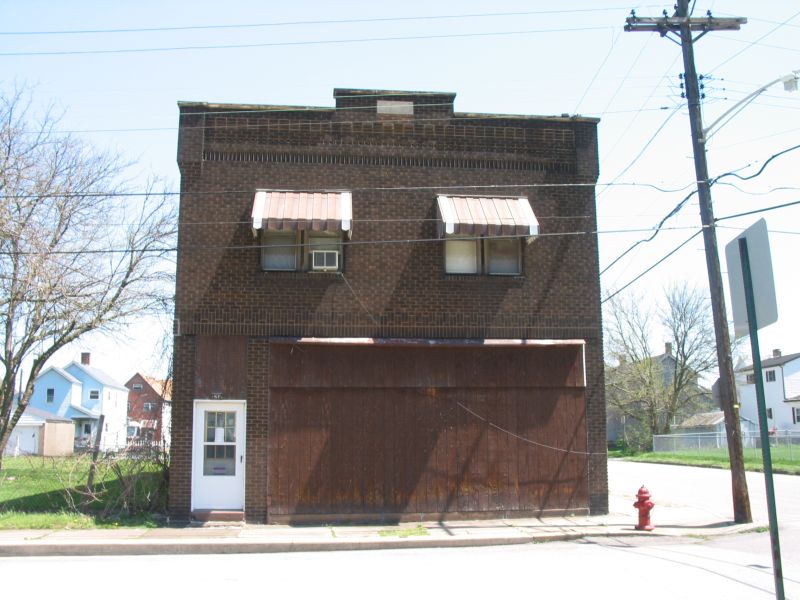 432 Beaver Ave Photo taken Apr 2009 |
| From: "Steve or Patricia
Crnkovich" <p.crnkovich409gmail.com> Subject: Date: Mon, 30 Apr 2012 21:59:09 -0400 Dear Mark, I must say---that you have done a fantastic job with you website, and as another genealogist, that I truly appreciate your efforts. It has certainly brought back enjoyable memories to so many people who formerly lived in our quaint little town of West Aliquippa, PA. Attached is a picture of the former Aliquippa now West Aliquippa, PA. Hope this will answer the question about the 1st. Train Station/Depot in the first Aliquippa now West Aliquippa, PA. Also for the Cepull family who wanted a picture of the family home. Hopefully this helps! Patricia (O'Connor) Crnkovich |
| Dear Mark, As promised--- I am sending you a few more early pictures of Aliquippa/West Aliquippa, PA for your readers to enjoy. I know I sent the third one earlier, but I thought you would like to see these three kept together, to show the progressive growth of the Village of Aliquippa, PA into a borough and eventually into a city. With more to come, Patricia (O'Connor) Crnkovich |
|
On September 18, 1893 a
petition
was presented to the Beaver County Courts to have the Village of
Aliquippa incorporated as a borough. The first Aliquippa now
West
Aliquippa, PA was incorporated as a borough on January 22, 1894.
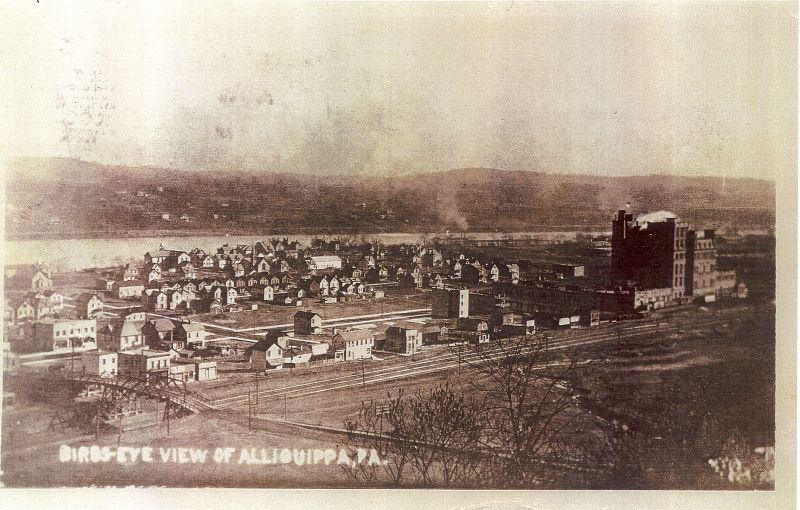 "Birds Eye Views" of the former Aliquippa, PA now West Aliquippa, PA circa 1910 View 1.) Is pictured before the tunnel was built---they only have a bridge at this time. Note: St. Joseph's R.C. Church & the 1st. convent for the nuns which will later be used for the rectory for the priest. The Russel Shovel Company 1891 brought work to many families in the area. Also see the Mutual Union Brewing Company that provided several jobs to people living there as well. On October 12, 1892 Aliquippa/West Aliquippa, PA had it first post office with John Stubert being the new postmaster. Submitted by: Patricia (O'Connor) Crnkovich |
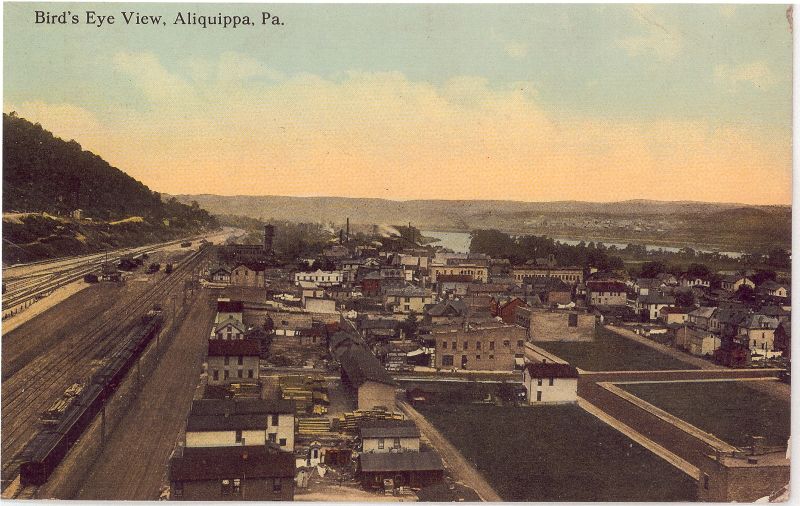 "Birds Eye Views" of the former Aliquippa, PA now West Aliquippa, PA --circa 1910 View 2.) Pictured---Must be on a Monday, because my grandmother Catherine O'Connor at 345 Beaver Ave., has her laundry out on the clothes-line. Owners that I know of for: The towns hardware store belonged to W. McIlheney's next Fred Walters then Milton Steinfeld & later Pete Sudak. Town Hall/Fire Hall is in the background. Vulcan Crucible Steel (1901) going full blast! Note: Looks like our future swimming pool is a lumber yard at this time. Submitted by: Patricia (O'Connor) Crnkovich |
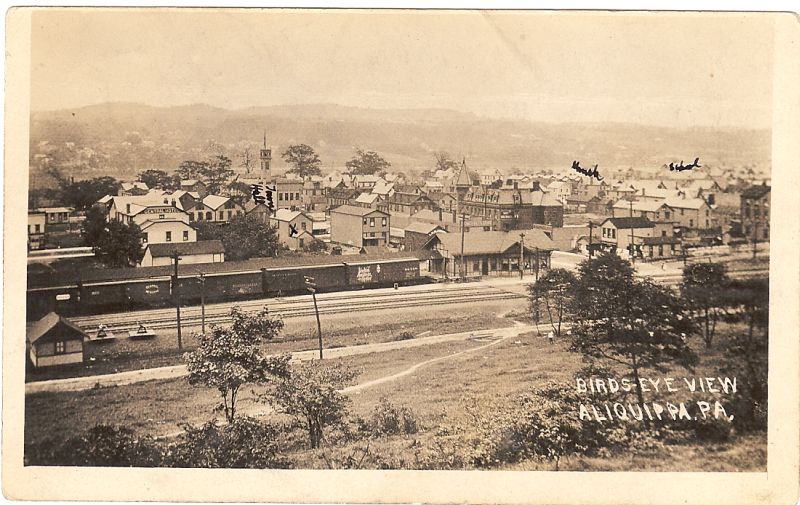 "Birds Eye Views" of the former Aliquippa, PA now West Aliquippa, PA circa 1910 Pictured is “Aliquippa”---No tunnel yet because we had a bridge at this time! This postcard is posted 1910 well before the consolidation in 1928. Therefore is shown as Aliquippa! Later---The two new Stations/Depots were built to the right of this old station with an office and a bridge over the tracks. Also note: Chris & Jennie Cepull’s house is on the right of the station. Everyone loved Chris’s shop and kids could be seen riding his bikes in the area. We passed it every day going back and forth to St. Joseph’s school. My sister Mary Lou (O’Connor) Keefe and I sometimes played with their two nieces who lived with them. From: Patricia (O’Connor) Crnkovich (Mark's note: See email below from a McNally descendant - the family that owned and operated the Columbia Hotel.) |
| From:
MaryJean Kancel <mjkancel01comcast.net> Subject: West Aliquippa Columbia Hotel ownership Date: Wed, 25 Jun 2014 15:49:12 -0400 Mark, In the "Bird's Eye View" photo of West Aliquippa you have the Columbia Hotel was later owned by "Mr. Cancel". Actually it was my uncle and aunt John and Malvene Kancel. I do not know the timespan they owned it but at least you now have the correct names. I do remember as a small child being there in the early 60's. Actually, some things just stick in your mind, I remember being there when the news broke that Marilyn Monroe died. Enjoyed the website, MaryJean Kancel |
The
Daily Times 5 Oct 1907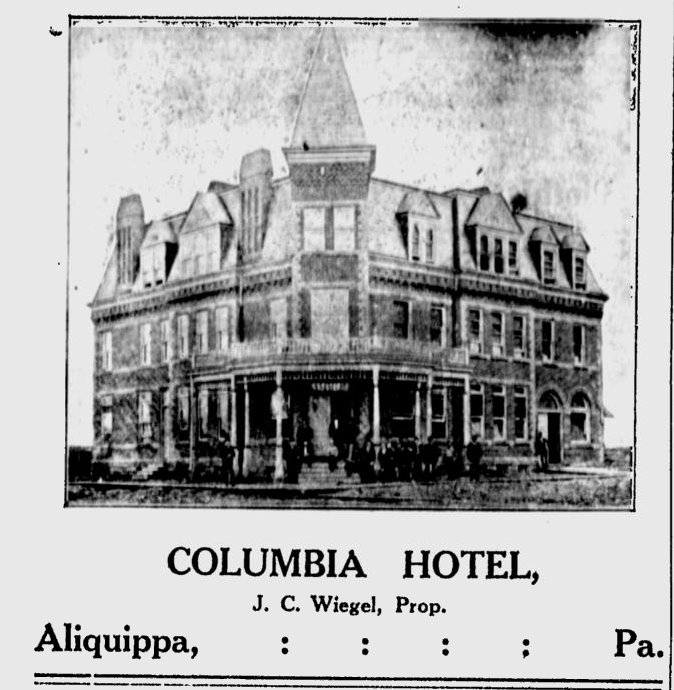 |
| Hi
Mark, I'm sending these pictures for the enjoyment of all your readers, and for those of us who lived near there, and who passed by daily on our way to school, church or to shop and etc. I was ever so happy to be able to see these grand old hotels once again and to hopefully help by exchanging my updated information with you and with the former owners. Patricia (O'Connor) Crnkovich |
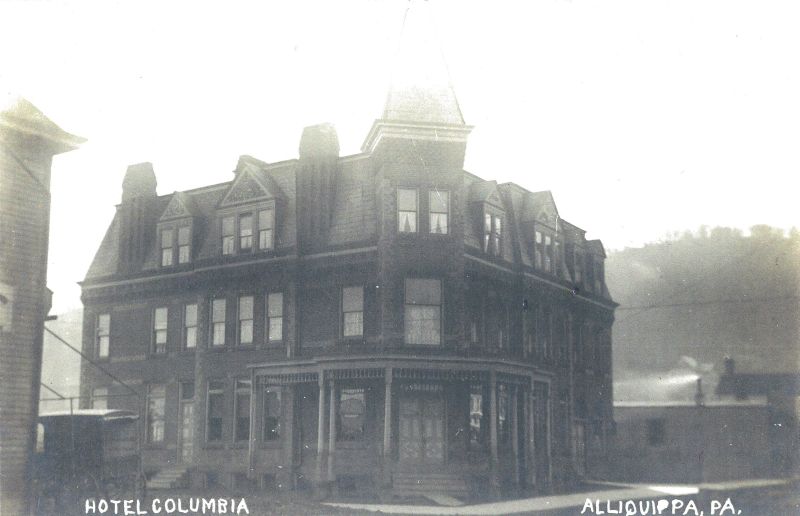 The Columbia Hotel, 301 Main St., Aliquippa (now West Aliquippa, PA) --In 1893 built and owned by: John C. Wiegel. Owners of the hotel from 1908 to 1916 Martin & Bridget McNally Owners of the hotel in the 1930's: Djedo & Baba Kovac's owned the hotel in the 1930's. Kovac children: 1.) Mary (Kovac) Sabo---Mary & John Sabo owned the Sabo's 5 & 10 Cent Store in West Aliquippa, PA and also the one in Monaca, PA. The West Aliquippa 5 & 10 Cent Store was next to the hotel. Children of John & Mary Sabo: John Sabo, Thomas Sabo & Violet Sabo---Family is in the 1940 Census. Living at 307 Main Street, West Aliquippa, PA. (I remember them all being extremely nice people to deal with) 2.) Julia (Kovac) 3.) Malvene (Kovac) & John Kancel followed in her parents footsteps and they became the next owners of the Columbia Hotel. Joseph & son John Kancel---Father & son are in 1940 Census---Living at 301 Main St., W. Aliquippa, PA 4.) There was one more sister but don't know her name? |
| From: "JoAnn Drake"
<joadracomcast.net> Subject: West Aliquippa History Date: Tue, 4 Sep 2012 15:13:35 -0400 Mark, I just finished viewing your website. I really enjoyed it. The pictures are fantastic. I am looking for information on the Columbia Hotel. It was located in the "original Aliquippa", which is now called West Aliquippa. I know that it was in existence in 1916. It was owned by my Grandmother's parents. I think their last name was McNally, but I'm not positive about that. I would like to find out their first names and if their last name was McNally. Also any other information that can be found about them and the hotel. Please let me know if you have any information and/or pictures. Keep your website going. It's great. one of the best I've seen. Thanks, JoAnn |
| I found a 1910 census sheet that shows Martin and
Bridget
McNally as proprietors of a Hotel on Main Ave. Then I
found this
at: http://genforum.genealogy.com/mcnally/messages/661.html “Genealogical and Personal History of Beaver County Pennsylvania” Under the editorial supervision of: JOHN W. JORDAN, LL. D. Vol. II New York: Lewis Historical Publishing Co., 1914. Pg. 604 McNALLY - The McNALLYS have come to America at various times, and the greater number of them have been identified with industrial callings. Some, however, are also to be found in professional and diplomatic lines. (I) PHILIP McNALLY was born in Ireland, and emigrated to the U. S. in 1896. He settled at Braddock, Allegheny Co., Pa., where his death occurred the following year, and he is buried in Calvary Cemetery, Pittsburgh. He married, in Ireland, ANN HANEY, also a native of that country, who died in 1891. They had children: MARTIN, HUBERT, MARY (deceased), BRIDGET (deceased), MICHAEL, PATRICK (deceased), ANN, JOHN (deceased). (II) MARTIN McNALLY, son of PHILIP and ANN (HANEY) McNALLY, was born in county Galway, Ireland, Nov. 8, 1856. He emigrated to America in 1881, arriving here in the month of May, and went to Albany, New York, where he was employed until 1885. He held a position on the steamboat “St. John,” of the People’s Line, and while in the company’s employ had the misfortune to lose one of his legs. For the next three years he was engaged in the fruit business, then moved to Braddock, Allegheny Co., Pa., where he opened a hotel, of which he was the proprietor and manager until he took a trip to Ireland in 1902. He remained in his native land for the period of one year, then returned to Pa., and lived in the city of Pittsburgh until 1908. Aliquippa, Beaver Co., Pa. was the next scene of his activities, and there he purchased the Columbia Hotel, and has been the proprietor since that time...MR. McNALLY was one of the organizers of the Aliquippa National Bank, and is one of its directors. He is a charter member of “The Owls,” which was organized in 1913, and is a member of the republican party. He married, in 1887, BRIDGET C. CONWAY, born in Ireland. They have no children. |
| Some mentions of the Columbia Hotel: http://www.hopewelltwp.com/hopewell_history.php http://news.google.com/newspapers?nid=1129&dat=19870722&id=x9ZRAAAAIBAJ&sjid=IW4DAAAAIBAJ&pg=5881,6535788 |
| Mark, Thanks for the information and help. I think Martin and Bridget are the ones I'm looking for. They adopted my Grandmother. My grandmother had a brother who she managed to trace, but I can't remember his name. He lived in West Virginia. I guess there is no way to find him or their real parents. Any suggestions? Sorry, I don't have any pictures of West Aliquippa. I wish I did. Thanks, JoAnn |
| JoAnn, Now-a-days with the Internet and all the on-line data bases, I've been able to find out a lot about my family and close relatives. Much more than I ever thought. The first thing you should do is collect information about your grandmother. Talk to all the living relatives. Look for old family photos, maybe your grandmother and her brother traded photos - or maybe letters. Check everything. Call the BF Jones library in Aliquippa and tell them what you are trying to do. Check everything and everybody that your grandmother might have come in contact with. Attached is the 1900 census from Braddock that shows the family and clearly shows Marie as an "adopted child". This says she was born in PA in Dec of 1892. Good Luck, Mark |
| JoAnn, Back in the 1800's when a child was adopted it was almost always by a relative. I would say its very likely that Marie was adopted from a close relative of Martin or Bridget. Do you know the descendants of the siblings of Martin as listed in the History of Beaver County? In that book (which was published in 1914) its lists 4 of Martin's siblings were dead. Possibly, Marie was a child of one of those siblings. Do those cousins know anything? Mark |
| I hope I'm not flooding you with docs but I'm sending
them in case you haven't seen them. Attached is the 1904 Ellis Island arrival of Martin, Bridget, Marie and Joseph on their return from Ireland. It comments on Martin's loss of his left leg. Mark |
| Mark, I can't thank you enough for all the help. I'm new at this and don't know much of anything, but I'm learning. Your idea about the adoption is a good one. It is very possible that Martin adopted from a close relative. It was my grandmother's mother who died, so I will try to get information on Mary and Bridget McNally. Joseph McNally, who appears on the Ellis Island sheet, is a mystery. Grandma never mentioned a McNally brother. The story that I got from a cousin about the adoption was that Martin and Bridget refused to adopt Grandma's natural brother. This is exciting stuff. I think I'm hooked. Thanks Again, JoAnn |
| JoAnn, In that biography in the "History of Beaver County" published in 1914, it says that Martin and Bridget were married in 1887 and had no children. Its most likely that she never had any children and that both Marie and Joseph might have been adopted (or at least not their natural children). So something is going on here. So I think there is a lot more information here than you might have expected. Keep me informed about your progress. Mark |
| JoAnn wrote: ---------------------- Patricia, I saw your name and the pictures you posted on Mark DiVecchio's website. In your postcard, you mention the Columbia Hotel. You say it is behind the railroad depot to the right. My grandmother's parents owned the Columbia Hotel between 1908 and 1916 for sure, but maybe longer. I think I know which building it is, but I'm not sure. Can you describe it? Do you have any individual pictures of the hotel? Also, do you have any information about it? I would appreciate any help you can give me. Your pictures are great. Thanks, JoAnn |
| Mark, Thanks for the newspaper articles. I connected with Pat Crnkovich, but she doesn't have any individual pictures of the Columbia Hotel. However, she sent me a copy of the one that is on your website. I'm going to try to isolate the hotel and enlarge it. Don't hold your breath. I don't really know how to do that. Thanks again, JoAnn |
| Mark, My cousin in California sent me a picture of my grandmother's foster mother. I recognize my grandmother's handwriting on the back of the picture. It says--Mrs. Martin McNally or Aunt Dehlia. Grandma also wrote "my foster mother". This information certainly ties in with your suggestion that many times children were adopted by close relatives. I don't have much information on Bridget McNally. Her maiden name was Bridget C. Conway. She married Martin in 1887. She was born in Ireland. That is all I know about her. I've tried to research Martin's 2 deceased sisters, but came up with nothing. Should I research his brothers? It was my grandmother's mother who died. Also, there is evidence that my grandmother spent some time in an orphanage. I am requesting that the orphanage search their records for her. However, this is going to take them 4-6 weeks. How can I find more information on Bridget Conway, my grandmother's foster mother? Grandma may have been adopted from Bridget's side of the family. I asked my cousin to look for pictures of buildings. Unfortunately, she couldn't find any. I haven't had time to look at the 1800 census, because I have to go to the library to do that. I want to see if Bridget Conway appears on it. If not, that would mean that she immigrated to the U.S. between 1800 and 1900, because she appears on the 1900 census as married, with Marie (my grandmother) as an adopted child. Am I on the right track with this? I think the 1800 census would be a starting point, then based on what I find, research her brothers and sisters as well as Martins. Does it matter when she came to this country? Lots of mysteries in my grandmother's past. I hope I can solve some of them. Thanks again for all your help. JoAnn |
| JoAnn, I think you should pursue all branches of your family. You never know what will turn up. I think that every detail that you can dig up matters. I'm writing the following so that I get it straight in my mind... Some comments about Bridget: 1. 1900 census says
she was born in March of 1858.
2. 1910 census says she immigrated in 1877. 3. 1910 census says she was married twice. 4. 1910 census says she was married to Martin for 22y or since 1888. 5. 1900 census says she was married to Martin for 12y or since 1888. And that means she was 30y old when she married Martin. Some comments about Martin: 1. 1920 census says
he immigrated in 1881 (after Bridget was here)
Do you know if Bridget was married twice? Would then Conway be her first husband's surname or is it her birth surname? When Bridget immigrated in 1877, she may have already been married to her first husband (if such a person exists) or if she was unmarried, she probably would have come to the US with her parents. Finding the immigration record could answer a lot of these questions. It would be interesting to know where Martin and Bridget met. That would tell us a lot about where Bridget was living at the time. Do you have a copy of Martin's and Bridget's marriage license and their death certificates? I think you will be able to find out a lot more about your grandmother than you think. Might take a year or two or three... Mark |
| Mark, Your attention to detail is great! I missed the fact that Bridget was married twice. I don't know if Conway was her maiden name or her first husband's name. I don't have copies of death records or Martin and Bridget's marriage license. I'm sending this quickly, because my computer went out on me a few minutes ago and I lost everything. JoAnn |
| Mark, I'm guessing that Martin and Bridget met in Braddock, PA or somewhere in Pittsburgh. According to Martin's biography, he moved to Braddock in 1885. They were married in 1888, so possibly they met in Braddock. My ultimate goal is to find my grandmother's (Marie's) birth parents. I thought tracing Bridget might be a good way to do that. I agree that finding her immigration record would be good. The Ellis Island records don't go back as far as 1877, so how do I find that record? JoAnn |
| Mark, Grandma's full name at the time of her death was Marie Dorothy McNally Murray. She died March 9, 1978. She was born Dec. 8, 1892. I don't have copies of her marriage license or death certificate. Thanks for all your help. JoAnn |
| Mark, I am going to get my grandmother's death certificate and marriage application. The burial certificate is on it's way, but I don't think there is any helpful information on that. Unfortunately, info on Bridget Conway isn't coming to light. Even though the 1910 census says she emigrated in 1877, the column for naturalization info is blank. Martin, her second husband, lived in Albany, N.Y. when he first came here. Maybe they met in Albany. JoAnn |
| Mark, I got my grandmother's SS number. How will this help me find her birth name and parents? I don't know whether she knew who they were. I just got off your website. I'm going to try and buy a copy of James Messina's book. What a great addition to your website. If you want my grandmother's SS number to do some searching, let me know. I don't know how to use it. JoAnn |
| Mark, There has been a recent change in the law in regard to adoption records in PA. I can petition the court to gain access to my grandmother's adoption record. It is a very involved process. I have to provide a lot of documentation to prove who I am. Do you know anyone who has done this? I'd like to know how long it takes and how successful it is. If you have any information, let me know. In addition to sending for my grandmother's application for a social security card, are there any other ways to use her SS number to get information about her birth name? In regard to Bridget Conway McNally (my grandmother's adopted mother), my uncle spelled her name with 2 "t"s. That could have just been a mistake, but it is the only new bit of info that I have. Did I tell you that she was born in March of 1858? I know I gave you the year, but don't remember if I gave you the month. Joseph McNally has been firmly established as a son of Martin and Bridget. Don't know if he was adopted or born to them. Just an update. JoAnn |
| From: "JoAnn Drake"
<joadracomcast.net> Subject: update Date: Sun, 16 Jun 2013 17:04:08 -0400 Mark, It has been a long time since we communicated. I have continued to do research on my family history, and have made great strides. Thanks for getting me off to a good start with the article on Martin McNally. My biggest accomplishment has been finding my grandmother's biological brother. She searched for him and found him after she got married. I found his name in a record book from a family funeral. My grandmother was a great record keeper. Unfortunately, I am no closer to finding their birth parents. I don't know whether her brother was adopted also or not. Recently, I connected with his granddaughter, and she is going to try to find that information. Cross your fingers. The last time we were in touch, you were trying to trace Martin McNally's wife, Bridget Conway. We didn't have enough info on her to find her among all the other Bridget Conways on Ancestry. I have some answers to the questions you asked back then. I will try to find your email and send you those answers. This is a great hobby. Thanks for helping me get started with it. JoAnn |
| Mark, Here are the answers to some of your questions about Bridget. She was married twice. I have a copy of her will, and her first husband is mentioned. She donated money for masses to be said for him and Martin, as well as her parents and brothers and sisters. His name was Patrick McDonald. I don't know where they were married. One thing in her will was odd. She was living in Aliquippa when she died in 1919, but she left a house and property that she owned in Turtle Creek to her sister. Perhaps it was a house she owned with her first husband, Patrick. I haven't had time to do any research on Patrick, because I have been researching my grandfather's family. I was reunited with an out-of-state cousin at a family funeral in Oct., and he gave me information on my grandfather's family. That sent me off in another direction. The good news is that I'm now in touch with a cousin that I have always liked. (Mark's note: I've always said that when you do genealogy research, you not only find dead ancestors, you find live cousins!) I couldn't find an immigration record on Bridget when I searched a while ago. I haven't gotten their marriage application or their death certificates yet. I've tried to get their obituaries, but the Aliquippa library doesn't have newspapers for the years when they died. I'm going to try the Carnegie library in Oakland. Bridget's obit is important. If any of her sisters preceded her in death, that might be my grandmother's birth mother. I'm still thinking that she may have been related to the McNally family, as you suggested. Unfortunately, I can't trace any of Martin's sisters. He had 2 sisters that were deceased prior to 1914 when the article you sent me was published. I'm hoping they will be mentioned in his obit. I really hope I can get these 2 obits. JoAnn |
| JoAnn, Thanks for the update. I can add some thoughts: Google has many decades of the Beaver County Times and Beaver Valley Times on-line. Try searching there if they go back far enough. Here are the two web pages: http://news.google.com/newspapers?nid=PRLG7g5oK-wC&dat=19500928&b_mode=2&hl=en http://news.google.com/newspapers?nid=QLZAdv6BrvsC&dat=19640815&b_mode=2&hl=en You might also try these Beaver County newspapers: Daily Times http://news.google.com/newspapers?nid=0MsrIDK0EWAC&dat=19450413&b_mode=2&hl=en Beaver Falls Tribune http://news.google.com/newspapers?nid=uoIO7Ko97q4C&dat=19230308&b_mode=2&hl=en They both go back to the 1910's. This web page lists the other places which have microfilms of the newspaper: http://www.timesonline.com/site/archive/ I would also research the Aliquippa & Southern RR which served the J&L mill. On eBay, I saw some older maps of West Aliquippa. I didn't bid high enough to win but I saved the photos that the seller had put up. They show West Aliquippa with some detail of buildings. Might be of use to locate homes. The photos are attached. I don't know their year. Good Luck, Its a long search but go at it step-by-step. Mark |
| Mark, Thanks for the pictures of the maps. They are interesting. I noticed that Vulcan Crucible Steel and Kidd Drawn showed on one of the maps. If you know when they opened, that would give you an idea of how old that map is. I don't know much about Aliquippa history, only what appears on your website. There is a book that has been published on Aliquippa history. It is called "Aliquippa". It was put together by one of the people who works at the Aliquippa library. It is for sale at the library, and all the proceeds go to the library (if it is purchased from the library). I think it can also be purchased from Amazon. I'm going to try to get down to Aliquippa and take a look at it. I'll probably buy it. I'm sure you are already aware of this, but I thought I would mention it just in case. If you find a picture of the Columbia Hotel on eBay, let me know. I have never gone on that website. I am looking for a picture that shows just the hotel or a large portion of it. I haven't had time to try the websites that you sent me, but I will get to it eventually. My yard is keeping me very busy right now. Thanks Again, JoAnn |
| From: "JoAnn Drake"
<joadracomcast.net> Subject: Columbia hotel Date: Sun, 20 Jul 2014 19:28:05 -0400 Mark, I tried to print the newspaper picture of the Columbia Hotel that is on your website, but it wouldn't print. My great grandparents, Martin and Bridget McNally, purchased the hotel in 1908. I don't have a picture of the hotel. Do you have the original? If so, can you email a copy to me? It is really a great picture. If you don't have the original, can you tell me who does. I was so thrilled to finally see a picture of the place where my grandmother lived as a young girl. It really made my day. Thanks so much for your wonderful website. JoAnn |
| From: "joadra"
<joadracomcast.net> Subject: Hotel Aliquippa Date: Wed, 2 Sep 2015 13:25:47 -0400 Hi Mark, I just discovered that my great aunt, Mary J. Connelly and her husband, John J. Connelly, owned the Hotel Aliquippa. He was named as owner when he died in 1913. She was named as owner when she died in 1916. Do you know anything about this hotel? I can't find any info on it. I have not been able to find John or Mary on any census records. Therefore, I don't have the address for the hotel. Looked at your website, but didn't find anything. Website is still great. Enjoyed it as always. JoAnn |
| JoAnn, Thanks for your email. I can't help on Hotel Aliquippa. I never heard of it. I also checked ancestry.com and the Google newspaper archives but could find no trace of the Connellys or the hotel. I'll keep your email on file in case anything shows up. Mark |
| Mark, Good news! I've found info on the Hotel Aliquippa, thanks to help from Pat Crnkovich. It was located on the corner of Main Ave. and Third St. It was owned by my great aunt Mary J. Connelly and her husband John. John Connelly died in 1913 leaving 2 sons by a former wife. My great aunt Mary owned the hotel until Oct. 8, 1916 when she was killed in a car accident. If you remember, my great grandparents, Martin and Bridget McNally, owned the Columbia Hotel which was located on the opposite corner of Main Ave. and Third St. Mary Connelly was my grandfather's aunt. The McNallys were my grandmother's adoptive parents. My grandfather was from New Salem, PA. He moved to Aliquippa to work at J&L. I believe he lived in the Hotel Aliquippa with his aunt, Mary Connelly. This is how my grandparents met. They were married in 1917 and lived on Beaver Avenue for a number of years. Eventually they moved to the Hollywood section of Plan 12. My grandmother always called West Aliquippa the "original Aliquippa". I thought you might like to know about this. JoAnn |
| Mark, Thanks for your efforts. I have a newspaper article that reports the transfer of the liquor license for the Hotel Aliquippa from the estate of Mary J. Connelly to another person. It was in the local newspaper. That is how I learned the name of the hotel. I will keep searching. Thanks again. JoAnn |
| Mark, Talked to Pat. She is going to send you a copy of an antique postcard that shows the Hotel Aliquippa. JoAnn |
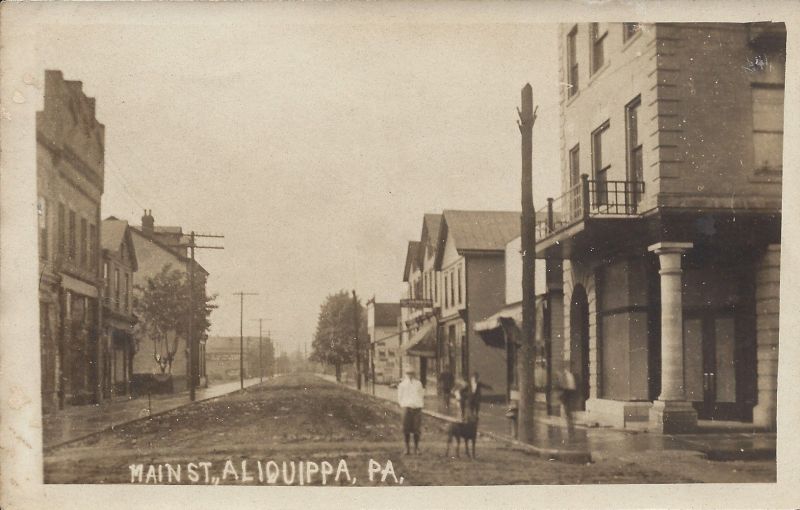 Main St (Avenue), (West) Aliquippa Owned by John and Mary J. Connelly until his death in 1913 Owned by Mary J. Connelly until her death in 1916 Sent to me by Patricia Crnkovich, who wrote: "As you already know Mark, I have been working with JoAnn Drake & trying to locate the Aliquippa Hotel, of which I had no results in the beginning. But through the "I grew up in West Aliquippa" site, I put out a request for any information, on the Aliquippa Hotel. A fellow "Westerner" named Steve Mumaw came up with a map of that particular part of Main St. in West Aliquippa. The corner building on the map read, "Aliquippa Hotel." Attached are some pictures of the Aliquippa Hotel aka Opsatnik's as most of us remember it today. JoAnn will share with you & everyone the rest of her family story." |
 email from Judy Palkovic
| From: Judy Palkovic <judy.palkovicgmail.com> Date sent: Tue, 5 Mar 2019 13:57:34 -0500 Subject: Columbia Hotel - West Aliquippa Hi Mark My name is Judy Palkovic, my maiden name is Dolnack. My father Andrew Dolnack was born in the Columbia Hotel in January 31, 1932. His parents, Stephen Dolnack and Anna Kovac (one of Malvene Kancel’s sisters) lived there. Malvene was my Great Aunt. My father and I toured the building in the late 1980’s before it was torn down. He had such found memories there. My Great Grandfather Andrew Kovacs (born in 1873) and my Great Grandmother Barbara (Kudzma) Kovacs owned the hotel at one time. Andrew also cofounded St. George Byzantine Catholic Church in Aliquippa. He organized the 1st Greek Catholic Church in West Aliquippa on March 15, 1915. Their daughter Anna (Kovacs) Dolnack was my Grandmother. She had a number of siblings including Rose Esley and Malvene Kancel. My father Andrew Dolnack was born in the hotel in January 31, 1932. Thank you so much for sharing all of these wonderful photos! My father passed away in 1997. I wish he could’ve seen your website! My brothers, Erik and David, and I loved our dad’s stories of West Aliquippa! Sincerely, Judy Palkovic |
| Hi
Mark, I'm sending these pictures for the enjoyment of all your readers, and for those of us who lived near there, and who passed by daily on our way to school, church or to shop and etc. I was ever so happy to be able to see these grand old hotels once again and to hopefully help by exchanging my updated information with you and with the former owners. Patricia (O'Connor) Crnkovich |
 |
 The Central Hotel, Main St., Aliquippa (now West Aliquippa, PA)--In 1893 built and owned by George Jeffrey. |
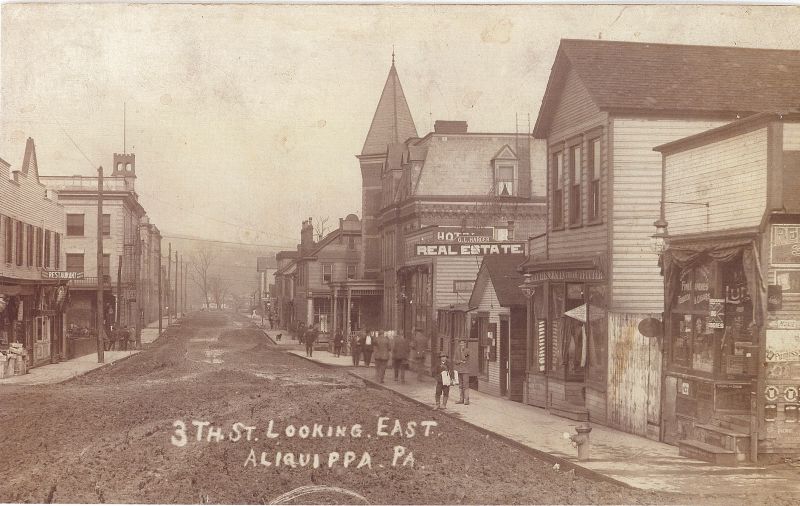 Third Street: You can also see the Columbia Hotel on this Third St. view and a Real Estate business next to it, the Barber Shop was later Tito D'Atri's Shoemaker Shop and next to it a Cigar Shop & etc. where Chris Cepull's Garage will be constructed in a few years. On the left side of the street is the former Como's Grocery Store--now Pippi's Restaurant is there but not built at this time is the original First National Bank.. Across the street--- the Opsatnik building is there and the Fire Hall too. The Second---First National Bank (across the street)---is now the New Alliance Federal Credit Union today. |
|
Click on the photo for a larger size. I don't know when this photo was taken. Might be about 1910 from comparison with other photos. I'm guessing that this was taken from the top floor of the Mutual Union Brewing Company building. This is a postcard. The P&LE, although it ran north and south through Aliquippa, was listed a line running west and east. When Aliquippa merged with Woodlawn in 1928, Aliquippa became West Aliquippa because it was further west along the P&LE. |
 Unknown date |
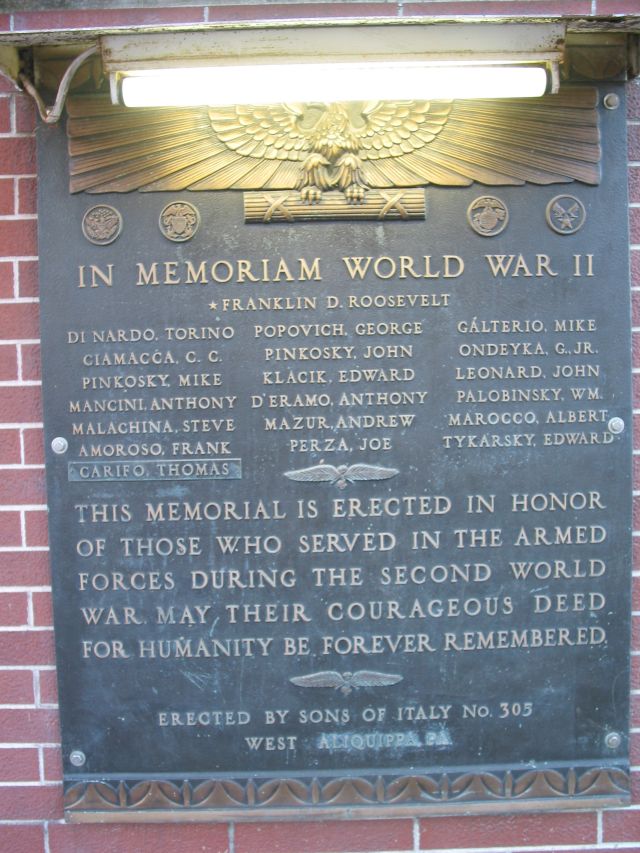 WWII Memorial in
West Aliquippa, PA
Photo taken 2005.
My father certainly knew most if not all of these men. My uncle Tony mentioned Mike Galterio in a 19 Mar 1944 letter after he heard of Mike's death. Other notes, dates of death and burial locations that I have been able to find (US burial information from Pennsylvania Veteran Burial Cards found on ancestry.com, foreign burials from http://www.findagrave.com): Mike Galterio (Michael S. Galterio) 1 Jan 1944 is buried at Sicily-Rome American Cemetery and Memorial, Nettuno, Lazio, Italy. (Born 1920 in Pacentro, Italy, arrived in the US on 10 Jan 1931) Grave G 15 45. Galterio is a good name for the town of Pacentro in Italy, nearby to my father's hometown of Sant'Eufemia a Maiella. Torino diNardo 27 Jan 1945 is buried at Luxembourg American Cemetery and Memorial, Hamm, Luxembourg. Anthony Mancini 30 Jul 1944 is buried at Brittany American Cemetery, St.James, Normandy, France. Born about 1923, the son of Bartolomeo "Barto" Mancini and Maria d'Alessandro. Anthony A. d'Eramo 4 Dec 1944 is buried at Henri-Chapelle American Cemetery and Memorial, Henri-Chapelle, Liege, Belgium. William J. Palobinsky (Palubinski) 27 Dec 1944 is buried at Mt. Olivet Cemetery, Aliquippa, PA. Army records show the spelling of the name as Palubinski. (born 20 Mar 1924) Sec H Lot 116 Plot 1, reburied 11 Jan 1949. http://www.findagrave.com Steve J. Malachina 9 Jul 1943 is buried at Mt. Olivet Cemetery, Aliquippa, PA. (born 26 Dec 1921) Sec L Lot 124 Plot 2, reburied about 22 Jun 1948. Andrew A. Mazur 17 May 1945 (age 25) is buried at St. Joseph Cemetery, Aliquippa (Center Township), PA. (born 17 Jul 1919) Sec 3 Row C, reburied 11 Dec 1948.  From the Findagrave page: "WWII Veteran of the Medics for Battery 'C'., 455th AAA Battalion, XX
Corps, Patton's Third Army in Europe. 'Andy' suffered a fatal heart
attack after the end of the War at Pocking Airdrome, Germany. The
Battalion Surgeon couldn't revive him." 455th AAA Historian. From the Findagrave page: "WWII Veteran of the Medics for Battery 'C'., 455th AAA Battalion, XX
Corps, Patton's Third Army in Europe. 'Andy' suffered a fatal heart
attack after the end of the War at Pocking Airdrome, Germany. The
Battalion Surgeon couldn't revive him." 455th AAA Historian.Ed Tykarsky 26 Nov 1944 is buried at Ardennes American Cemetery and Memorial, Neuville-en-Condroz, Liege, Belgium. Thomas G. Carifo 17 Sep 1944 is buried at Ardennes American Cemetery and Memorial, Neuville-en-Condroz, Liege, Belgium. George Ondeyka Jr. 22 Jan 1945 is buried at Woodlawn Cemetery, Aliquippa, PA. (born 29 May 1924). His older brother, John (1922-2011), also served. George Popovich 20 Dec 1944 is buried at Florence American Cemetery and Memorial, Florence, Italy. John Pinkosky 9 Jun 1944 is buried at Normandy American Cemetery and Memorial, Colleville-sur-Mer, Basse-Normandie Region, France. Other sources say that he is listed as unrecoverable. Frank A. Amoroso 1 Feb 1944 is memorialized at North Africa American Cemetery and Memorial, Carthage, Tunis, Tunisia. He may be listed as MIA on 1 Feb 1944 in North Africa. Joe Perza 2 Mar 1945 is buried at Henri-Chapelle American Cemetery and Memorial, Henri-Chapelle, Liege, Belgium. Albert Marocco (Marrocco) 18 Apr 1945 is buried at Florence American Cemetery and Memorial Florence, Provincia di Firenze, Toscana, Italy. Army records spell the name as Marrocco. Plot A Row 11 Grave 9. No information found yet about: C.C. Ciamacca
- I've found a Christy Ciamucca in the 1930 census from 222
Main Ave, Aliquippa. Son of Philip and Mary (Marchionda)
(?) Ciamucca (6 children total). 5y
9m old. Family also found in 1920 census from Mckees Rocks, PA, Phillip
and Mary with 3 children. 1914 3 Jun Ellis Island manifest for Filippo
and Maria shows hometown as Pacentro.
1953 article in the Beaver Valley Times about brother Donald Ciamacca still has the family on Main Ave. US School Yearbooks shows the Ciamocca's attending high school in Beaver Falls. 1961 article about Salvatore (Solly) Ciamacca, Duss Ave, Ambridge. 1993 Public Records Index has him living at 1513 Idlewilde Ave, Baltimore, MD, 21228-5702. He was born 23 Jan 1927. A brother, Joseph, who died in 1969 is buried in Mt. Olivet Catholic Cemetery, Aliquippa. 2005 obituary of Phillip Chiamack mentions a deceased brother - Christopher Ciamacca. John Leonard
With help from Gino Piroli, the family name is DeLeonardis. Based on Ellis Island records, the family was probably from either Pacentro or Spoltore. Possible family in 1930 and 1940 census from Aliquippa show a John born in 1917. Possibly married to Rose by 1940 with daughter, Rosaland, born about 1939. (If you can add info about these men, please email me markd@silogic.com .) Some information from: Ancestry.com - World War II Young American Patriots, 1941-1945 |
The Aliquippa-Woodlawn merger was not without controversyGino PiroliClick Here References 28 June 1958 issue of the Beaver Valley Times (page 18) "Merger of Two Towns Climaxed Bitter Rivalry". |
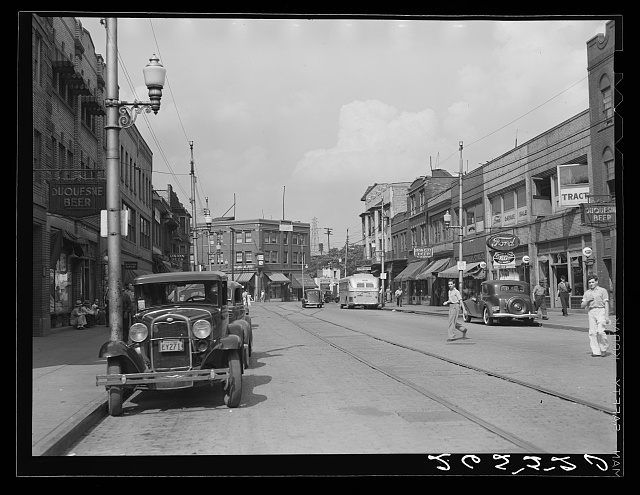 1938 Franklin Avenue looking toward the Wye Photo by Arthur Rothstein of Aliquippa, Pa. July 1938. Click here to view the photo at the Library of Congress web site. Library of Congress Photo Collection, 1840-2000 Record Title: Main street. Aliquippa, Pennsylvania State/Province: Pennsylvania Country: United States of America Year(s): 1938 Subject(s): United States--Pennsylvania--Beaver County--Aliquippa. Format: Safety film negatives. Medium: 1 negative : safety ; 3 1/4 x 4 1/4 inches or smaller. Created/Published: 1938 July. Collection: Farm Security Administration/Office of War Information Black-and-White Negatives Notes: Title and other information from caption card. LOT 1337 (Location of corresponding print.) Transfer; United States. Office of War Information. Overseas Picture Division. Film copy on SIS roll 20, frame 1890. |
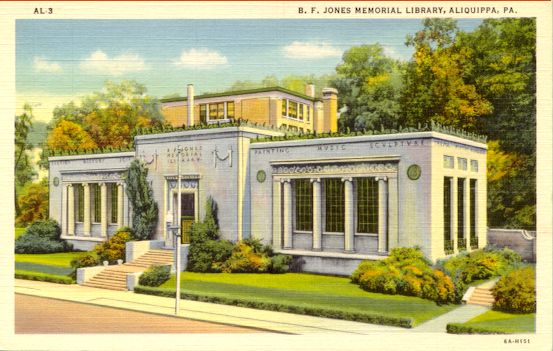 |
| From:
Terri Gallagher <T.L.Gallaghereagle.clarion.edu> Subject: Website. B.F. Jones Date: Wed, 6 Oct 2010 03:50:39 +0000 Greetings, My name is Terri Gallagher and currently am finishing my Master's in Library Science at Clarion University. I am working on a research article about B.F. Jones Memorial Library. I ran across your Web site, which I loved, by the way, and saw the library postcard. Is there a date on the card? Also do you know where it came from? If it is in your possession, would I be able to copy the card from your site for my article? I would credit your site. Please let me know what you think. By the way, I am a Beaver County girl: Rochester native, East Rochester to be exact! All the best, Terri Gallagher From: Terri Gallagher <T.L.Gallagher eagle.clarion.edu>Subject: RE: Website. B.F. Jones Date: Thu, 7 Oct 2010 21:32:00 +0000 Dear Mark, Wow! Thank you so much! You made my day. I will send you a copy of the article. I just hope it is interesting to you and worthy of reading. I've spent a lot of time looking through the archives at B.F. Jones _ amazing _ but have been really rushed to produce the article, which is geared toward librarianship.The article is a requirement of a scholarship I received through a Laura Bush and Institute of Museums and Library Science program. The profs have given us four weeks to produce a polished draft, in addition to keeping up with the work of two grad classes. I am also the director of the Rochester Public Library and up until Jan. wrote for the Beaver County Times (I had to take leave of writing for the Times to keep up with everything). My background is journalism and I would love to write the BF Jones library story from that perspective instead of for a scholarly publication (read footnotes) but I do want tuition paid. lol. (We have three sons - two also in college now). Again, I was thrilled to run across your site. I too am an ancestry buff but have no time right now for sleuthing. Some day...... Well, I better get back to writing. A heartfelt thank you again. Beaver County people are the best. If you have any questions about the archives, please feel free to ask. Keep preserving history!!!!! Terri |
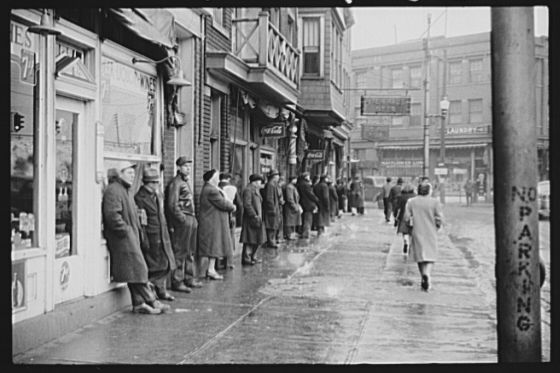 1941 People waiting for the bus Near the Wye on Franklin Avenue Photo by Arthur Rothstein of Aliquippa, Pa. July 1938. Library of Congress Photo Collection, 1840-2000 Record |
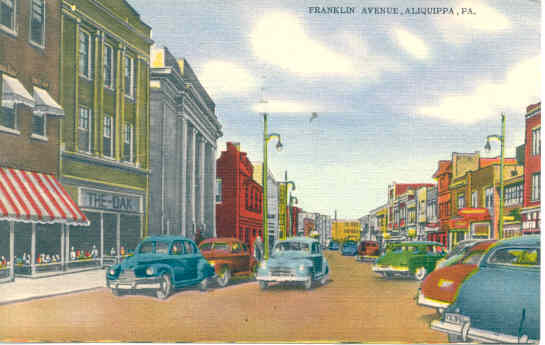 Franklin Ave The white building on the left was a bank. |
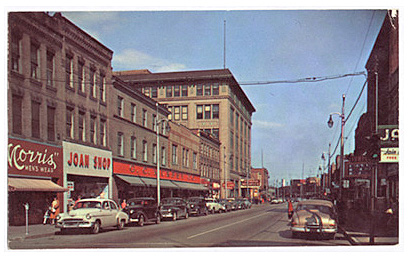 Franklin Avenue - late 1940's or early 1950's. The tall building is the Pittsburgh Mercantile Company - the "PM" (it was a Jones & Laughlin Corp Company Store). G.C. Murphy Five and Ten Cent Store. |
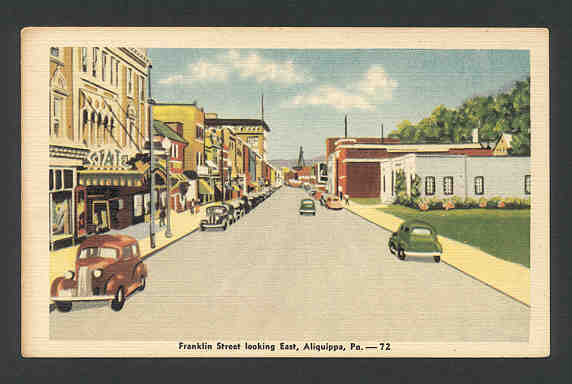 Franklin Avenue State Theater on the left, white one story building is the post office. |
| From:
"Wayne Mineard" <wmineardfrontier.com> Subject: State Theater Date: Tue, 31 May 2011 16:09:38 -0700 Hi, I was looking over your site. Saw the postcard showing the State Theater. My grandfather, Harold Mineard, was the projectionist there for many years. I got to see several movies free. :-) Both my paternal and maternal grandparents lived in Plan 12..."The Bricks". I was looking for pictures of that area and found your site. I lived in Logstown for a year or so, but spent many summers with my grandparents. Enjoyed the other pics. Noted the 5 & 10 aka G.C. Murphy's. Couldn't count the number of times I went in there. Anyway, thanks for the memories. Wayne Mineard Las Vegas, NV (Formerly Chester, WV) |
|
I found this photo in
2014 from the Library of Congress:
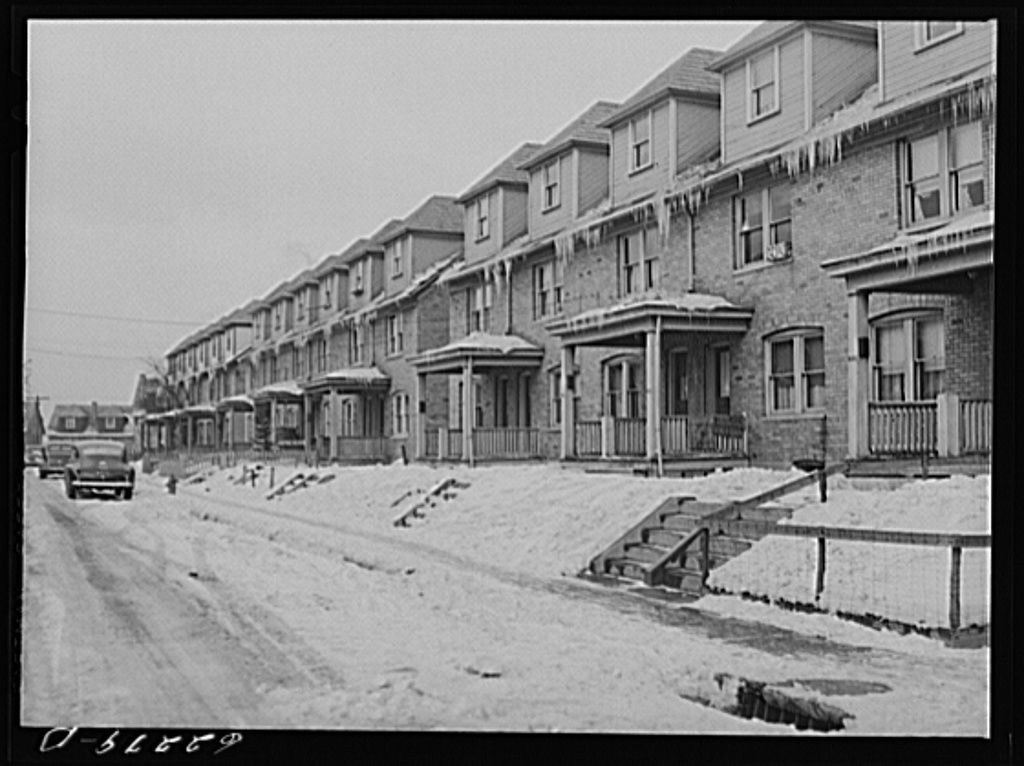 1941 "The Bricks" - Company Houses Another photo of these homes shown in the booklet "Woodlawn on the Ohio". |
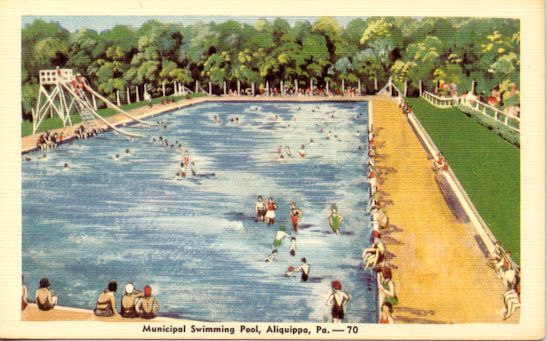 Municipal swimming pool in Aliquippa. I originally didn't
think this was the Plan 12 pool but now stand corrected:
From: "Paul Gentile" <pl.g comcast.net>Subject: Your web site Date: Mon, 14 Jun 2010 13:46:50 -0400 Hi Mark, My brother forwarded your web site on Aliquippa to me and I thoroughly enjoyed it. I was born and raised in Aliquippa, my family moved to the Terrace when I was 3 years old (1943). I taught at Aliquippa Jr. high from 1962 to 1967. Just wanted to let you know, there is a photo titled Aliquippa municipal pool and you state it is not. Actually, it is. That was the pool I attended growing up in the 50's. After college and married we moved to a duplex on 16th Street right at the plan 12/Hollywood bridge. By then, the old pool had been torn down and the current, much smaller one built. The two sides in the photo curved, one to the shallow end and one to the deep. In fact, there were two diving boards, one low and one high. Nice job with the site. Best wishes, Paul Gentile |
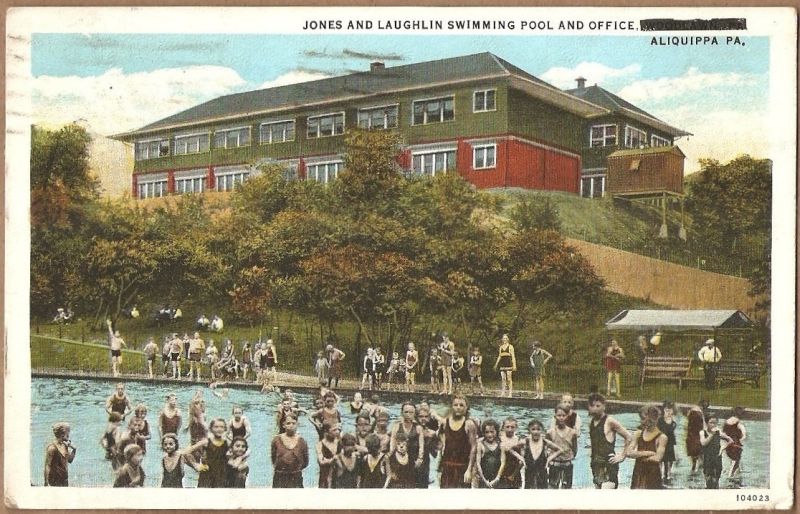 Another interesting swimming pool Its next to the J&L office building that was moved from Aliquippa Park. Anyone know anything about this? The card was postmarked in 1930 but the blacked out "Woodlawn, PA" means it must have been printed before Woodlawn and Aliquippa merged in 1928. In response to my
question, I received this:
From:
Patricia Crnkovich <greengrl409
msn.com>Subject: Jones & Laughlin Swimming Pool Date: Mon, 19 Aug 2013 01:22:44 -0400 Hi Mark, Not sure if you are aware that there is a new book out on Aliquippa, PA---"Images of Aliquippa, PA" Written by Cindy & Ed Murphy of Aliquippa, PA. She is a librarian at the Aliquippa Library. New book is for sale at the Aliquippa Library. If you haven't already bought one---I am sure that you will find it quite enjoyable! Also: I believe all profits go to the Aliquippa Library, Aliquippa, PA 15001 The J&L Community Pool pictured on your site: Inside the book on page 31 are two pictures: One is of the area below the main office where the pool will be constructed in early 1900's. It is the area that J & L chose to build the first community swimming pool. The second picture is a different black/white one of children swimming in the pool and the date is July 4, 1921. She states: "The pool was enjoyed by hundreds of the town's residents." It served as the public pool until the late 1920's, when the mill found a need to expand and then the community constructed three new pools away from the mill. Ref: Thank you Cindy and Ed Murphy Aliquippa Swimming Pools: 1.) Plan 12 swimming pool---completion year---(1928) 2.) Plan 11 swimming pool---completion year---(1929) 3.) West Aliquippa swimming pool---completion year---(1942) The Aliquippa Gazette---serving the Industrial Community of 50,000 reads on Wednesday, January 29, 1941: West Aliquippa Swimming Pool
Gets WPA OK.
The Federal
Government footed $31,175.00 and Aliquippa Borough footed
$31,015.00. They doubted that work would begin before spring. The
pool was completed in 1942. WPA heads in Washington today approved a $62,000.00 swimming pool project for West Aliquippa. Ref: Thanks to my niece Judy Rowley for her research on the West Aliquippa pool. It is so Ironic, that our family was just reminiscing about the West Aliquippa pool and when it was built. Summer job: Judy's mom, our older sister Kay O'Connor and our first cousin Mary Ellen Herzog were the first checker girls. For your convenience they checked your regular clothes, that were usually rolled up in a towel and then put into a wooden square slot, after you changed into your bathing suit. Next, they would give you a number of the slot and you would have to remember it, in order to receive your clothes back. And, as a last resort---If you forgot your number---they would let you in the door to look for them. Hope this answers your question about the J & L community swimming pool, Patricia (O'Connor) Crnkovich |
| Yet another pool! I found this postcard but its only identified as "Woodlawn Park Pool". The kids look to be dressed in 1950's outfits. The guys are wearing DA's and white tee shirts. 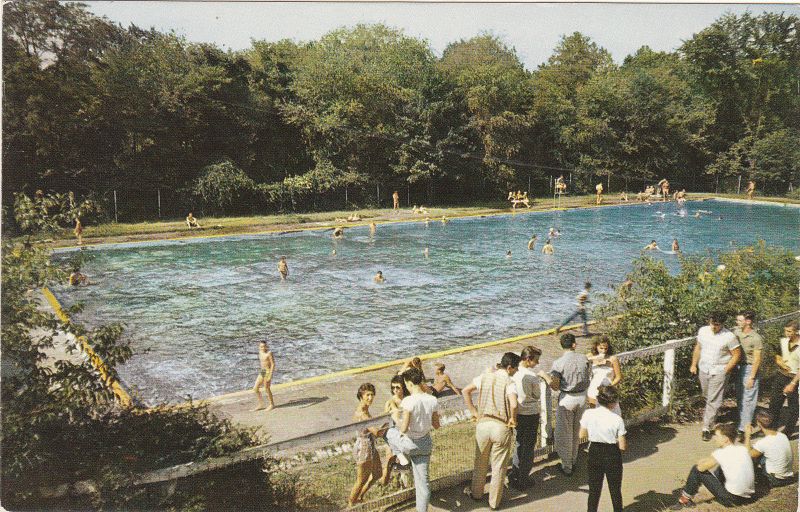 I'm pretty sure that this is a 1950's photo of the Plan 12 pool as shown in the next postcard. The boys in the photo are wearing white T-shirts (probably with a pack of cigarettes in the sleeve) and DA's. |
 This postcard is postmarked 21 May 1945 at Aliquippa. In Sep of 2015, Patricia Crnkovich wrote: "May have started off being named "The Woodlawn Park Pool". But the picture-postcard is aka the Plan 12 pool. Like everything else---things do change over the years. It went from double slides to single to no slides, only diving boards & etc. Also, I grew up in the 50's and the hair & clothing styles were all the same as pictured." |
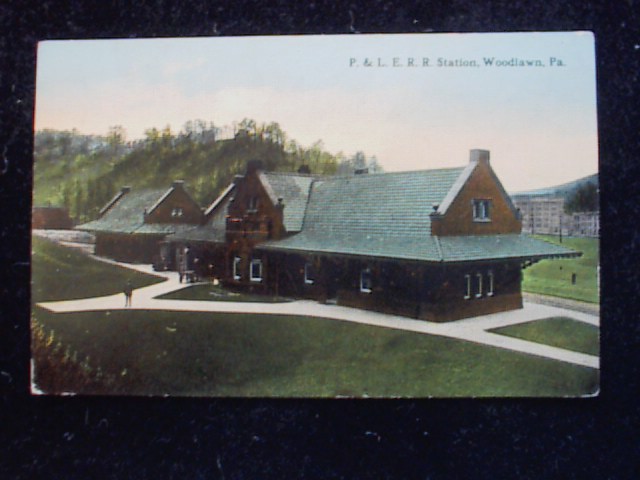 Pittsburgh & Lake Erie Railroad Station Location is listed as Woodlawn which would date the image from before 1928. |
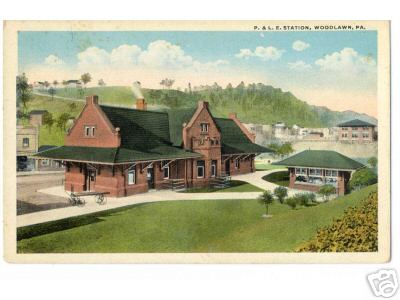 P&LE Station |
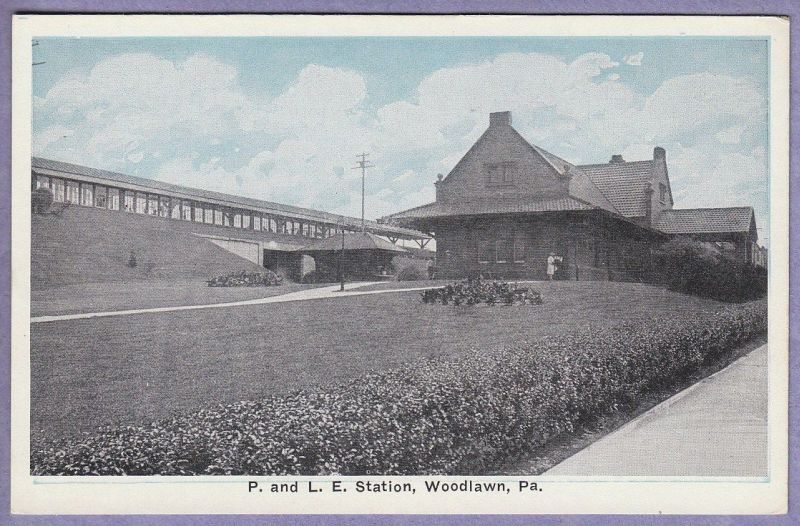 Another view of the P&LE train station |
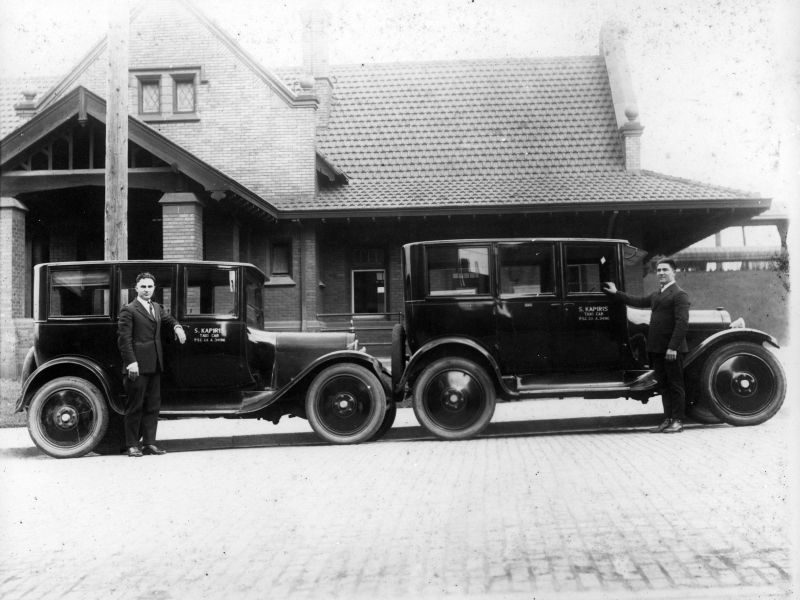 In Feb of 2012 I received an email from George Englezos. George lives in Greece and he asked me about the Capiris family. I helped him with some searching on ancestry.com and he sent me this photo of Satiris (Sam) Capiris. The photo was taken in front of the P&LE Railroad Station in Aliquippa. Satiris had a brother, Athanasios (who might have gone by Tom) but I'm not certain if he is in this photo. Full size scan clearly shows "S. Kapiris Taxi Cab" on the door. Undated but probably 1920's or 1930's. |
| From: John Suhayda <jg.suhaydagmail.com> Date sent: Wed, 29 Nov 2017 00:18:11 -0600 Subject: Aliquippa Site Hello Mark: I came across your Aliquippa site today and I want to thank you for your efforts to document the history of the city. My parents were born and raised in Aliquippa, and my maternal grandfather John Cavoulas was friend of Sam Capiris whose photo you show with his taxi cabs. In fact, my grandfather's Petition for Naturalization from 1927 was signed by Sam Capiris as a witness (Sam's occupation is listed as Taxi Driver). And my grandfather co-founded the Crystal Market in Aliquippa with Tom Capperis (note the alternate spelling of the last name). I assume that this Tom is the brother of Sam, although I am not certain about that. By the way, the Shorpy web site recently posted a high-resolution image of the 1938 Arthur Rothstein photo of Franklin Avenue. Thanks, John Suhayda |
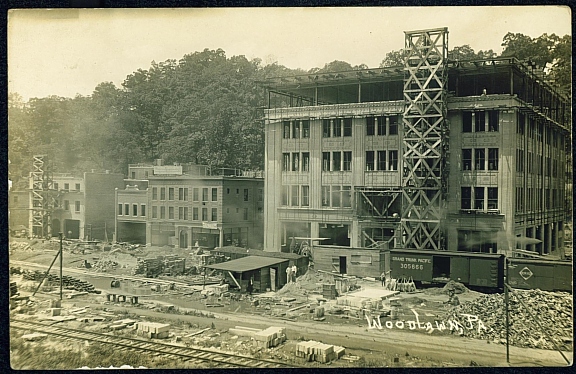 Pittsburgh
Mercantile Store under construction. Pittsburgh
Mercantile Store under construction.Railroad tracks going right up Franklin Ave. (postcard sent to me by John Fibbi, Feb 2012) Another photo of this building shown in the booklet "Woodlawn on the Ohio". |
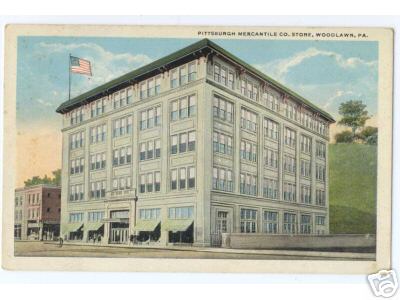 The locals called this the "PM" |
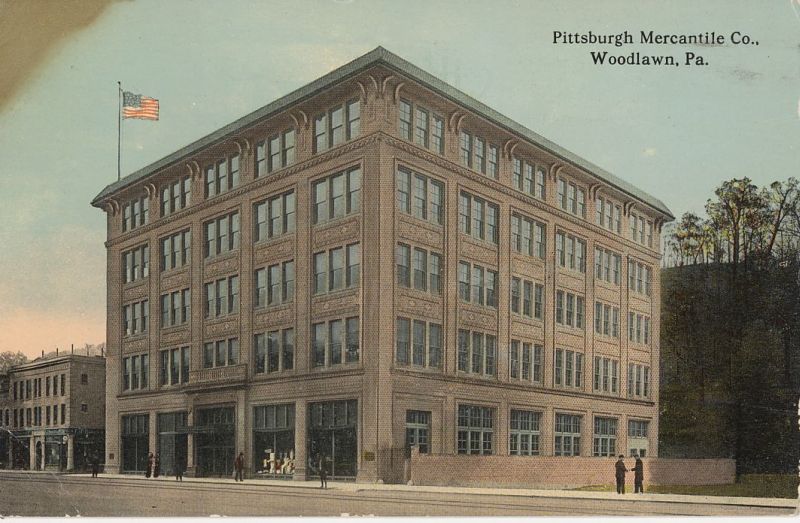 Pittsburgh Mercantile Store Postmarked 21 May 1920 Another photo of this building shown in the booklet "Woodlawn on the Ohio". |
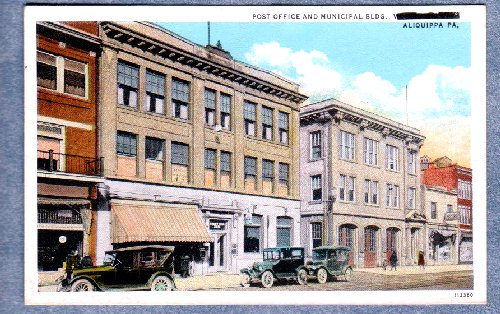 The post office on the left under the awning. On the right is the municipal building which contained the fire department behind the three large doors. Notice on this postcard that Woodlawn, PA was overstamped with Aliquippa, PA. Woodlawn became Aliquippa in 1928. Another photo of these buildings shown in the booklet "Woodlawn on the Ohio". |
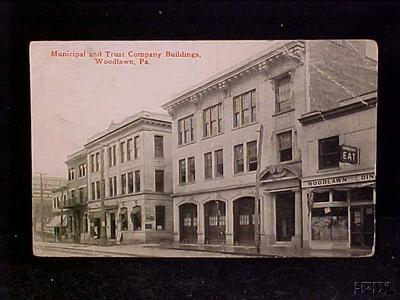 The post office may have moved to is present location by the time this photo was taken. The fire department and city offices moved in the 1970's. The municipal building is now gone. This photo must date from before Woodlawn became Aliquippa in 1928. Another photo of these buildings shown in the booklet "Woodlawn on the Ohio". |
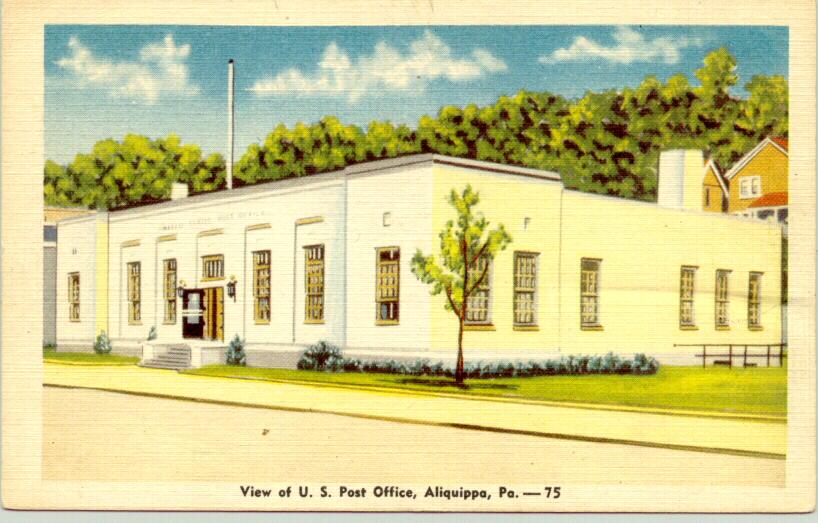 The current post office on Franklin Avenue |
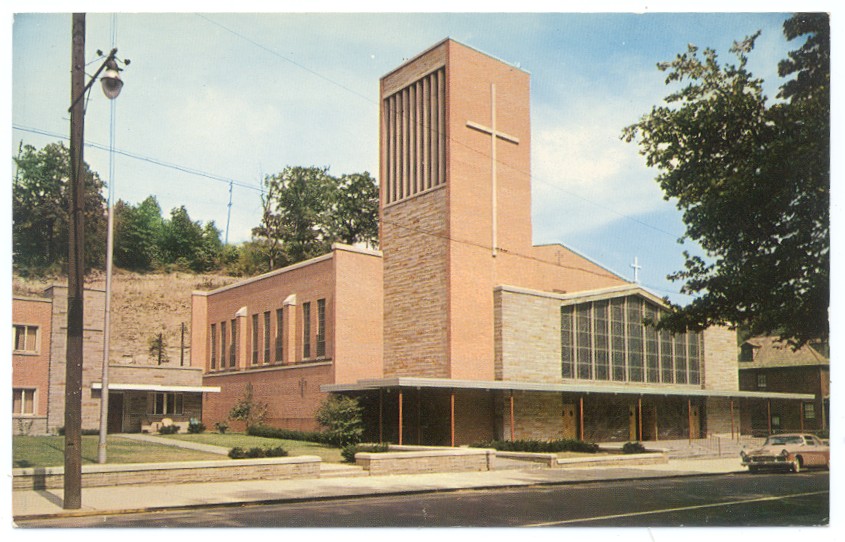 St. Titus Roman Catholic Church Built in the 1950's on Franklin Avenue. |
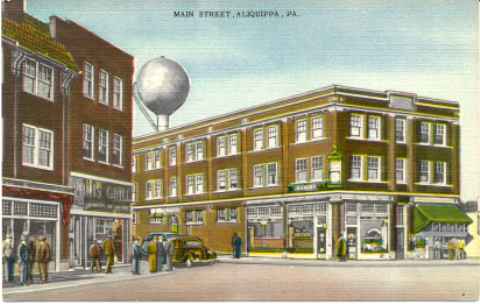 Franklin Avenue at the Wye The tower in the rear was part of the Municipal Water Authority plant. This section of Aliquippa was bisected with a four lane highway overpass in the 1960's. The buildings on the left is where the overpass went through so the buildings are gone. The building straight ahead and the watertower are still there. |
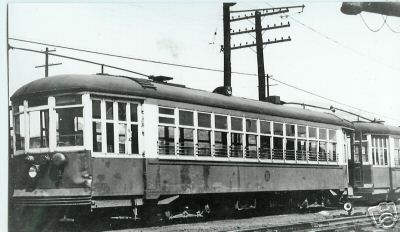 Woodlawn and Southern Trolley |
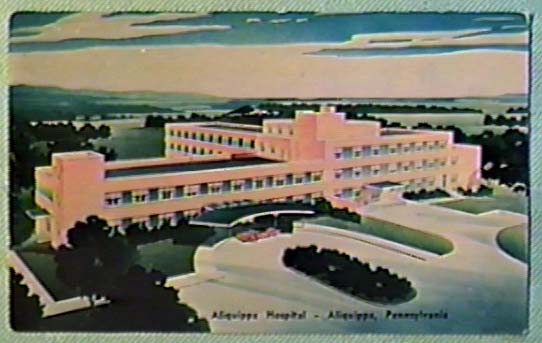 Aliquippa Hospital Built in the 1950's or 1960's. In 2009 it closed its doors for the last time and has since been torn down. This hospital was not there when I and my sisters were born so we entered the world at Providence Hospital in Beaver Falls, PA. |
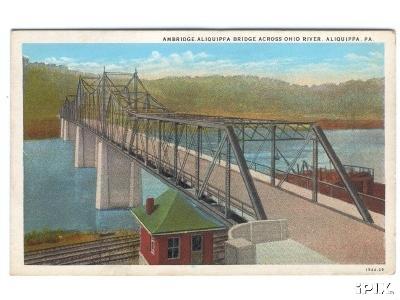 Ambridge-Aliquippa Bridge Across the Ohio River |
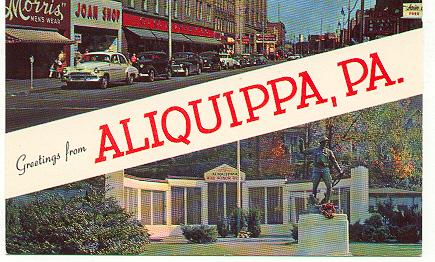 |
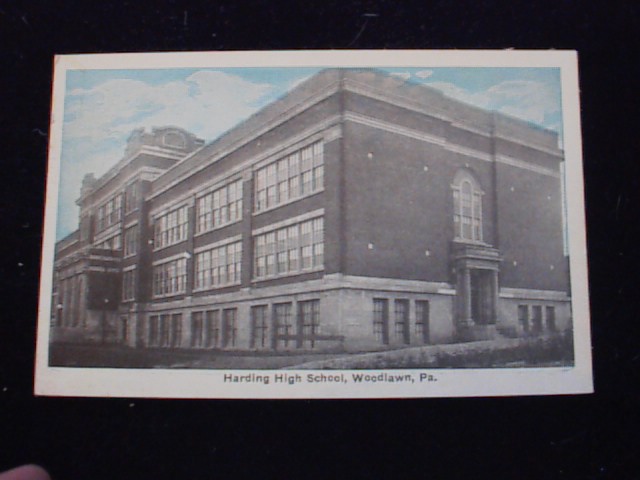 My alma mater - also gone - torn down in 2009-10. |
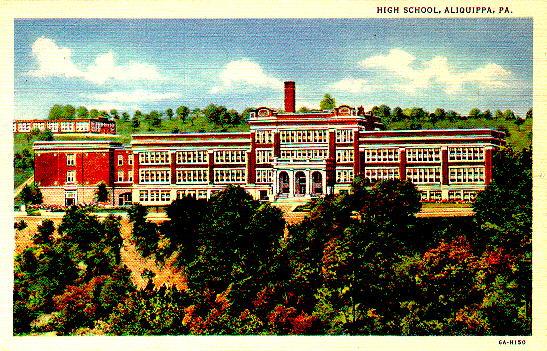 When I went to school here, the addition on the left of the main building was called the "new wing". It was built in 1932. |
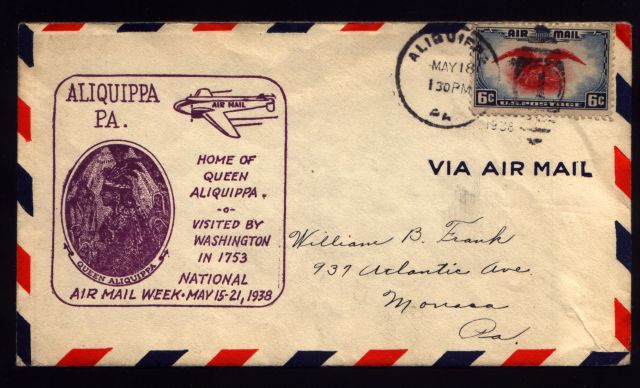 Not everything you read is true. (As you read above, Aliquippa is named after an Amusement Park. Queen Aliquippa never lived around here.) |
msn.com>. Patricia wrote
(in Jul of 2012) (her comments in RED):| Dear
Mark, I found the picture you received from a Mr. John Fibbi (Feb.2012) to be most interesting and educational as well. As the construction progresses: Attached are four postcards to complete the picture of up-town Franklin Avenue, Woodlawn/Aliquippa, PA. Postcards are made to be shared---I believe that postcards were made to be used as a greeting card, to send messages to friends and family, business advertisement, people's collections, pure enjoyment and thankfully they also recorded history along the way. I must say, that we surely miss Bill O'Neal or O'Niell (now deceased) of Aliquippa, PA, recording our local history with his camera. I think he was some sort of cameraman on planes recording World War II and later on made a small business selling his beautiful postcards. I believe you have some on your site of J&L/LTV while the mill was still in business. They are the ones with the red borders and were sold in our local stores. Earlier, his job was, "Recorder of Deeds" at the Beaver County Court House. I visited there with our Genealogy Society of Beaver County and also for personal family research. He was always patient, kind and very helpful, when you visited his department. I sure he is well remembered by all who knew him. Also, many thanks to "you" for recording our local (Aliquippa, PA) history on your site! It is not only beneficial to us, but especially to our children and grandchildren, who haven't any idea of what our towns of Aliquippa and West Aliquippa, were like in their "hey-day". Patricia (O'Connor) Crnkovich |
Woodlawn, PA in its early years |
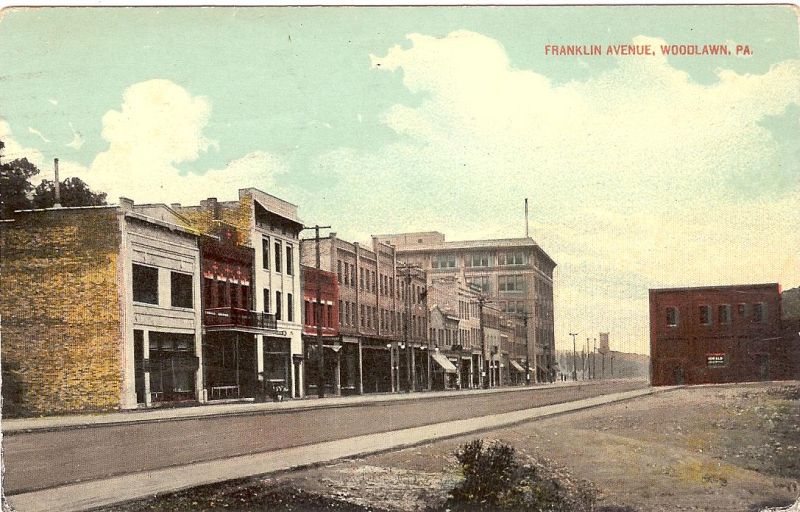 Franklin Avenue, Woodlawn, PA---Circa 1910-1912 This gives you an idea of the continuance of the former growth and development of Franklin Avenue in Woodlawn, PA. Note right side: Empty lots where more stores and a new post office (meaning our current one) was built at a later date. Submitted by: Patricia (O’Connor) Crnkovich |
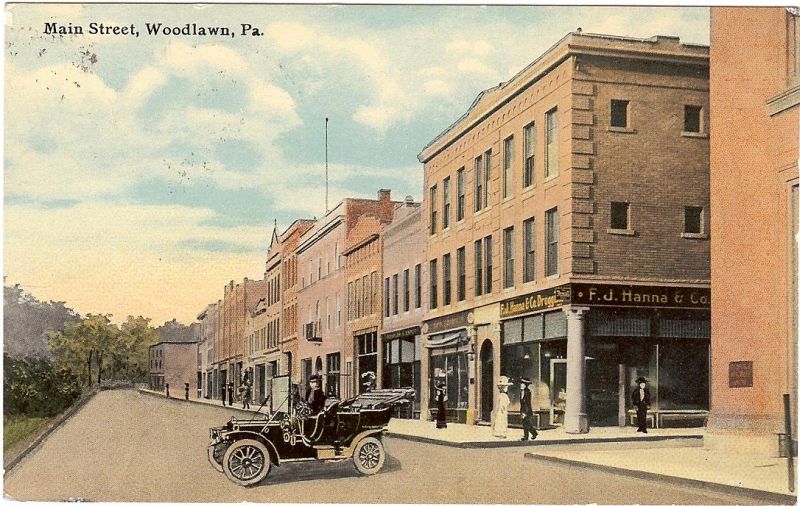 Main Street, Woodlawn, PA---is dated 1912---- “Main Street” is Franklin Avenue, Woodlawn, PA---now Aliquippa, PA after the consolidation in 1928. F. J. Hanna Drug is on the left side of the Pittsburgh Mercantile Department Store. Submitted by: Patricia (O’Connor) Crnkovich |
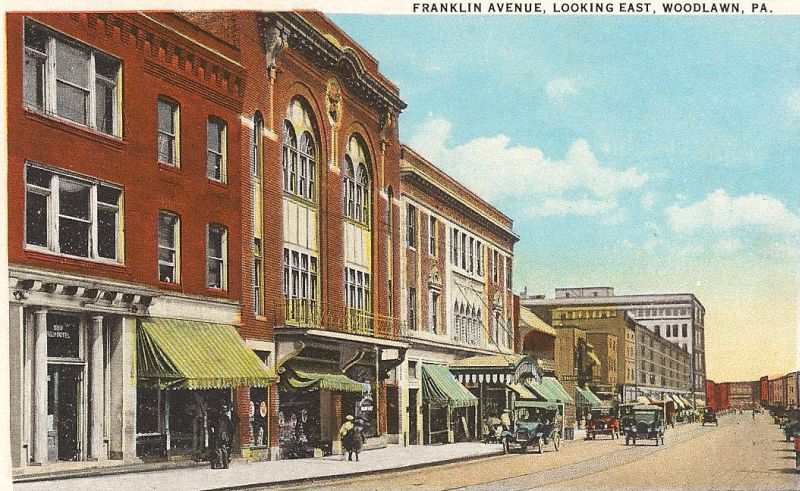 circa 1915-1920:---The completion of the left side of Franklin Ave, (business district) Woodland, PA---now Aliquippa, PA 15001 Submitted by: Patricia (O’Connor) Crnkovich |
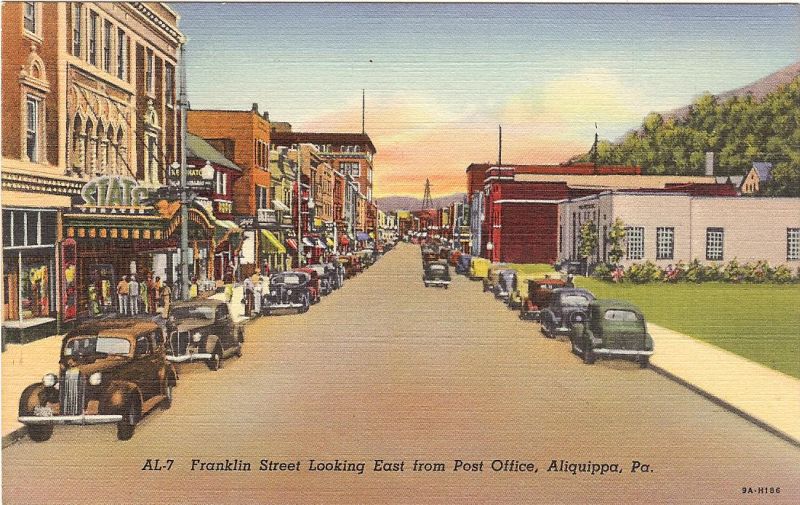 circa 1940 Just to name a few: Left side----Moose Club, State Theater, Villa’s-(later), Autenrieth’s 5 10, Young’s Drug, Hoffman’s Drug, Stamen’s Women’s Wear, Morris Men’s Wear, Joan Shop, G.C. Murphy’s 5 & 10, Thrift Drug & Pittsburgh Mercantile Dept. Store, Plodinec’s Furniture, Mellon Bank and much more. Note: The Strand Theater was also on the left side of the street-one block up from the Wye. Right side---U. S. “Aliquippa”, Post Office, The Aliquippa National Bank is later The Union Bldg. 1211, Jacobson’s Vater’s then Sol’s Sporting Goods, Temple Theater, Olikers Men’s Wear, Sullivan Children’s Store, Michael’s Furniture and so much more. Submitted by: Patricia (O’Connor) Crnkovich |
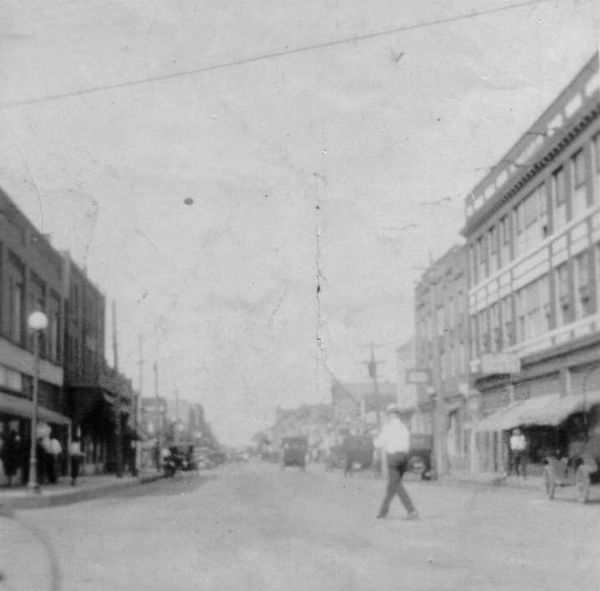 |
| From:
DJCobiaaol.com Date: Thu, 4 Jun 2009 02:46:34 EDT Subject: Aliquippa History Hi there, I want to tell you your site on Aliquippa is great. I guess you are wondering why I am writing you. My father's family was from Aliquippa. He and his brothers were born in New Castle PA and moved to Woodlawn - Aliquippa when my father was 2 or 3 years old. My grandfather and his boys all worked for the J&L at one time or another. My grandfather also owned a gas station and was the Tax Assessor. My grandmother sang opera on the radio there as well. I have a newspaper article that I just found in my parents things all about my grandfather. I was wondering if you would like to have a copy of it for your records. I can't give up the original but I am willing to send you a copy of the newspaper. Denise Cobia |
| Denise, Thanks for your email. My Aliquippa web site is just a small page that only has very limited info about Aliquippa. You might look around for an 'official' Aliquippa web page - if such a thing exists. Your stories would make a good addition to that kind of web site. Otherwise, you might make copies and send them to BF Jones Memorial Library. I'm sure that they have an Aliquippa oral history section. In any case, can you scan the article and email it to me? Never know when I might make some connection to your family. Mark |
| Hi I kept your email and I hope you don't mind. I have this old family picture of what I am guessing is a street in Aliquippa. I was wondering if you could identify it. Thank you Denise |
| Mark, If you want to put this on your website to see if anyone can identify it that would be great. I had sent a copy of this to my cousin who knows my family history and he couldn't identify it either. Unfortunately anyone who would know has passed on. I have undertaken a big project of trying to identify family members and then make family dvd's for all of them. I am hoping to include notes etc about who is in the pictures at least for posterity. This one was included in my dad's family pictures that is why I thought it was Woodlawn/Aliquippa. I tried to magnify the pic in my photo editor to see if I could make out a name of a store but had to make it so big it distorted the pic. So lets see what happens. Thanks Denise |
verizon.net).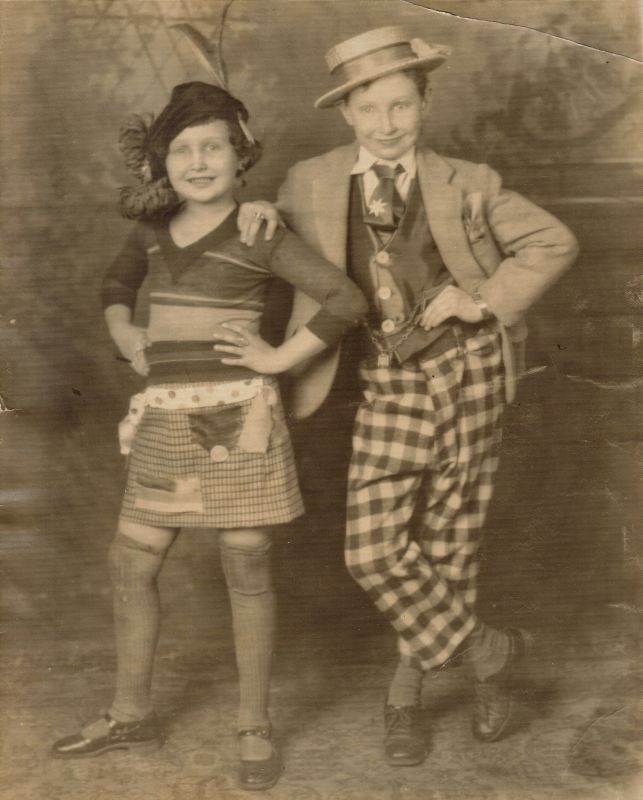 |
| Bill wrote: "The Aliquippa school play pics are my dad James Gaughan Jr. And his sister June Gaughan Santilli." |
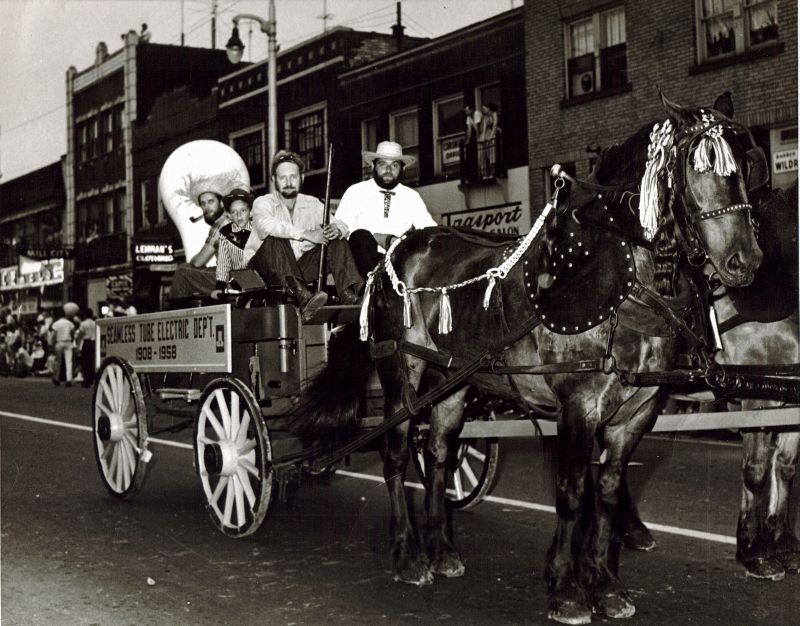 1958 Aliquippa Golden Jubilee Parade - 50th Anniversary The 5 July 1958 issue of the Beaver Valley Times noted that this float won a $15 award for the best team of horses. |
| Bill wrote: "Joe Petrella driving the wagon, my dad with the coon skin cap beside him. James Gaughan. from Plan 12." |
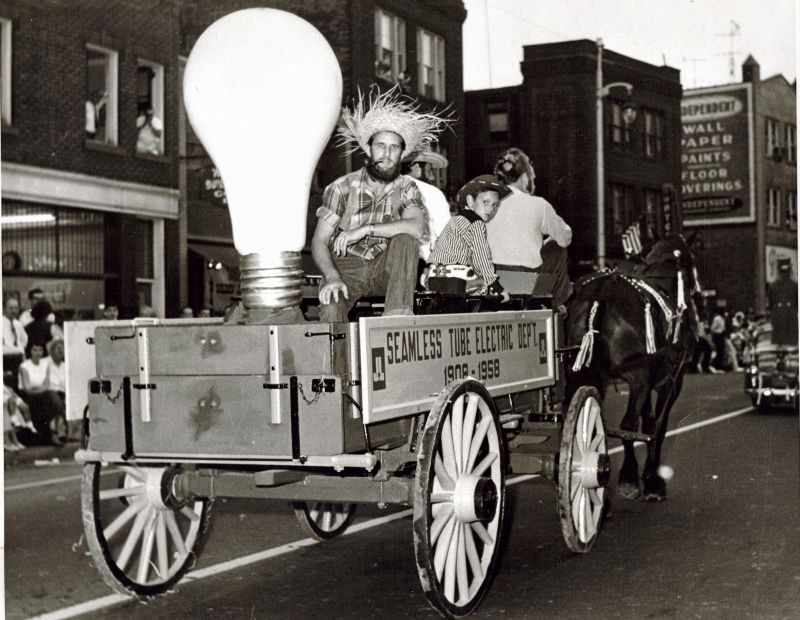 1958 Aliquippa 50th Anniversary |
| Bill wrote: "That was Joe Petrella's son.
I missed out of the pics I got farther down the avenue. I don't know if I am spelling Joe's name right. My uncle by marriage is Frank Santilli. They were from West. He had a house on Irwin St. My other uncle Cliff Davies was just up the street from him." |
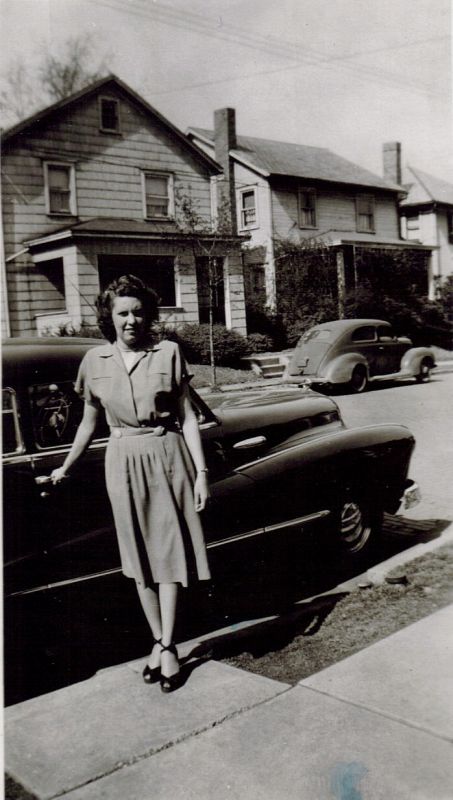 |
| Sent to me by Bill Gaughan, May 2012 : 1111 Irwin St Plan 12 - My mother Ida Gaughan in front of Cliff Davis house. |
verizon.net>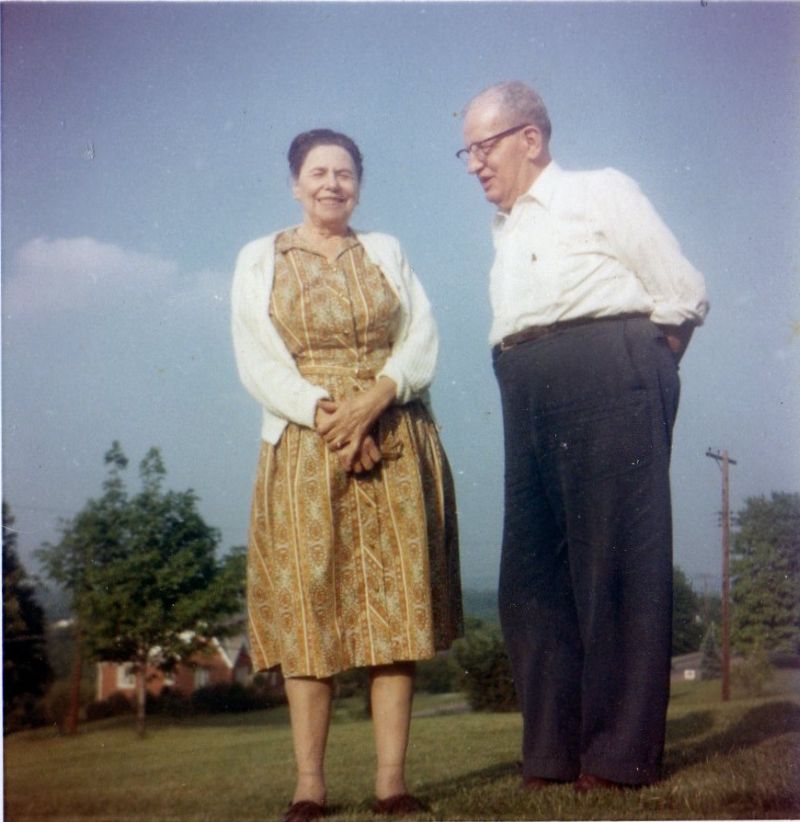 |
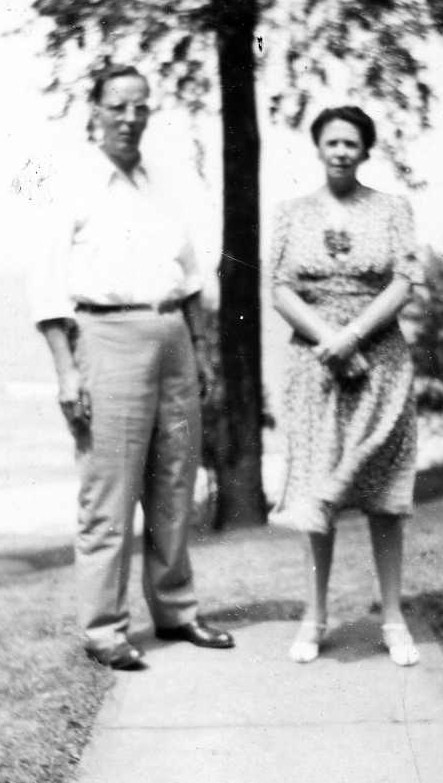 |
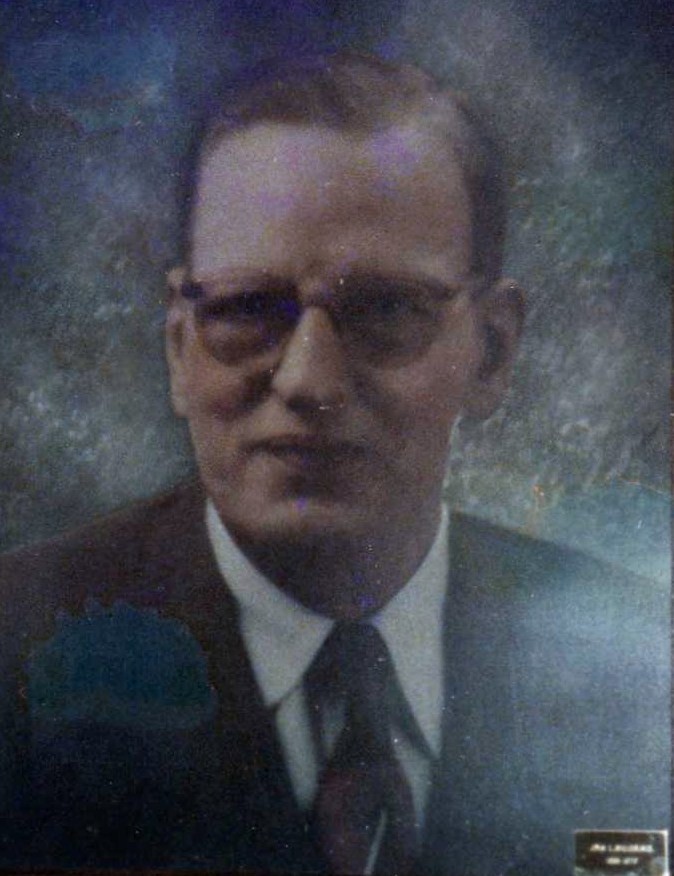 |
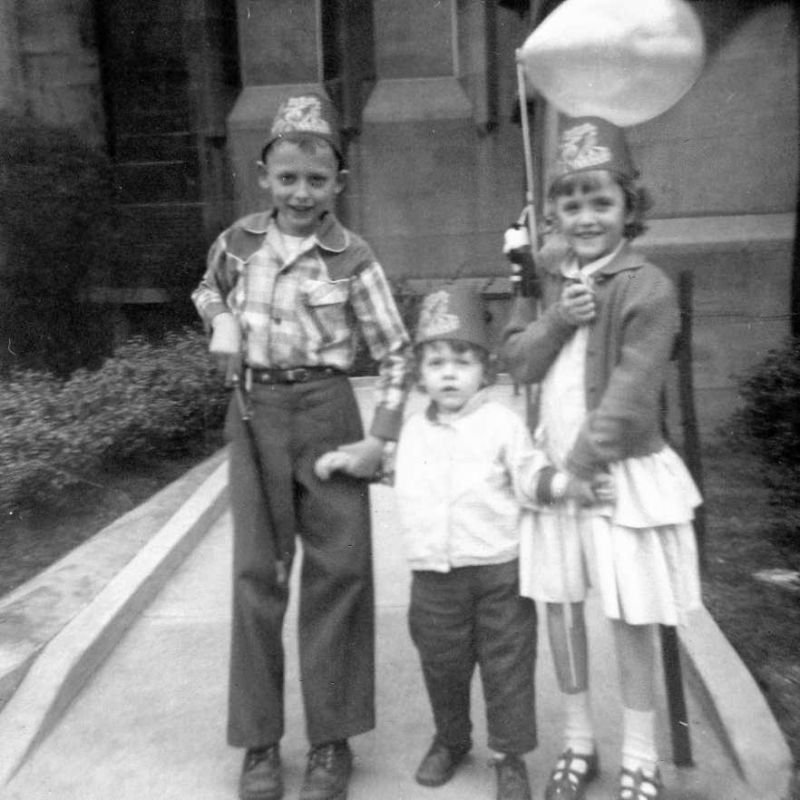 |
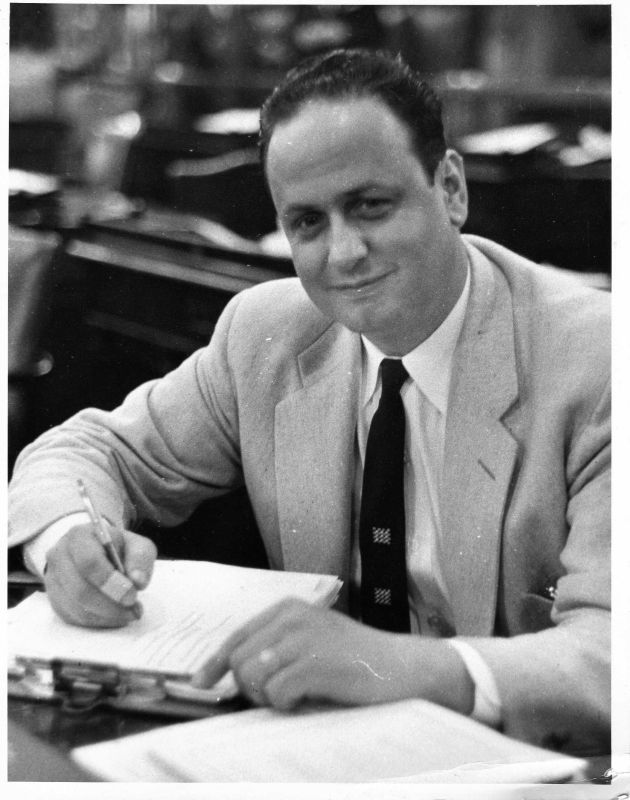 John C. Miller |
| From: "John J. Nadzam "
< jjrail comcast.net> Received this shot from a railroad friend. I remember seeing this awhile a back. Used in ore traffic from J&L Adams mine on ONTA via CN-NYC-P&LE to Aliquippa. I recall during the mid-60s the Canadian National Railway (which was shown on one side of the car as Canadian National Railway) marked hopper cars for various products. Saw many of them at Valley Street Tower in Youngstown. I think they were marked at various levels for ore, sand, and for gravel. |
 |
 2012 Mike Varosky
and John Fibbi
|
| John posted this to his
Facebook page: Childhood friends growing up on Van Buren Street in Aliquippa Pa reunite after 42 years. Once separated by Grand Avenue then later by the expanse of the county, John Fibbi and Mike Varosky met at Mike's business MikeCo in Camarillo, CA, where he buys and sells Antique, Kustom, & Obsolete Auto Parts. Connecting via email through the website www.silogic.com<http://www.silogic.com> maintained by another former Van Buren Street resident Mark Di Vecchio, John arranged to meet with Mike during a business trip to CA this week. John moved with his family to Monongahela PA, days before the start of 9th grade in 1969, Mike moved with his family to Tempe AZ, at the beginning of the second semester of his junior year of high school 1971-72. We had a great evening, the conversation made the 42 years feel like only 42 days. |
| Subject:
DiVecchio in Aliquippa Band From: BCepull mcdanelceramics.comDate sent: Wed, 22 Feb 2017 11:26:54 -0500 Hello Mark, I picked this photo up in a Beaver Falls antique store and posted it on "Remembering Aliquippa" site on FB. I looked over the names again and saw a Dominic DiVecchio listed so I thought I would send you a scan. I'm not sure if/how related to you but here is a copy for you to do what you wish. I have no family members in the photo. It has generated a lot of interest on FB, even Gino commented that his wife is the last majorette on the right (Bologna). Gino is somewhat of a cousin, my aunt Elvira (lefty Cepull's wife) was a Piroli. There was also a 1949-50 band photo that I scanned. Best Regards, Bill Cepull |
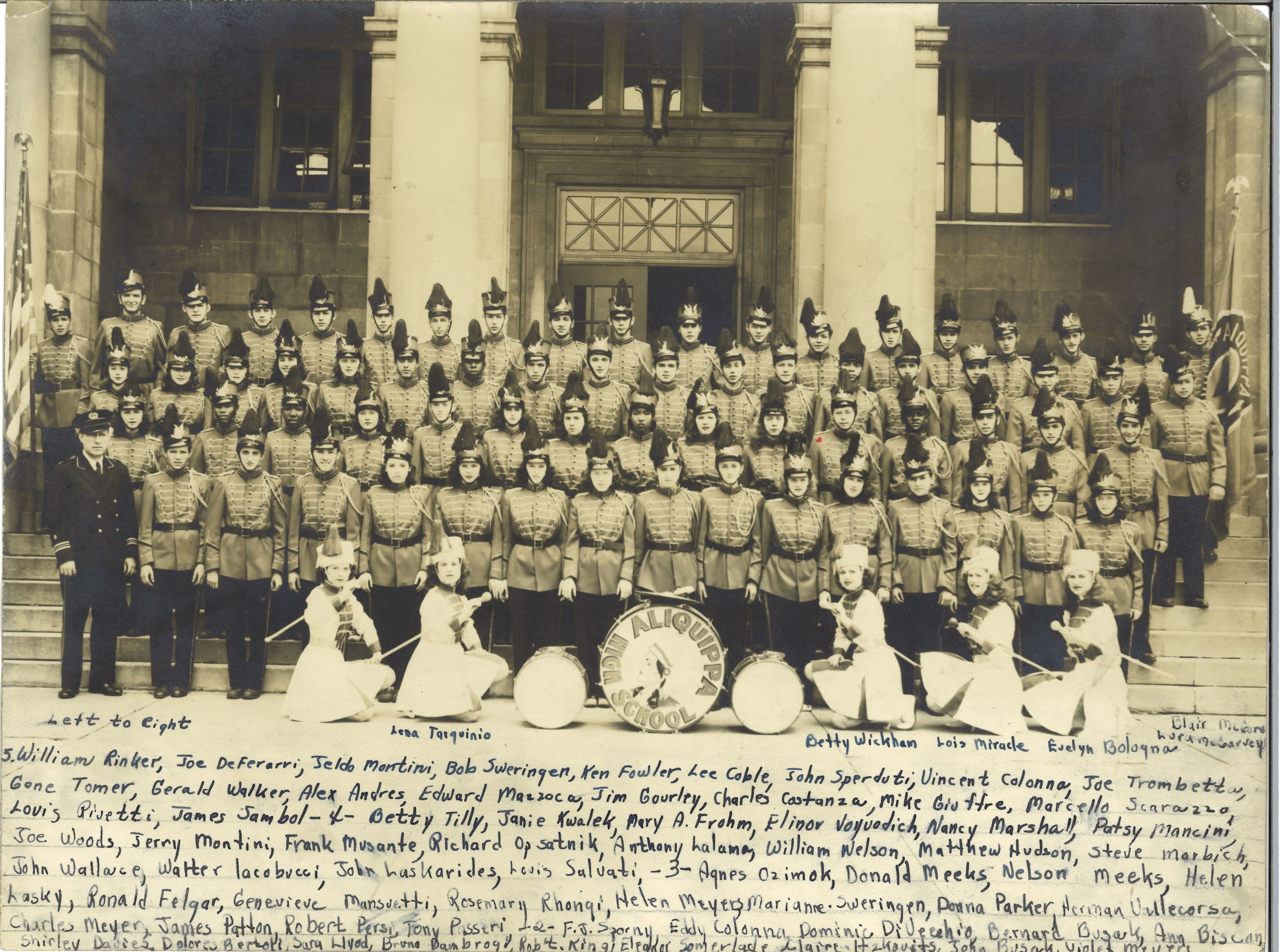 Identifed as the 1946-1947 Band 1947 AHS Yearbook shows list of Baton Twirlers that match this photo. Click on the photo for the high resolution version that Bill send me. |
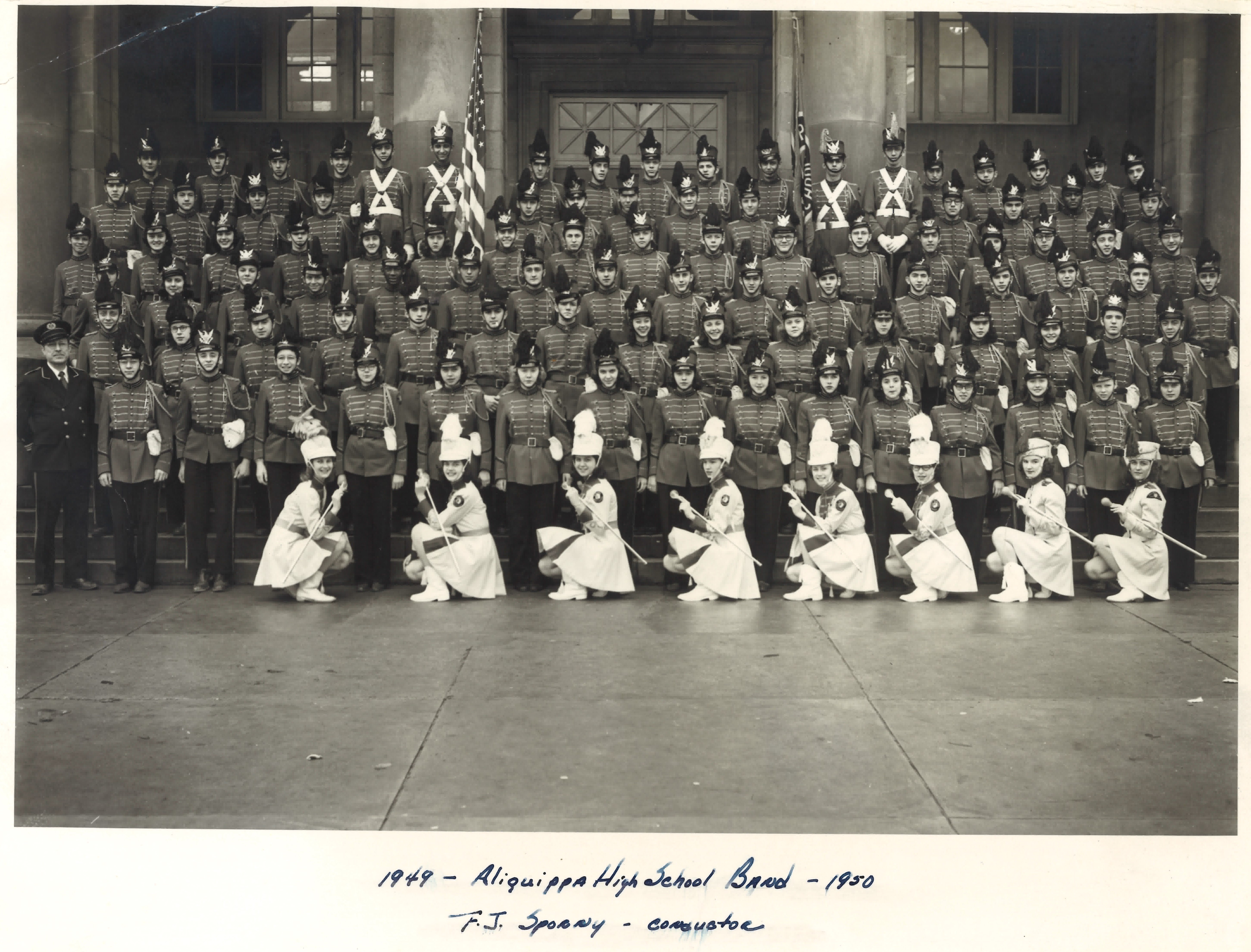 The 1949-1950 Band Click on the photo for the high resolution version that Bill sent me. |
| From a 4 Feb 2002 olumn in the Beaver Valley
times by Gino Piroli: <http://www.timesonline.com/featured-columnist---gino-piroli/article_11309fc1-2edf-5a59-9d4b-def5ace77c2c.html> Another recent obituary had the name of Vic Sporny, and it listed as one of his occupations that of band director. It failed to mention that he was the Ambridge High School band director, a post he held from the late 1940s until the late 1960s. The Sporny name was well-known in Beaver County. His brother, Fred, was the Aliquippa High School Band director from 1946 through 1961, and another brother, Chester, was the Aliquippa Junior High band director. Future high school band directors Pat Mancini, Ed Mazzoca and Dom DiVecchio were in Fred's early bands. For many years, Vic and Fred combined their bands for halftime shows at the Aliquippa-Ambridge football games. This show of unity wasn't always to the liking of some die-hard fans from both sides of the bridge, who resented sharing anything with their rivals. Mancini, when he was the band director at Monaca High School, and DiVecchio, who led the Midland High School band, liked the idea and also combined their bands for halftime shows when those great rivals met on the gridiron. This continued until DiVecchio went back to Aliquippa to take over when Ed Mazzocca, who had replaced Fred Sporny in 1961, passed away. (Mark's note: Ed Mazzocca PA DC 3 Mar 1931 - 21 Dec 1963.) Vic Sporny's son, David, who was an outstanding trombone player for the Bridger band, is now associated with the music department at the University of Massachusetts in Amherst, Mass., and came back a few years ago to lead the Midwestern Honors Band at the Ambridge auditorium. Sporny left Ambridge in 1967, and Emileo "Lee" Tolfa, who still has a popular dance band, became director in 1968 and continued the tradition, which has passed on to Sal Aloi and that great organization. Times columnist Gino Piroli can be reached online at Gpiroli yahoo.com. |
| 2015 Obituary of Betty Wickham (one of the Baton
Twirlers), states she graduated from Aliquippa High in 1949. <http://www.timesonline.com/community/obituaries/betty-jean-musgrave/article_f8427c4e-2f20-11e5-a14a-13c7a30366eb.html> "Betty was born September 1, 1930. She graduated from Aliquippa High School as Betty Wickham, Class of 1949." |
|
A later band
director, Domenic DiVecchio, was a cousin of mine. This scan from the
1966 yearbook.
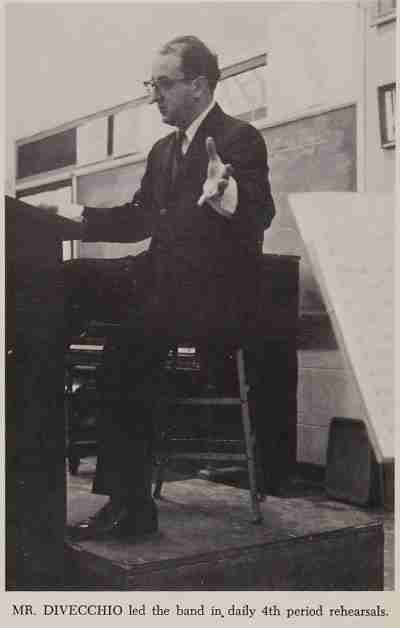 |
| You can find many of the 1940's - 1950's yearbooks on
ancestry.com. Here is the 1949
AHS yearbook. |
| Date: Tue, 15 Mar 2011
17:35:57 -0400 Subject: West Aliquippa From: Charles Messina <chuckmessina gmail.com>Hi
Mark,
I found your website on line, and thought I'd contact you to see if you can help me out. My father grew up in West, and passed away in 2008. He wrote his life story, and I'm in the process of getting the book published. I have been searching for photographs of West Aliquippa between 1920 and 1960. There is an aerial image you posted that I like. I'm trying to find some that show the train/tracks and homes in the foreground and the mill/smokestacks in the background. There are a few that have been posted on the site, but I can't seem to contact anyone to find out where to find these images. Any advice or direction you can give me would be greatly appreciated. Thanks, Chuck |
| Mark, Hey, thanks for the pix. I will let you know when the book is completed. Chuck |
 |
| Author: James J. Messina Editor and Co-Author: Charles D. Messina On March 20, 2008, James J. Messina passed away. As a deep and personal gift to his two sons, he wrote (in longhand) an illustrated his life story. Mr. Messina began the project in 1985 and completed it 8 years later. His youngest son, Chuck, was so impressed with his father’s talent, he contacted a journalist at the Beaver County Times who was known for his interest in local history. After interviewing Mr. Messina, a two-page article describing the book was published in the local section of the newspaper. The journalist praised his work as a tremendous accomplishment, as well as an important piece of history, and urged his son to share it with the world. Chuck had wanted to pursue publishing the manuscript for a long time, but his father wouldn’t hear of it, claiming it was merely a gift to his children to remember him by. After hearing the journalist’s encouragement, this was all Chuck needed to propel him into action. It took Chuck almost nine years to accomplish this dream becoming a reality. With the dawn of the digital age, and the economy in a downturn the whole time, it was nearly impossible to find anyone interested in this type of manuscript. The first task was the most difficult, transcribing the entire manuscript word-for-word. That in itself was a monumental job. After numerous publishers showing interest, but then retracting their offers, editing and re-editing, months of sorting through piles of transcribed and written versions of the story, arranging and organizing illustrations, researching multitudes of websites and books, submitting and re-submitting files, it’s finally come to fruition. This book is based on material from five hand-written volumes of stories and drawings that his father compiled over the years using large bound artist sketch books. Most of the original illustrations were in color, one hundred sixty-four in all, with captions describing each and every one. These drawings are of activities from days-gone-by, and specific to the little town, West Aliquippa, Pennsylvania, where he grew up. The story is rather typical of most of his generation: children of immigrant parents, impacted by the Great Depression, finding financial stability with work in the steel mill; service in World War II; a new life after discharge with marriage, buying a home and car, and having children. Then, he was stricken with an unexpected disability that forced him to retire, and after agonizing months of pain and discomfort, he found peace in writing and drawing, which lead to this incredible manuscript. This story will bring back a lot of memories to many in the southwestern Pennsylvania region because it reflects the lives of many from that era. It is not a captivating mystery leading to a riveting climax. Instead, it’s a collection of vignettes, accompanied by beautiful illustrations, with some entertaining and great moments, during a time gone by, that has been captured by a very special and gifted storyteller. His story, and the manner in which it’s told, is a testament to what a truly amazing man James J. Messina was. Part II: The Call of a Lone Wolf will be available in the near future. 2012, 8.5x11, Softbound, 267 pages ISBN 9781558565548 |
| Chuck, I can't say enough about your father and his book. He had a fantastic memory and the illustrations make the stories come alive. I have some information about the people that your father mentioned from West Aliquippa. I'll email you the bits and pieces as I come across them. Mark |
| Thanks Mark, I'm very proud of this book. If you read my thoughts throughout the book you'd know how felt about him, and his vivid memory. I'm working on book 2, where he enlists in the Marines now. I think it might even be as good or better than the first book because his story is more cohesive, and exciting. The book is definitely going on sale at the Beaver Valley Mall, Books-a-Million store, so please pass the word around. Thanks again, Chuck |
| To: gpiroliyahoo.com Subject: Sullivan LaRocca (Solly Rock) Copies to: snewc161 sbcglobal.netDate sent: Mon, 14 Jul 2008 10:23:47 -0700 Dear Mr. Piroli, My name is Mark DiVecchio. I grew up in Aliquippa. My father, Patsy DiVecchio, still lives on Van Buren Street. I started doing genealogy research a few years ago, digging into my DiVecchio ancestors. The scope of my research has quietly grow from Sant'Eufemia a Maiella, where my father was born to surrounding towns and their connection to Aliquippa. A couple of years ago, I was contacted by a woman named Shirley Newcombe. Shirley's grandfather was Joseph (Giuseppe) Rock (LaRocca). The LaRocca family was from Pacentro. Shirley knew little of her family (seems to be a common problem in many Italian families - for some reason, we didn't like to talk about our ancestors). She asked me if I could help her. I did some checking and we found a few new pieces of information. Shirley's great grandfather, Tony (Antonio) Rock (LaRocca) and his family appear in several US census: 1900 Census, Hopewell Township, PA Tony Rock, 42y Anna (Ciccone) Rock Joseph Rock, 8y Sulvani Rock, 7y Mary Rock, 5y Louis Rock, 2y 1910 Census, Hopewell Township, PA Tony Rock, 48y Annie Rock, 44y Sullivan Rock, 19y Joseph Rock, 18y Mary Rock, 16y Louis Rock, 12y Philip Rock, 8y 1920 Census, Aliquippa, PA Annie Rock, 56y, widowed Sullivan Rock, 28y Joseph Rock, 26y 1930 Census, Aliquippa, PA Anna Rock, 69y, widowed, boarding at the home of Guy Carifo. The person in this family tree that remains a mystery is Sullivan Rock. We aren't exactly sure where or when he was born. It was either 1891 or 1892 in either Denver, Colorado or in Pacentro. We think that he served in the US Army during WWI since he died at the VA Hospital in Pittsburgh in 1961. He is buried next his brother, Philip, and sister, Mary, in St. Patrick's Cemetery in Johnstown, NY. His 1917 WWI Draft Registration card records him as mentally disabled - which makes us wonder if he really could have served in the Army. It is believed that he was gassed during the War which did something to his mind - but that may not be true. He lived the life of a hobo in West Aliquippa. He was known as "Solly" or "Sully". Pete Gaudino, a former Aliquippa resident, sent me these photos of Solly (Mark's note, see below). Pete took the photos in the 1950's sometime. The photos were taken behind Harper's Tin Shop in West Aliquippa. Joe Anthony (Joseph d'Antonio) who lives near me in California, and grew up in Aliquippa, also remembered the hobo who was Sullivan Rock. (Mark's note: Joe passed away in 2011). In 1993, Carl Wilson, another former Aliquippa resident, wrote an article about his hometown for a small Las Vegas newspaper. He wrote: "Solly Rock called the river bank his home for no other reason but that he liked it there. Some would call him a 'bum' today, but not in my time. He was a symbol of freedom to choose a life that suited the individual." I know that you have a lot of knowledge of all things regarding Aliquippa. Can you help to find out more about Sullivan Rock? Sincerely, Mark DiVecchio |
| Dear
Mark: I knew your Dad very well in fact I worked with him a few years as J&L pipefitters. The last time I saw him was at a pipe shop picnic. The tracing of Sully has become difficult because those who would know most about the subject are now gone. One of that last breed is a former barber, Al Taglieri who is now 90 and his rememberances of Sully like most that I ask that say he was a bum who slept in the stairway to the bar part of the Sons of Italy hall. Al and his wife gave me some names to follow up on but they also have been difficult to locate. I'll keep working at it. As to those census figures , I'm not sure that you know that almost all of our area was in 1800 called Moon Twp One. Hopewell came out of Moon in 1812, West Aliquippa, then Aliquippa came from Hopewell in 1894 and Woodlawn, now Aliquippa ( they merged in 1926) came from Hopewell in 1908. You correctly noted that most Italian families didn't keep family trees. I was able to trace back to my great-grandfather with the help of an aunt who fortunately I decided to ask in her later years about the Piroli family and she wrote it out. Of my grandfather's 4 brothers and 4 sisters, all but one of that clan settled in Aliquippa so we now know how we're related. There were about 250 at our first reunion. Some came from San Diego. I'm also going to forward you a recent e-mail from a former West Aliquippa resident he lived just above the road going down to the tunnel so he describes his memories from that perspective. I'll keep looking Sincerely Gino Piroli |
| Dear Gino, Thanks for your reply to my email about Sully Rock. I've forwarded your email to Sully's grandniece and I hope that we can uncover a little more history about him. I will mention you to my father when I talk with him next. His memory is not so good but he does remember a lot about the pipe shop. grazie. Mark DiVecchio |
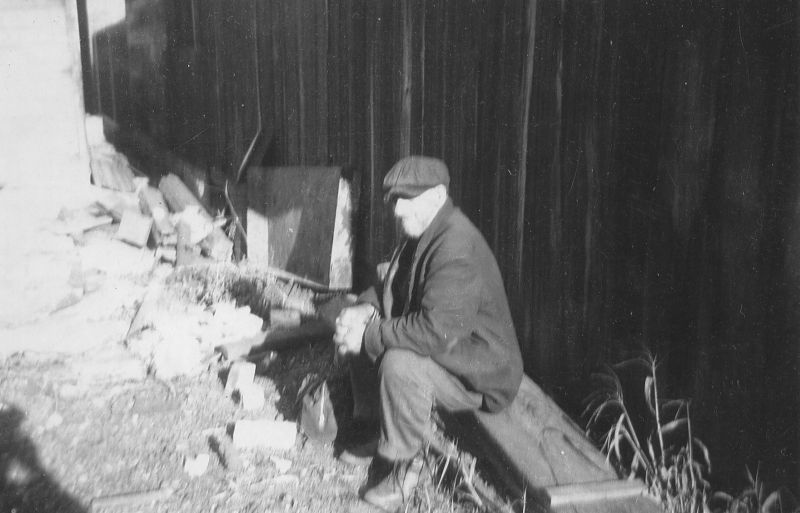 |
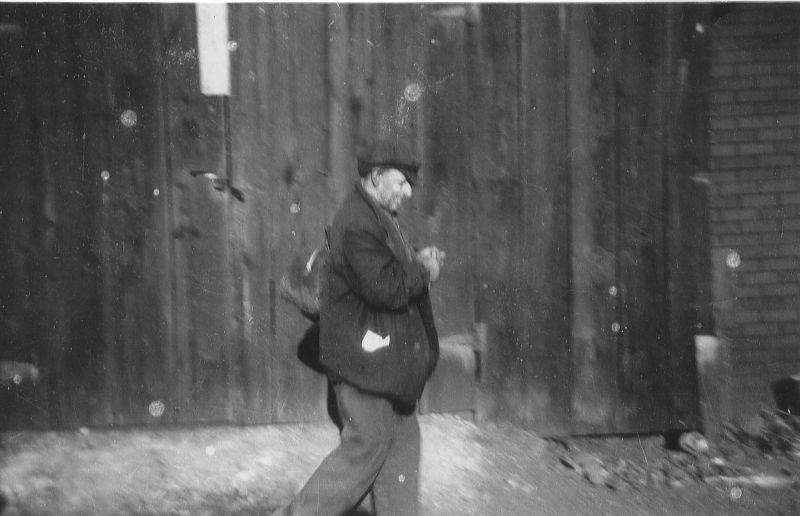 |
| From: Anthony Rock <rockin05tjuoutlook.com> Subject: Silogic genealogy website Shirley Newcombe Date sent: Tue, 11 Feb 2025 16:22:28 +0000 Hello, my name is Anthony Rock. I am Shirley’s cousin. I found some information about my family on your website about the Rock (larocca) family and my great great uncle Sully the hobo. Shirley recently passed away and I too have her interest in genealogy. Anyway, thank you for having that information on your website it was enjoyable to find and read. |
| From: Anthony Rock Subject: Re: Silogic genealogy website Shirley Newcombe Date sent: Tue, 11 Feb 2025 17:57:54 +0000 https://www.richesonfh.com/obituary/shirley-newcombe The information I have is only from the tree she already built. I have asked my dad about the Rock family history but he is known for fabricating stories and is generally unreliable besides a few uncles and aunts. Anytime you ask about the family history he usually reverts to the same family stories about his dad and uncle drinking and singing and playing guitar and other stories. My dad and his father did not have much contact. I probably saw my grandfather 10-20 times from 93-2015 when he died. So that adds difficulty to research. I never really thought to ask Melvin about the family before he died. I learned more about the rock family by finding the records Shirley attached to the tree. My dad won’t know much anyway because most of the family around what would be his grandfather were dead around the 1950s and he did not have much contact with his uncles or aunts outside of a couple and most of them died before or in the early 2000s Me 1993 Anthony My dad 1967 Joseph Rock His dad was 1947 Melvin Rock Melvin's dad was born in 1891 I believe Joseph Lawrence Rock But my dad told me Melvin did not think that Joseph was actually his dad because he “wasn’t like any of them” I don’t know if this is true or said in jest. I dont know anything about Sully beside what I found on your website. |
| Mark's note: with the above email, I learned that Shirley Newcombe died in 2022. She was Sully Rock's grandniece. Shirley A. Newcombe July 8, 1949 - June 24, 2022 Shirley A. Newcombe, nee Sanders, 72 of Marine, IL, formerly of Troy, IL, born Friday, July 8, 1949, in Pittsburgh, PA, died on June 24, 2022, at home surrounded by family. Shirley is reunited in heaven with the love of her life, her husband Bob. Mom loved with her whole heart and entire self. She was a very special, strong woman that will be missed more than words could ever express. Nothing was more important to her than family. Shirley was a retired beautician and homemaker, but most of all a loving, caring mother, grandmother and friend. Shirley was preceded in death by her husband Bobby C. Newcombe Sr, her parents Floyd Sanders and Mary, nee Rock, Sanders. Surviving are her children, Bobby C. Newcombe Jr. of Troy, IL, James (Tara) Newcombe of Troy, IL, Kevin (Angie) Newcombe of St. Louis, Mo. Her grandchildren Krista (Jenna), Sydney (Daniel), Brandon, Ashley (Gavin), Tyler (Nylynn), Grace (Tyler), Christian, and Harrison. Great Granddaughter Paisley, and many other family and friends. "There is no greater love than Family" Visitation for Shirley will be held 9:30 to 11 am on Wednesday, June 29, 2022 at Richeson Funeral Home, Troy, IL. Funeral services will be held 11 am Wednesday, June 29, 2022 at Richeson Funeral Home, Troy, IL with Pastor John Shaw officiating. Interment will be in Jefferson Barrack National Cemetery. RICHESON FUNERAL HOME, Troy, IL |
| From: "P.B.H.B.B. INC."
<pbtwins8gmail.com> Date sent: Sat, 13 May 2017 15:00:22 -0400 Subject: Dave DiPietro Hi Mark; My brother and I were raised in Hopewell Township. We went to Penn Technical Institute after high school by bus from Aliquippa. Our parents were raised in Aliquippa. Many of the pictures at your website are familiar to us. We are working on our family tree. Our sister married Joseph Baghetti son of Anna and Frank. Anna was from West Aliquippa and her maiden name was DiPietrantonio. She had 2 brothers John and Fred who changed their last name to DiPietro. Their parents were Fiore and Domenica DiGiovine. We noticed that you received a picture of Silvestri's Grocery from David DiPietro. He is the son of John DiPietro. We would like to get information regarding his grandmother Domenica specifically the name of her parents. Enclosed is an attachment with a picture of where our parents lived. It is Logstown which was a suburb of Aliquippa. It it was taken from across the river. Within the picture is the neighborhood school house. Fred had a son and his name is also Fred. Regards; Philip and Paul Babish |
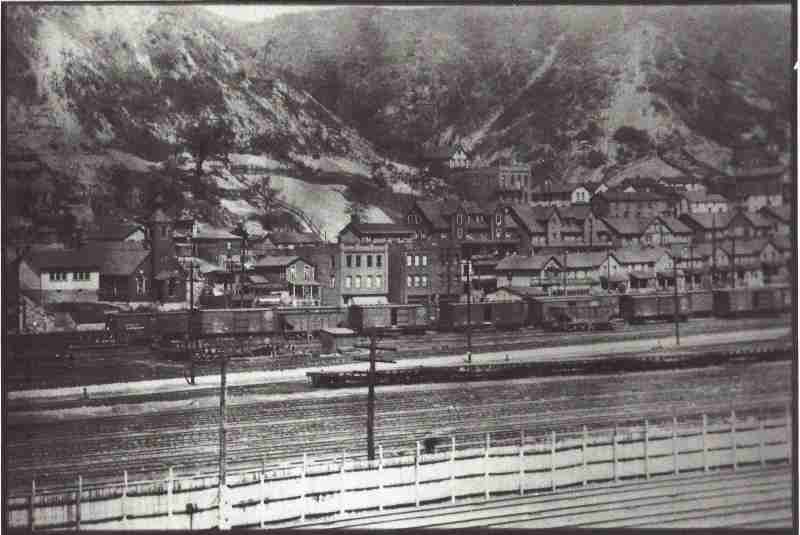 |
| From: Keenan Shaffer
<charitywrestlergmail.com> Date sent: Sat, 16 Sep 2017 03:31:20 -0700 Subject: My father... Mark, thank you for your attention. My name is Keenan Shaffer, 44, of Hopewell Twp. I found your site as I was searching for photos of the mill. Awesome site! I tried to post a comment asking if anyone reading might remember my dad, Lyle H. "Moe" Shaffer (1930-1989). He was a welder from the boiler shop, taught the welding apprenticeship for a few years and co-led the local and national rallies against LTV to convince the federal courts to restore the stolen pensions. Most people recognize or remember him because he was missing his left arm...lost it during the initial invasion into Korea from Japan in 1950 to start The Korean War. Not sure if you're still in the area; however, if you've driven near the Wye within the past 30 years, you might have noticed a life-size crucifix and Mother Mary standing to the left of the old guard shack at the outside end of the tunnel. It was put there by my dad, some of the other protesters and myself on the day of the first rally vs. LTV on Franklin Ave. If you'd like, I can send pics of my dad and the crucifix. I'm trying to have a plaque put at the Wye to remember the rallies. Thanks for reading, and take care. Best regards, Keenan Shaffer |
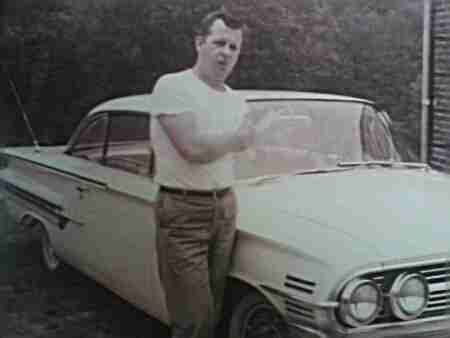 |
 |
I received these photos from Linda Opsatnik Fuller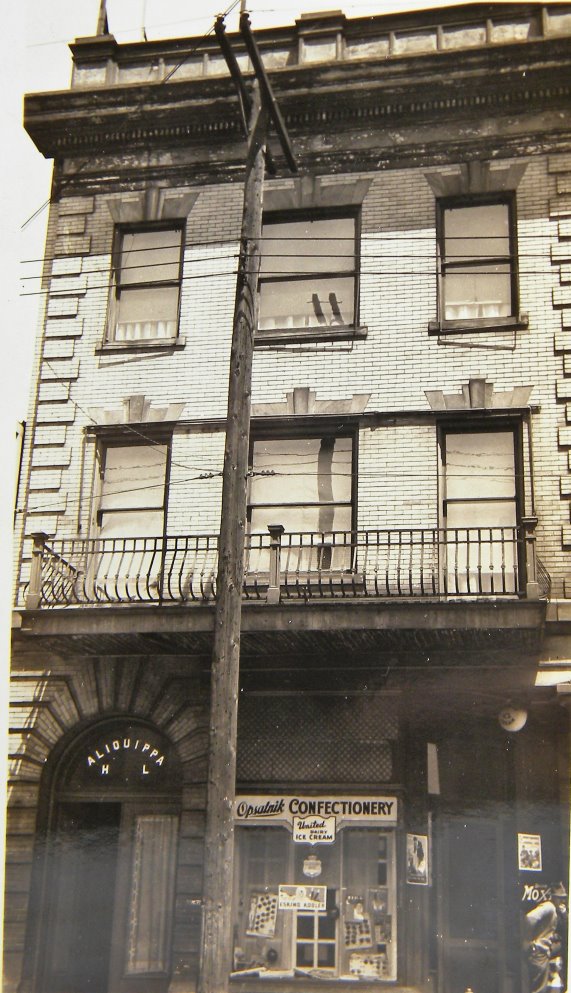 |
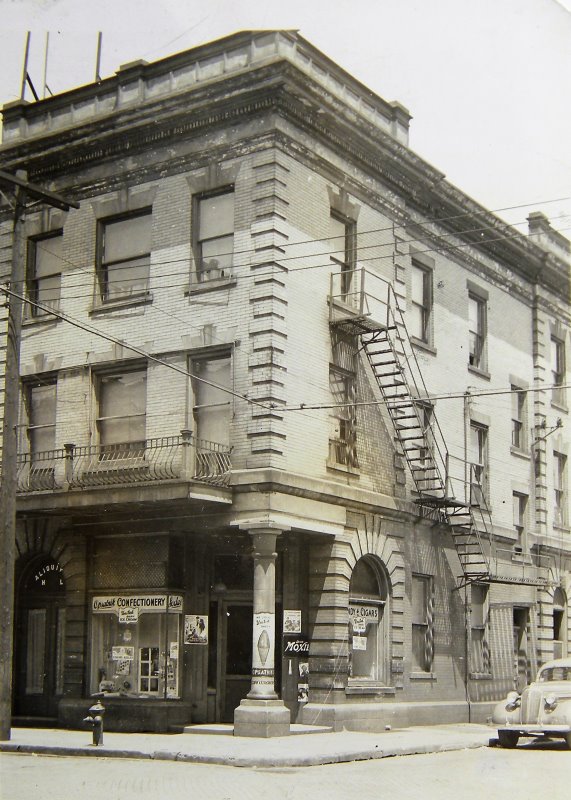 |
| From: Linda Fuller <lindakf27gmail.com> Date sent: Tue, 3 Apr 2018 16:34:36 -0500 Subject: West Aliquippa To: Mark DiVecchio <markd@silogic.com> Hello Mark, I'm from West, and I found your web site last year when I was researching my family's genealogy (the Opsatniks). About one-third of the way down on your Aliquippa page, I saw a discussion of the hotels in West; and I'd like to add to that discussion. I'm the daughter of Paul and Mary Opsatnik, owners of Opsatnik Confectionery at the corner of Third and Main (official address of 242 Main Ave.). I recently read an article in the Beaver County Times about the hotels there, which the writer listed as the Central Hotel, Connelly Hotel and Columbia Hotel. Last year, with the help of Beaver County's Recorder of Deeds, I got the complete history of my family's property. The Connelly Hotel was named when John J. Connelly of Mckeesport purchased it in 1907 or sometime thereafter. The property changed hands in 1919 and again in 1921 before being sold to my grandparents, Max and Anna Opsatnik, in 1928. (They had a coal-delivery business). That is probably when the building became Aliquippa Hotel with Opsatnik Confectionery as the business on the ground floor. Enclosed are two pictures from 1937 that show "Aliquippa Hotel" (with a few letters missing!) over the door. The building ceased to be a hotel at some point according to Census records I have showing my dad's siblings and their families living in the four apartments above the store. All traces of the Aliquippa Hotel sign were gone when I grew up there from 1949 through 1970. When my parents sold the property and moved away in 1978, it was razed in the early 1980s, I believe, and was a park for awhile. Recent photos show that businesses now occupy the area. Thank you so much for your wonderful site and all the photos anddiscussions with other natives of West. Please feel free to use the photos I've attached. Linda Opsatnik Fuller |
| Linda, Thanks for the info. I will add it to my web page, its great information about West Aliquippa. Did I know you in school in Aliquippa? I graduated in 1966. My sister Patricia in 1968 and sister Diane in 1970. I remember the Opsatnik name for sure. Mark |
| Hi Mark, Thanks for getting back to me! I have the 1965-67 yearbooks since I graduated in 1967. I saw your picture, it looked familiar, but I don't think our paths ever crossed. Did you end up becoming an electrical engineer? Didn't one of your uncles move to Las Vegas? My parents moved there, and after my father died I remember my mother telling me about one of the DiVecchios advising her about a financial matter. Unknown to me at the time, but soon thereafter she was diagnosed with Alzheimers and passed away in 2005. After that, my husband and I wanted to move back East, so here we are in Middle TN, about 90 miles southwest of Nashville. It's always nice to talk to someone from back home. TN is a far cry from The 'Burg, but the winters here are very mild. I heard your class had a really rocking 50-year reunion in 2016 with the Jaggerz! Did you go? I ended up not going to our 50th last year after looking forward to it. Anyway...it's always nice to talk to someone from back home. Thanks, Mark, Linda |
| Linda, I missed our 50th reunion. Just too far to travel from CA. I did become an electrical engineer. Mostly designing the electronics circuits for computers. Bill Dye and Bernie Carifo were a couple of good friends who graduated in 1967. Bill lives in NC. Bernie died a few years ago of cancer. Domenic DiVecchio was a cousin. He was the band director at AHS for many years but after I graduated. He moved to Las Vegas in the late 1980's to be near his daughter and died in 2004. My sister Diane still lives in the old family home in Aliquippa. I get back to see her every couple of years. She is a rabid sports fan and we have gone to Pens and Steelers games over the past few years. Next time, I'm aiming for a Pirates game. Mark |
| Date sent: Sun, 22 Mar 2020 21:50:29 +0000 (UTC) From: Tom Diaddigo <tdiaddigo yahoo.com>Subject: MPI Club Hi, Mark - I enjoyed your site about Aliquippa! I found it when I was searching for photos of the MPI Club on Plan 11 so that I could compile a history of my early days to pass on to my children. Lots of time on my hands these days during the 'lockdown'! I was born two blocks away from the club on Plan 11 in 1942. (I think you graduated with my younger brother John in 1966. I graduated in 1960). So far all I can find MPI-wise are photos after it moved to the Terrace. On Plan 11, the old site is now an empty lot. I wonder when it was demoolished, or indeed if it was demolished or burned or just dissolved. The nearby Quippian Club looks like it was bombed. Too bad Google Earth just shows things as they are now, and doesn't have a time machine built into it. Anyway, I'd like to ask you if you have any photos of the old MPI Club, which I always considered to be a fantastic structure. Bowling alleys in the basement. We watched fireworks from the top floor. Great memories, sad conclusion. Be well, young man Tom Diaddigo |
| Tom, Thanks for your email. I do remember your brother John. On my web page, I have class photos and he is in them. I've attached the only MPI related photo that I have. It does not show the MPI but the San Rocco parade heading toward it. Also attached is the email from the person that sent me the photo. (as an aside, my old family home is one house away from the current location of the MPI on Sheffield Terrace. My sister still lives there.) You might consider this web site for old aerial photos: https://www.historicaerials.com/ But it only shows roofs. You might also considering contacting the Beaver Valley Insdustrial Museum. I'm not sure if they would have anything but might be able to refer you somewhere. http://www.beavercountyindustrialmuseum.com/ If you find any photos (of the MPI or other Aliquippa scenes), I would be happy to put them on my web page. Mark Mark's note: here is the MPI photo and the email I received in 2010: |
| From: "J.Mark Palma" <ccmlasssssnet.com> Subject: RE: Hello from Mark Palma native of Aliquippa/ Re. West Aliquippa DiVecchio family web-site. Date: Mon, 30 Aug 2010 17:40:23 -0400 Hi Mark, Thanks for writing to me and explaining the West Aliquippa name conundrum. Dominic DiVecchio was a great teacher and mentor of mine when I lived in Aliquippa. We were both members of the MPIC band when it was located on Fourth Ave. Plan 11. As band director of the AHS band , he allowed me to sit-in with the band when I was in seventh grade. I was very grateful for his gesture. He and his friend Frank Musante played the trumpet very well. They both could wail. He was great at picking music that made the AHS band sound so great. What a great man. I don't have any recollection of the MPI club on Sheffield Terrace. My family moved from Aliquippa to Miami Florida in 1968. At that time, the club was still on Plan 11. I remember the Festa di San Anthony and the Festa di San Magno (Magnus) in West Aliquippa very well with Duffy Antonucci leading the procession. Duffy lived on Linmar very close to our home. He was a very colorful man (with his bowler hat and cigars) and a passionate supporter of the AHS football. He loved the Quips. Mark, you are correct; the people who emigrated to the USA from Italy had a much better life. When the MPIC would make plans to travel to Patrica, Italy, I would ask my grandparents if they would want to go back to see their old hometown. Their answer was always no. My Nonno Palma would say, " I did not leave anything back there but misery." Again, you are correct, people from Italy settled closest to their relatives and friends when they settled in the USA. I always enjoyed listening to the various Italian dialects. I have attached a picture of the San Rocco procession heading up 5th Ave. from St. Titus to the MPI club: circa1950's. I hope you enjoy it. Again, many thanks. Mark |
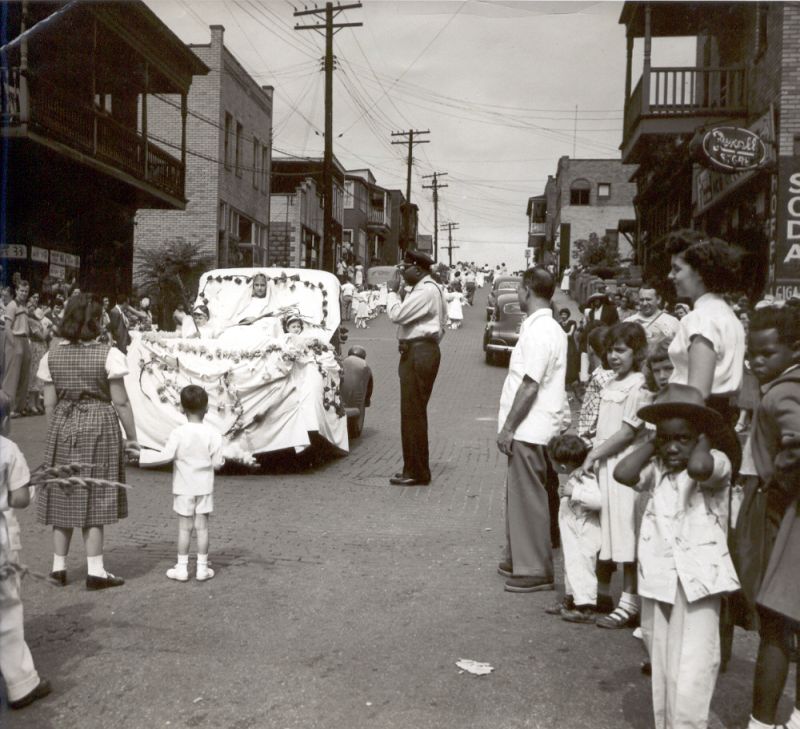 |
Fred Waters Store| From: Karl Sponholtz <ksponholtzhotmail.com> Subject: 347 Main Ave / Aliquippa Date sent: Tue, 10 Mar 2026 20:57:45 +0000 Hi Mark, I found your website in a search and thought you might like to see these photos that my grandparents had. Grandma wrote the note to her son (my dad) about where his father grew up. This was my great grandfather's business. I see from the current building that it was completed in 1909 (medallion at the top center) and so I'm guessing that the first photo was taken in 1910. I know that in the 1910 census the family was living above the store. Fred Walters (in the photo with his wife and oldest son) passed away in Nov 1912. The second photo is taken later - everything looks more worn and it looks like the light above the door has been changed to electric. I'm not sure when the second photo was taken - possibly 1915? I know that they had to close the business with prohibition coming, and that the family moved to Monaca by 1920 when his two oldest sons were working at the steel mill. Thanks, Karl |
 |
 |
| Karl, Thanks for your email. May I use the photos on my web page? I'm sure they will be of interest. There are a couple of other postcard photos on my page that show the building. Mark |
| Hi Mark, Yes, of course, you can use the photos - I hope to get some clues eventually about when their liquor business closed. I think it may have been sometime after Fred Sr. dies in Nov of 1912. I have a very peculiar obituary my grandma had in her things for him. He died in New Brighton, PA - on his death certificate is says he was a liquor dealer so that tracks, but the obit says he was a "well known hotel proprietor of this place (New Brighton)" and then lists his 7 children (all correct). I don't remember anything about a hotel - do you think it's a mis-print? You can use his photo here too. Also including a photo here of some kids in Aliquippa. My grandpa (Chuck Sr.) was born in 1906 and sister Margaret in 1899 so I'm guessing the photo is about 1910. The kids are all named on the back of the photo - I've found the names Swogger, Ciccone, Miller and Meyers all on the West Aliquippa Heritage Facebook page - maybe they are related? Feel free to post this too. Thanks again, Karl |
 |
 |
 |
 |
| Karl, I would say, with the obit, the comment about the hotel is correct. Interestingly, the web site "newspapers.com" has some references to Fred with regard to his liquor license. These show up in various newspapers and are notifications that his liquor license was granted: 13 Mar 1906 23 Mar 1908 21 Mar 1911 29 Mar 1912 Articles earlier or later not shown could only mean they were not in the newspaper, not that they didn't happen. Now if you really want to dig, Google has copies of the Beaver County newspapers. Here is one: https://news.google.com/newspapers In particular, this search, "Fred Walters Aliquippa", shows more liquor license dates for Fred: https://www.google.com/ and this one titled "More Hearings Had in License Court": https://books.google.com/books This one is the transfer of Fred's liquor license to his wife, Anna, just after his death: https://books.google.com/books This one is the closing of the liquor store in 1913: https://books.google.com/books Man Dies In An Ambluance https://books.google.com/books Just a font of the information. It will keep you busy for a long time. The Daily Times, published in Beaver, has issues that cover 1906 through the 1950's. The Beaver Falls Tribuine is covered from 1912 to 1928. Might be word of Fred's hotel. Let me know what you find and I'll make a section of my web page about Fred. Mark |
| Also - here's a close-up of the date the building was completed - 1909 Karl |
 |
| Wow, Mark - this is
amazing stuff! Yes, I will look a little deeper to try and solve
a few mysteries - this is a great resource. I'll let you know what I find. This is a part-time hobby so don't expect anything too soon - haha! Karl |
| Hi Mark, That's great - thanks for posting! In the newspaper archives, you found that the liquor license did transfer to his wife after his death - I was able to find that his son, Fred Jr. did apply to take over the license and business but was denied. With this, I'd guess that second photo was taken earlier - probably 1912. 1913 Feb 4 / The Daily Times / wholesale liquor license / application filed for the year commencing 1913 Apr 1 / Fred Walters Jr. - he is 22 years old and applies for the liquor license to continue the family business. 1913 Mar 2 / The Daily Times / The case is heard for Fred Jr. to protect the liquor license for himself that is currently held by his mother, Anna (reported in the Daily Times the following day). The license had been transferred to her in Dec 1912 after her husband's death. The news article states that the application was ultimately denied. Regarding the obituary, I found no evidence of hotel ownership - but I did find that the words "hotel proprietor," were used politely in place of "liquor dealer" during the time leading up to prohibition. Thanks again for your help - best of luck to you! Karl |
email : markd@silogic.com
DiVecchio
HOME
Frazzini
HOME
Site HOME
Join our Sant'Eufemia a Maiella email mailing list here :
https://groups.google.com/d/forum/santeufemiaamaiella
If you can help with the expenses to develop this web site:

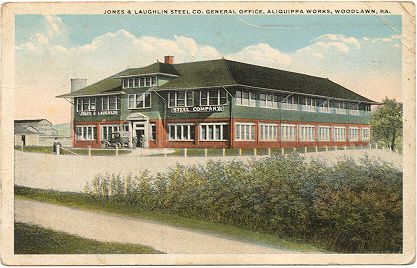
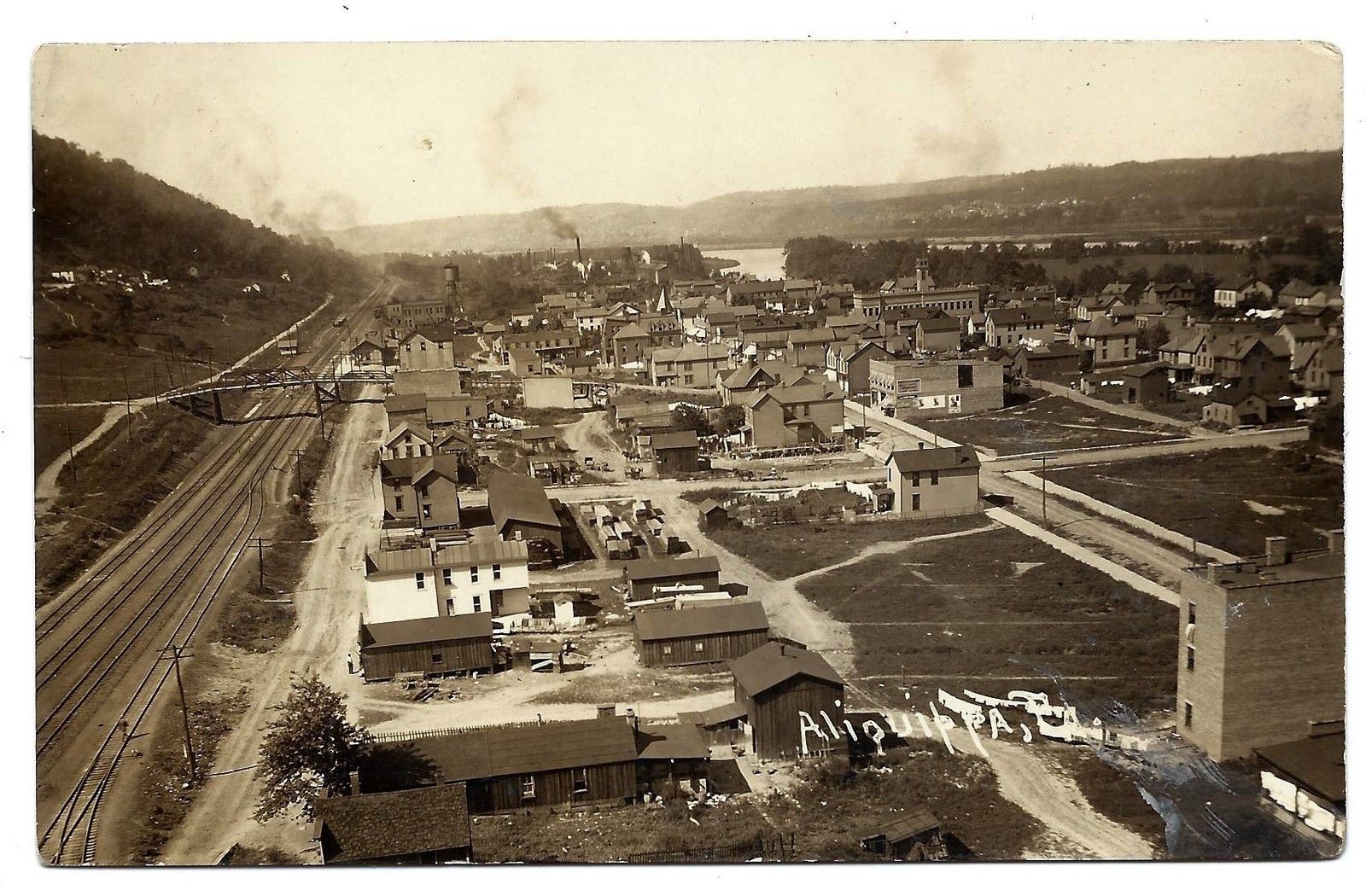 1910 Looking North, Aliquippa, PA