| Patrick Stakem | PS08 | pstakem loyola.edu |
![]()
Professor Patrick H. Stakem - Linux in Space Presentation - Sheffield October 2003
|
| Mark DiVecchio | MD05 | markd silogic.com |
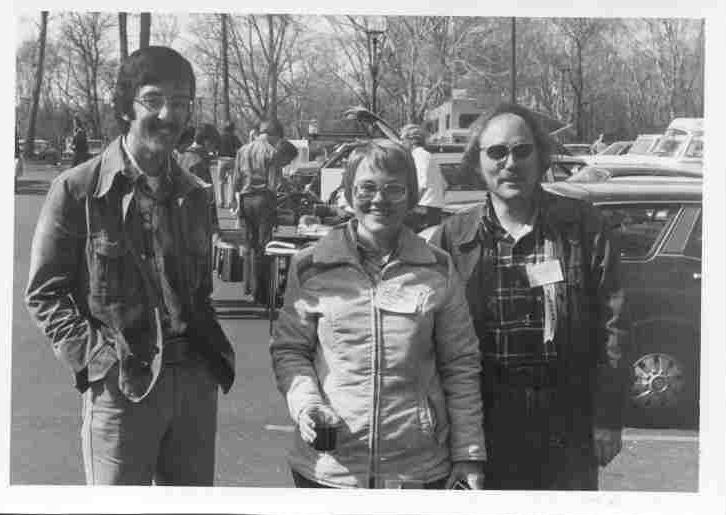
Its Mark on the left in this 1978(?) photo. |
| Joel Platt | See below for 1967 photo. | ||
| Chris Hausler | JH37 | jchausler earthlink.net |
Its Chris on the right in this 1978(?) photo. |
| Charlie Putney | CP05 | chputney gmail.com |
|
| Lauston Stephens | LS28 | Ls28 aol.com |
![]() Taken at son, Micah's, wedding Sep 2003. |
| Dave Vavra | DV03 | davavra verizon.net |
|
| Dave Rodgers | DR04 | drodgers agami.comdave_rodgers msn.com (best) |
![]()
From http://www.agami.com
See below for 1967 photo. |
| Glenn Sembroski | GS33 | sembrosk physics.purdue.edu |
|
| John Yurkon | JY08 | yurkon msu.edu |
|
| Jim Pollock | JP40 | ![]() From last contact that I had with Jim - about 1972 |
|
| Walt Sullivan | |||
| Dale Dewey | ded rochester.rr.com |
![]() |
|
| Ken Corbin | |||
| Tom Englesiepen |
| H. Roy Engehausen | HE01 | r.engehausen gmail.com |
Here is a photo of Roy and me taken about 1966 (from my genealogy web page) |
| David Chou | DC08 | dchou u.washington.edu |
Dave worked in the Comp Center. He sent me scans of several G-21 manuals. Links to those manuals are in the G-21 section of this page. |
| Bob McFarland | RM08 | rm08 alumni.carnegiemellon.edu |
Bob, Dave Vavra and I worked together during 1970-71 at Management Science Associates. We were PDP-8 programmers for the scoreboard at Three Rivers Stadium in Pittsburgh and for the passenger information sign system for the Bay Area Rapid Transit System in San Francisco. |
|
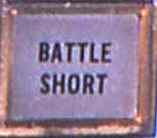
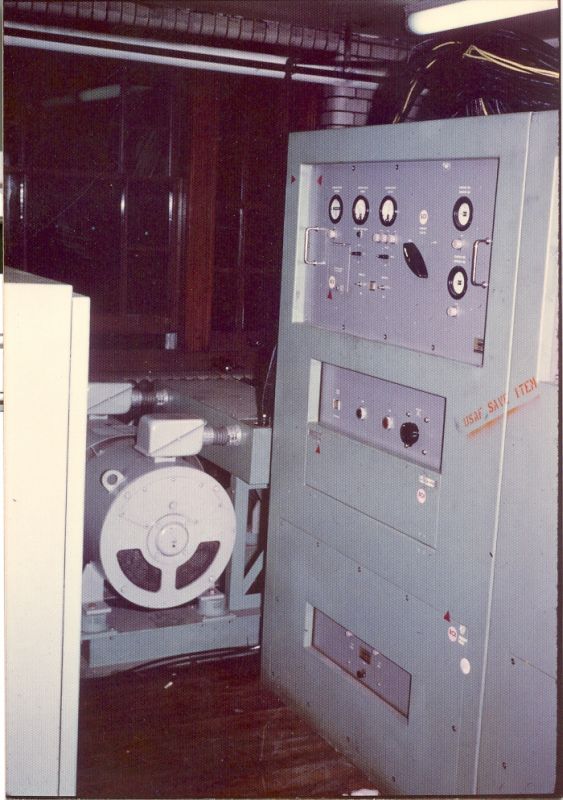
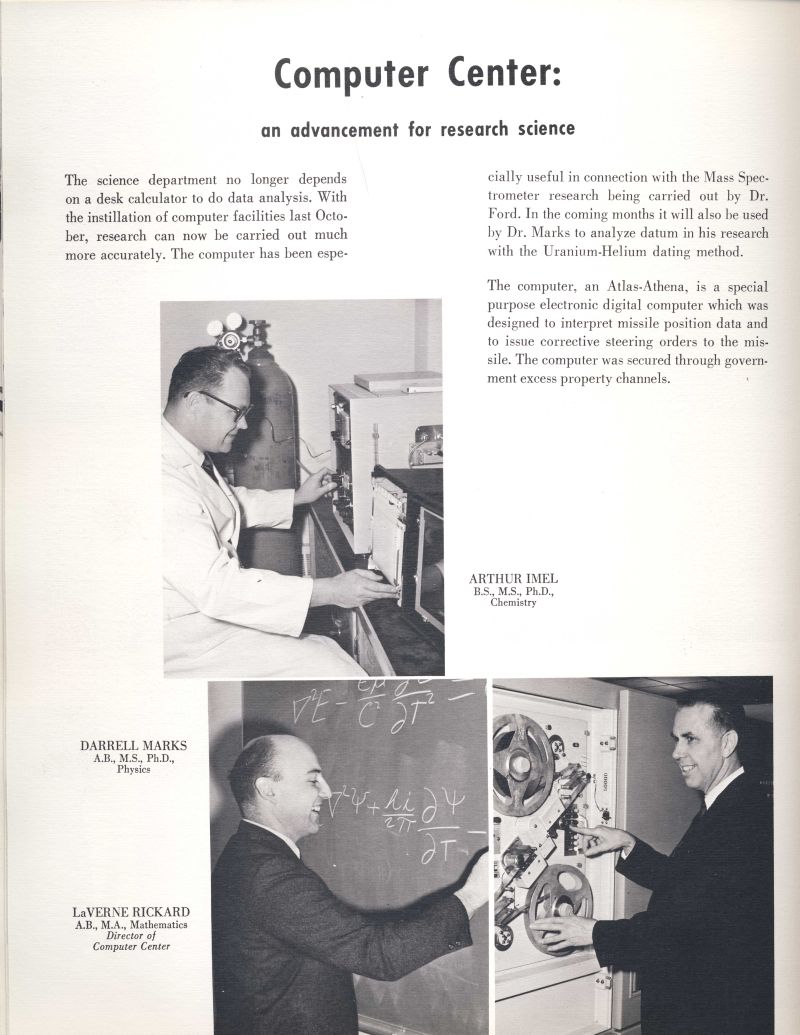
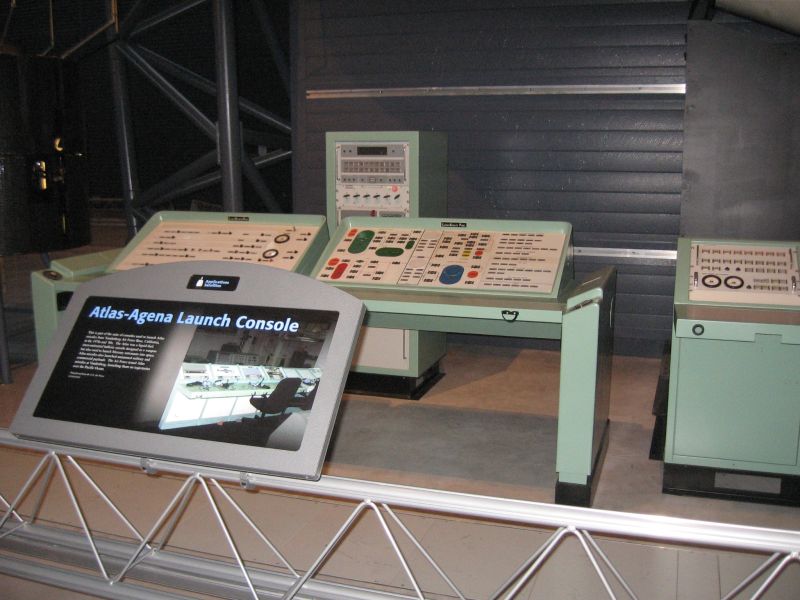
The Athena cost about $1,800,000. when new, and weighed over 18,000 lbs when shipped. It spent most of its operational life at a missile silo. It was built by Sperry Rand/Univac, for support of the Titan missile. The computer, declared surplus by the Federal Government, went to Carnegie Tech via the Pennsylvania Bureau of Surplus Federal Property. It was used as an undergrad project until 1971, when the former EE undergrad students (Athena Systems Development Group) orchestrated its donation to the Smithsonian. It joined a sister unit, the Atlas Mod I Guidance Computer, at the Smithsonian. The architecture was Harvard; separate data and instruction memories were used. A Frieden terminal with paper tape equipment was used with the Athena, as well as an operating console. An interesting feature, mentioned in the CalPoly section, is the mode "BattleShort". In this mode, referred to as melt-before-fail, the power to the machine could NOT be shut off. The Athena used a massive motor-generator set with 440 volt 3 phase AC input. I hooked this up from the lab mains, and got the generator set going initially. When the generator was started, the building lights dimmed, and there was no question that the machine was on. The motor generator control unit (seen behind the console) weighed a ton, and the motor/generator itself weighed over 2 tons. The last launch supported by an Athena computer was a Thor-Agena missile launched in 1972 from Vandenberg AFB in California. It was used on over 400 missile flights. |
Unisys History NewsletterVolume 3, Number 4August 1999 Sperry Rand Military Computers 1957-1975by George GrayAlthough many of the computers of the 1940s were developed as military projects, the use of vacuum tubes made them too big and unreliable for incorporation into actual weapons systems. The Eckert-Mauchly Computer Corporation built the BINAC in 1949 for Northrop Aircraft, but no one seriously expected it to be put into an airplane. The massive SAGE (semi-automatic ground environment) system built by IBM during the 1950s for the North American air defense system was for command and control, not for missile guidance. When vacuum tubes were replaced by transistors, it became possible to have computers of smaller size and greater reliability. The transistor was invented at Bell Laboratories in 1948, but it took several years of development to become suitable for use in computers. Bell Labs built the first transistor computer, the TRADIC (Transistor Digital Computer), for the Air Force in 1954. It used 700 point-contact transistors and 10,000 germanium diodes. (A diode is an electronic device which allows current to flow in only one direction.) Both of the two major computer development groups (St. Paul and Philadelphia) at Sperry Rand became involved in early transistor computer projects. Philadelphia became embroiled in the long and costly LARC supercomputer project for the Atomic Energy Commission. St. Paul, building on its early work for the Navy, became heavily involved in military projects. AthenaSt. Paul made its first venture into transistors with the Athena ground guidance computer for the Air Force's Titan intercontinental ballistic missile (ICBM). A ground guidance computer, as the name indicates, stayed on the ground and transmitted instructions to the missile. The Athena's designers had a choice of technologies. During the early 1950s there was a period of time when the magnetic amplifier, which was eventually used in the UNIVAC Solid State computer, was a serious rival to the transistor. One of the first proposed designs of the Philadelphia division's LARC computer used amplifiers, but they were soon rejected as being too slow for a machine which had to be very fast. At St. Paul, the lead computer designer for the Athena project, Seymour Cray, directed the construction of two prototypes. The Magnetic Switch Test Computer (MAGTEC) used magnetic cores, while the Transistor Test Computer (TRANSTEC) used transistors. They had identical instruction sets. Two versions of the MAGTEC were built; both had magnetic core circuits on plug-in cards less than three inches square which were mounted on racks. There were two models of the TRANSTEC, which had transistor circuits on its plug-in cards. The TRANSTEC II had 4,096 24-bit words of memory. After thorough testing, Cray was satisfied that transistors were superior and would be reliable enough to meet the stringent requirements in the Athena contract.The Athena computer had 256 words of 24-bit core memory to be used as a data work area and an 8192-word drum for the storage of the program and data items which did not change (constants). The Athena was completed in 1957. It occupied 370 square feet and weighed 21,000 pounds. Once in service, it was found to have a mean time to failure of 48 days, twenty times better than the original specifications. Since the late 1950s were the time of the perceived "missile gap" between the U.S. and the Soviet Union, the U.S. Air Force deployed the liquid fuel Titan as an interim measure pending the completion of the solid fuel Minuteman ICBM. St. Paul delivered 23 Athena computers to Air Force sites by the mid-1960s. In the late 1960s, the Air Force gave one of the original Athena computers to the electrical engineering department of Carnegie Mellon University. It was used for various class projects and later donated to the Smithsonian Institution. BogartSt. Paul's original customers, the nation's cryptologists at the National Security Agency, wanted machines more powerful and versatile than the Atlas I (UNIVAC 1101) and II (UNIVAC 1103) to process text and look for patterns, a task which they called data editing. This led to a secret project for the Bogart computer, a code name which supposedly referred to a then famous newspaper editor, John B. Bogart. At other times the computer was referred to as the X308. Once the computer was completed the secrecy was not so great as to preclude a presentation on it at a 1957 Association for Computing Machinery conference in Los Angeles. The design team was led by Seymour Cray. The processor logic circuits did not use transistors, but a combination of diodes and magnetic cores, so it can be viewed as a further development of the MAGTEC. The instruction word was made up of a six-bit operation code, a three-bit field to indicate the use of index registers, and a 15-bit memory address. The memory address was in turn composed of a 12-bit address followed by three bits which gave the capability of addressing any of the three 8-bit characters in the word (partial-word addressing). There were three arithmetic registers and seven index registers. The Bogart had 4096 words of 24-bit core memory, the maximum which could be addressed in 12 bits. The memory system was designed by Cray and Sidney Rubens of St. Paul in conjunction with Jacob Randmer of Norwalk and was manufactured at Norwalk. The Bogart's central processing unit weighed 3000 pounds and occupied 22 square feet of floor space, a considerable reduction in size and weight from comparable vacuum tube machines. The prototype Bogart was completed in September 1956 and tested for ten months. The four production models of the Bogart were delivered between July 1957 and January 1958. Later the NSA wanted another one, so the prototype model was given some finishing touches and delivered in December 1959. It was used in ROB ROY, an early NSA test of the remote job entry (RJE) concept. After he left Sperry Rand in late 1957, Cray used much of the logic design from the Bogart in his first computer at Control Data Corporation, the 1604, which was completed in January 1960. |
CIT Student-produced documentation (list from Pat):
Athena Console User's Manual, 1970
A Technical Description of the New Monitor, 1971
Using the Athena Assembler, 1970/71
| Date: Fri, 11 Apr 2008 23:28:26 -0700 From: Roy <r.engehausen gmail.com>James Pollock worked for IBM San Jose for a number of years. I think I last saw him in 2002 or so. He is not listed in the San Jose employee directory that I can access. It may be an unlisted entry. However, IBM San Jose is a shadow of its former self. The disk division was all sold to Hitachi around that time and that is where he worked. |
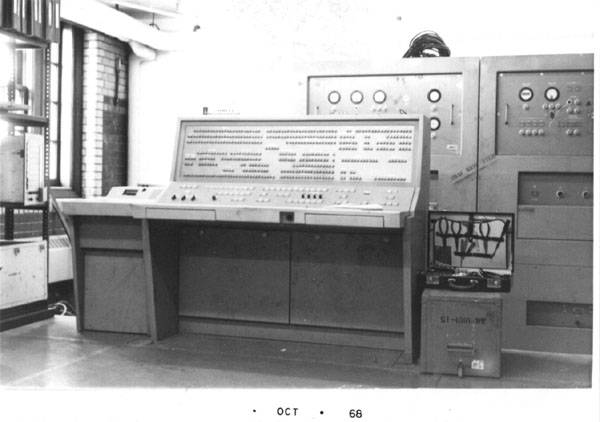
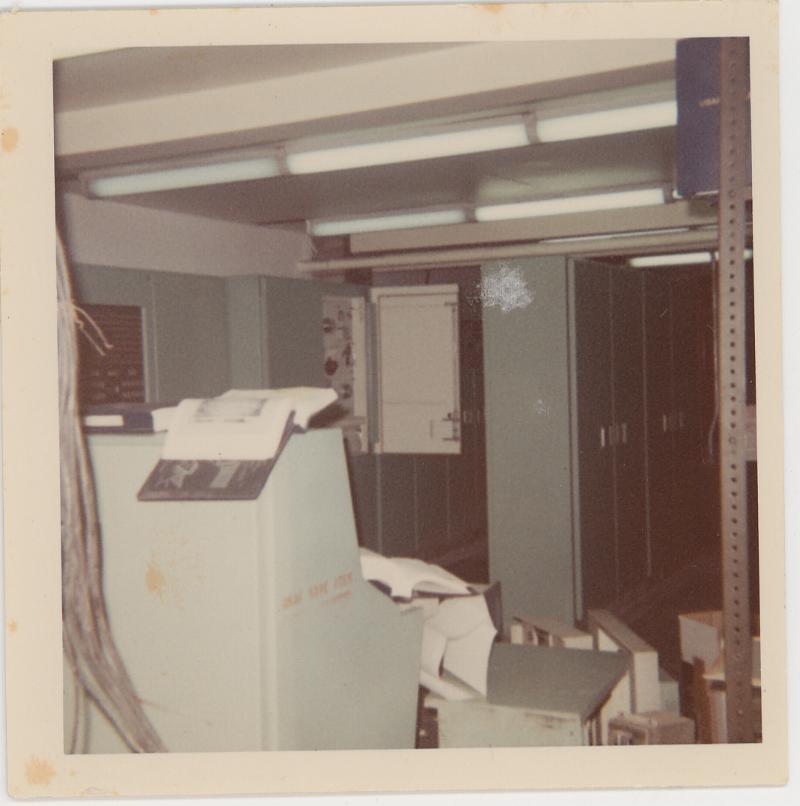
Oldest photo we have. Taken by Patrick Stakem soon after the Athena was installed at CMU. This is in room 55A of Hamerschlag Hall on the CMU campus.
Pat may have more taken at the same time. He wrote:![]() |
| 1968 October - Athena installed at CMU. This was before the computer was modified to give it more general purpose functionality. |

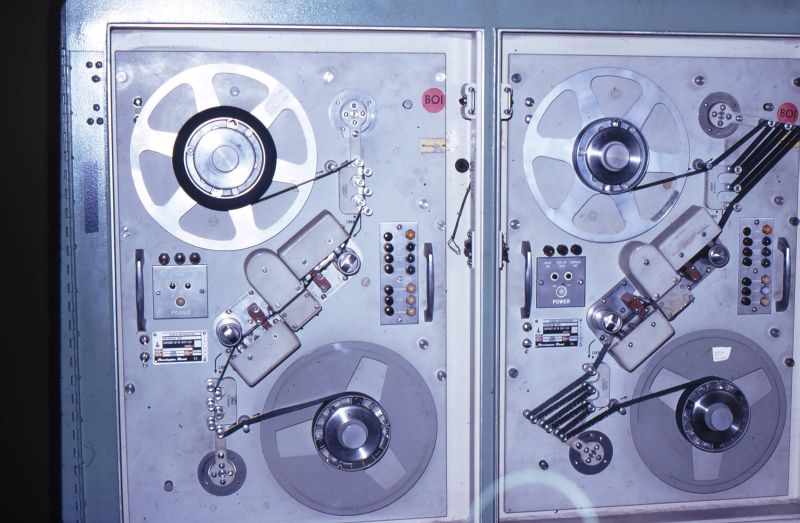
| Date: Sat, 12 Apr 2008 10:07:10 -0700 From: Roy <r.engehausen gmail.com>Subject: Mark's web page From the web page Pat wrote: "My understanding was that the Dept. Head (and I can't remember his name, preceded Jordan) had this thing for surplus stuff, and that's why we had the Bogart, the Athena, the big lathe that broke the granite steps, etc." The answer is Everard M. Williams A great web page including a picture of the G-21 tape drives : http://www.ece.cmu.edu/visitor/history.html |
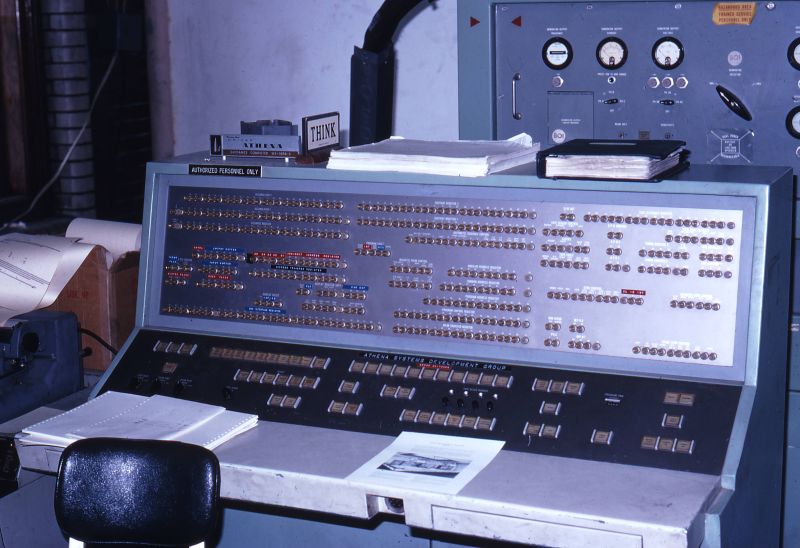
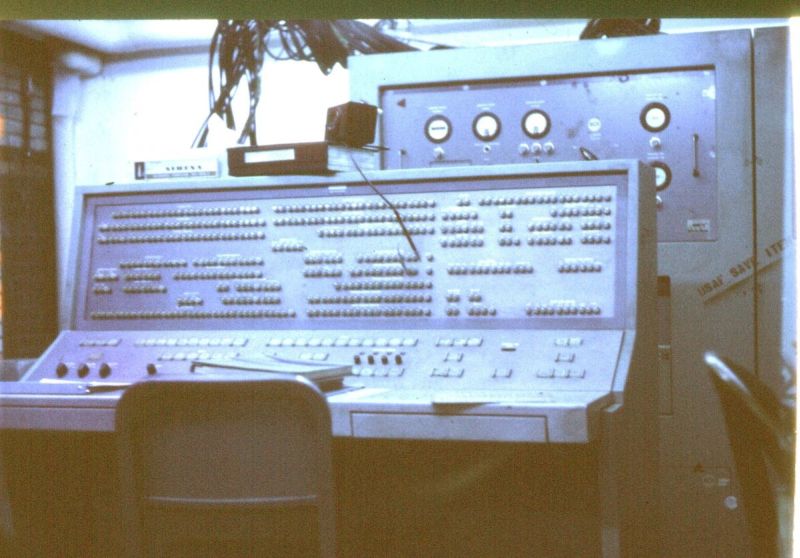
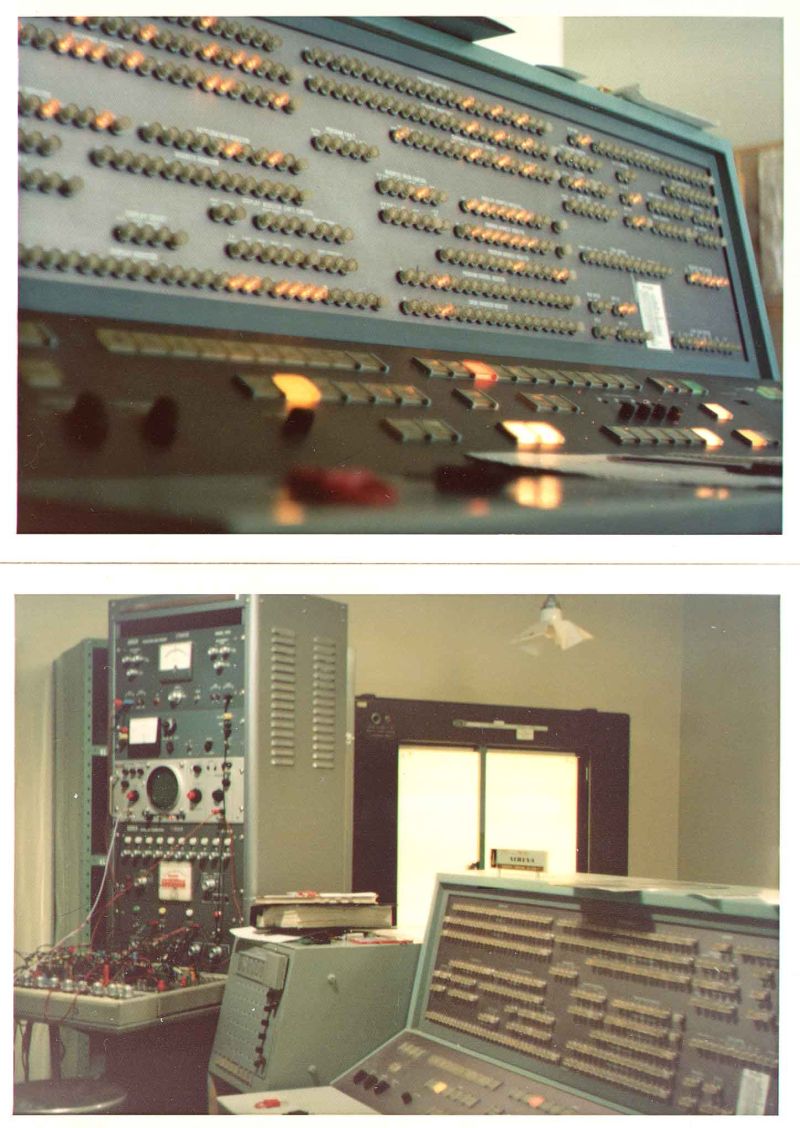
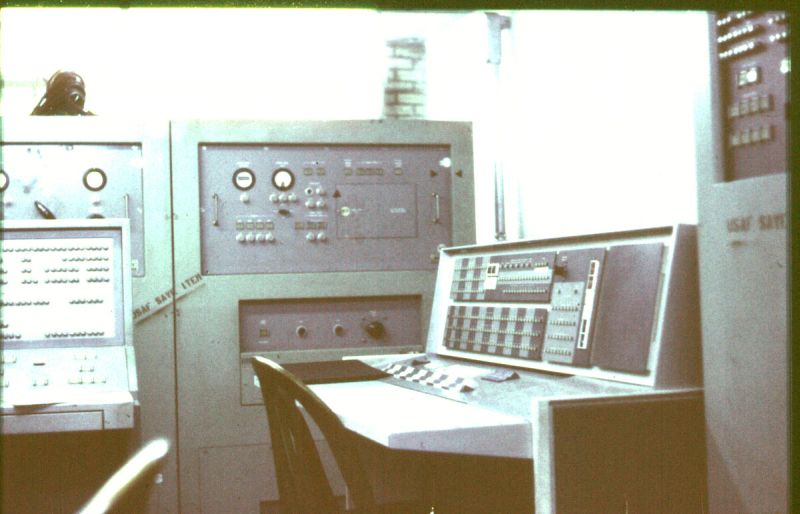
Control console
about 1971
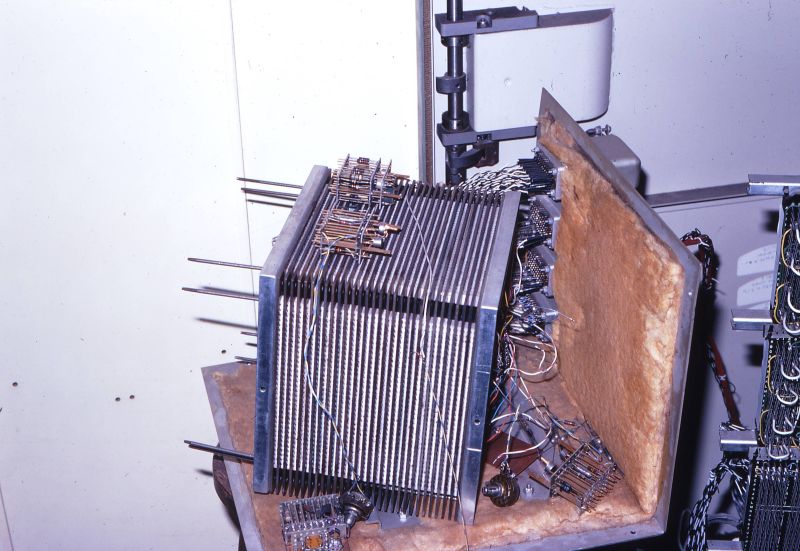
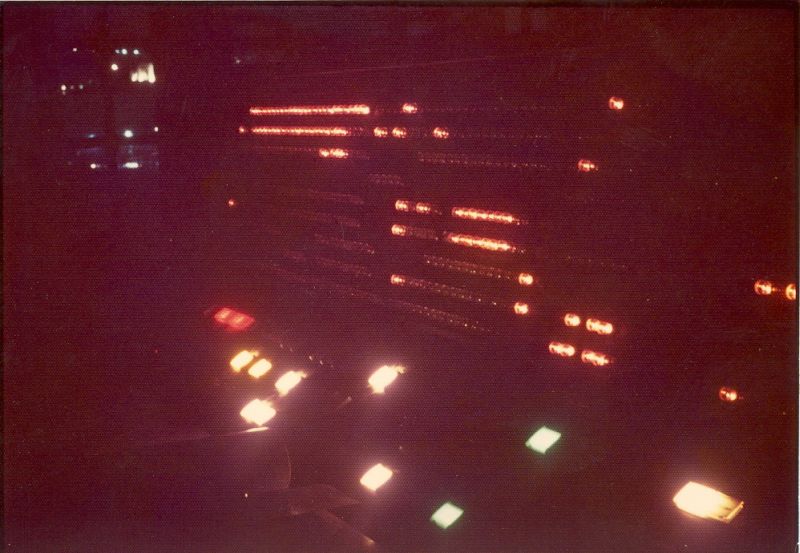
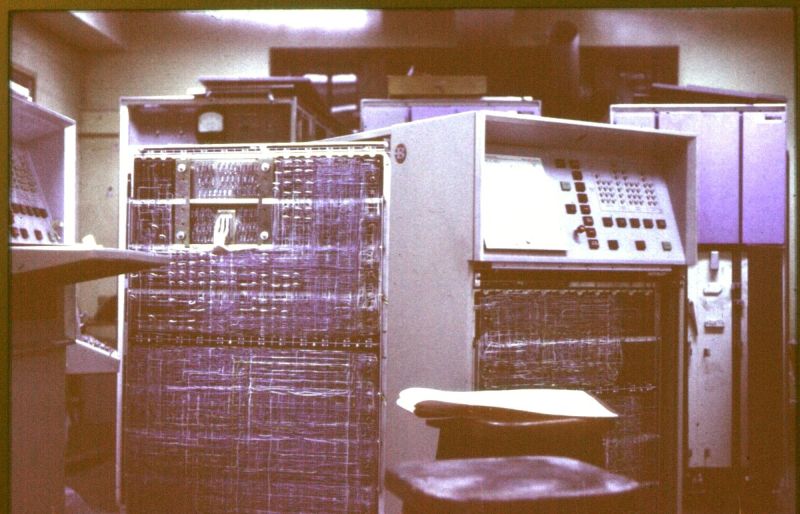
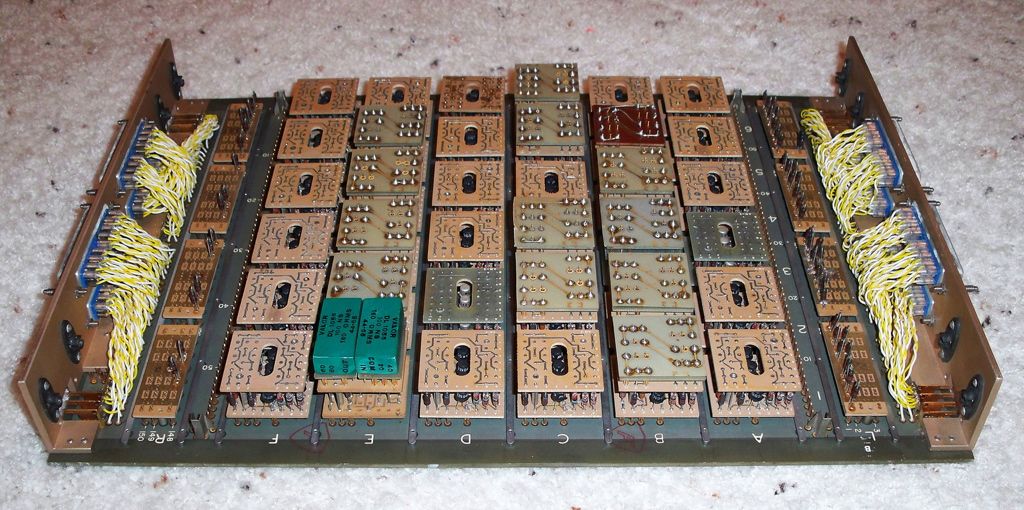
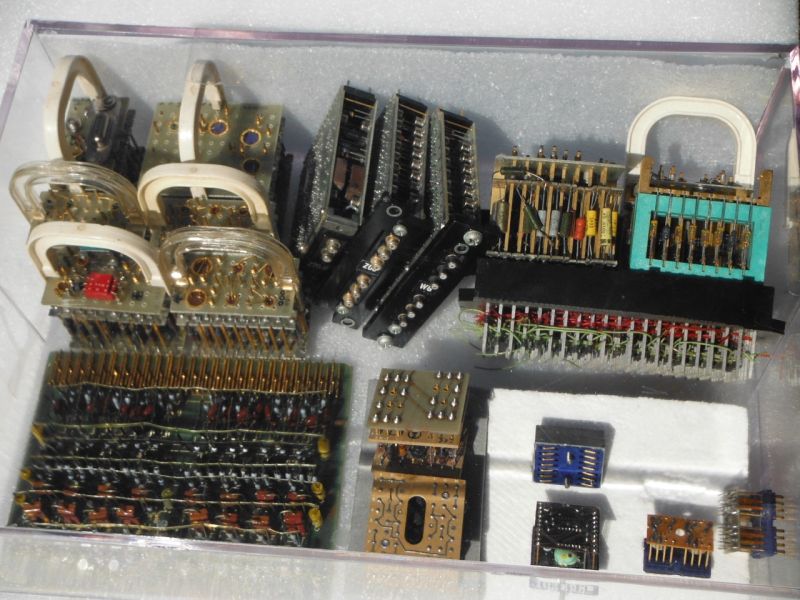
IIRC every bit in every register appeared on the console. Each register had one clear button on the end and each bit could be individually set by pressing the lamp for that bit which was also a pushbutton.Typical circuit cabinet showing the logic modules. Each of these metal modules was replaceable. Each contained a small number of logic elements. Like 2 flip-flops or 4 AND gates. Similar to the first generation of IC's. Photo taken about 1971.
John Yurkon wrote:
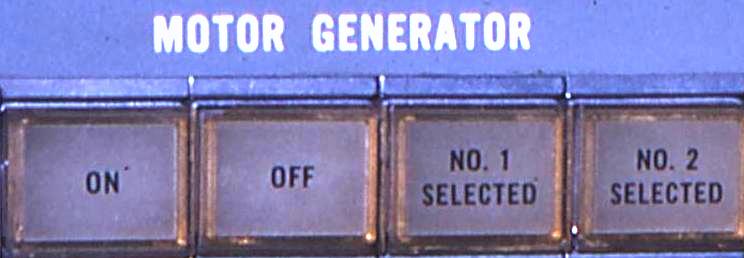
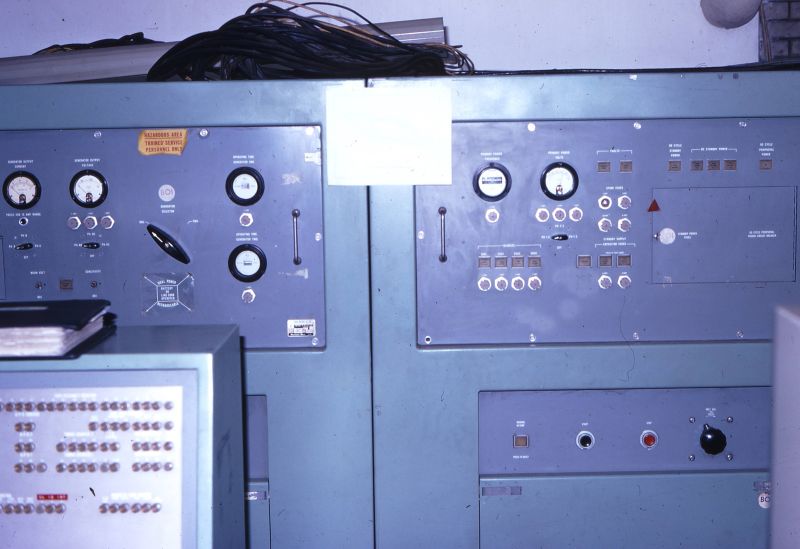
"One detail that isn't on the web page, but perhaps is in the manual, is that the transistor circuits were in cans pressurized with argon to keep the computer running under the most adverse conditions."Motor Generator Unit
about 1971
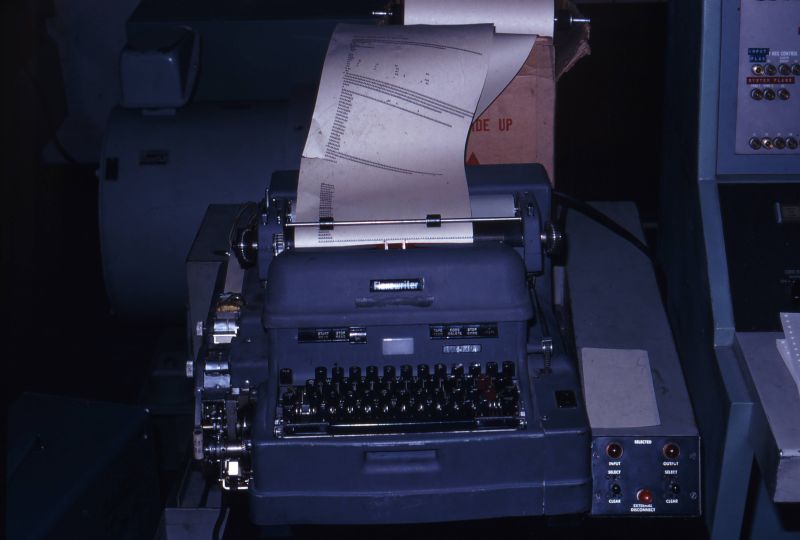
This teletypwriter was added by ??. A Frieden Flexowriter. It was the only human interface device (besides the lights on the console. Originally, the Athena came with an adding machine type of very simple output device. This Flexowriter came from the Bogart computer which was also given to Carnegie. Photo taken about 1971. Constants Unit.This could hold 8 constants which could be read by a running program.
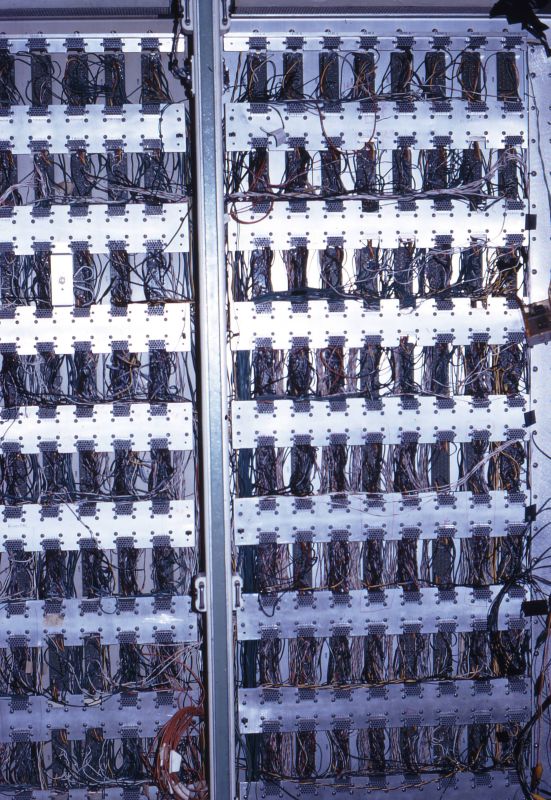
Typical backpanel wiring in the one of the cabinets. Photo taken about 1971. Date: Sat, 15 Sep 2007 21:33:39 -0400
From: John E Yurkon <yurkonmsu.edu>
My involvement was helping to finish connecting the units and diagnosing why the RAM wasn't working. That turned out to be simply one unconnected power supply cable.
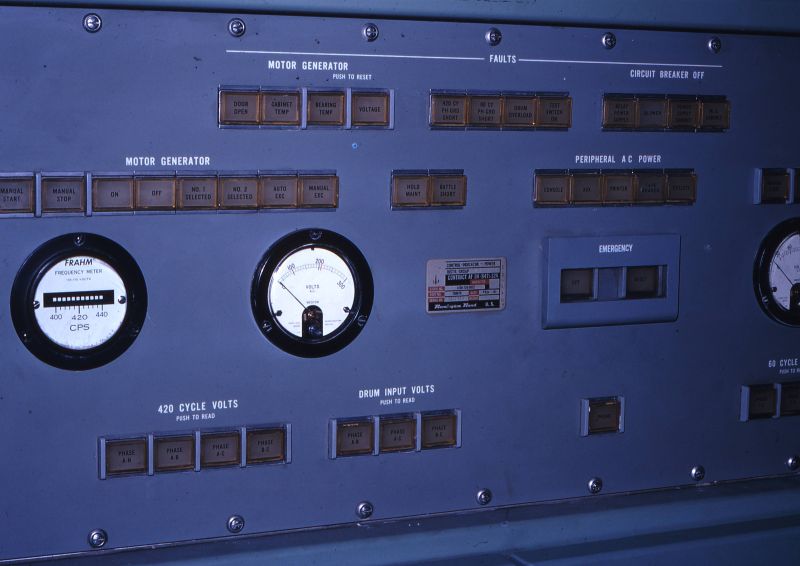
JohnControl unit for the Motor Generator
Photo taken about 1971. Power controlRight in the middle is the famous "Battle Short" button. The Athena ran on 208VAC 420 CPS (Hertz).
Photo taken about 1971.
Date: Sat, 15 Sep 2007 14:11:30 -0700
From: David Rodgers <dave_rodgersmsn.com>
Mark, et al.,
I started working on Athena when it first arrived: cables cut by ax, documents in disarray. We first figured out how to power the MG set and learned not to press the "battle short" button. Regards to all,
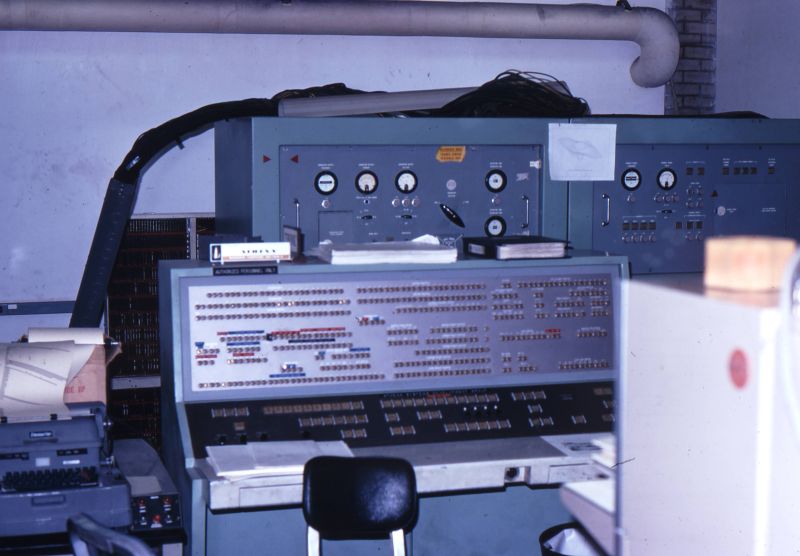
DaveAnother view of the console along with the Motor Generator control unit. Photo taken about 1971. John Yurkon wrote:
"Charlie, perhaps along with others, wrote a prime number generator for it. Writing any code for it was a chore because the speed of the magnetic drum was fast enough that it would pass by the next address before an instruction would complete. So, to maximize the use of the limited instruction space you'd have to sort of interleave the code and make sure you knew how long an instruction would take."
The raised floor of the Athena. The first cabinet on the left was the paper tape readers. Photo taken about 1971.
Glenn wrote:
"I just looked at the site. Very very cool. I think the Burroughs computer was a B280. I have a couple of logic modules from it and a memory stack stuck away in storage some place. When I have time I'll send more info. For instance, I was the one who "decabled" the Athena so it could be taken apart and loaded on the moving trucks to the Smithsonian. That was a job that took me a good part of the summer (1972)."Paper tape readers. This loaded programs into the 8K of drum memory. I originally wrote here that these were magnetic tape readers. Lauston wrote:
Mark, et al.,
The caption for the photo of the tape drive says, "Magnetic tape."
The manual says: "HIGH TEMP TAPE, DS123, figure 1-65, T,O. 21-SM6B-2D-6-1: Indicator Iamp which indicates a condition of high temperature in the perforated tape reader assembly". IIRC, it was originally paper tape, read by photo cells and sometimes there were light or oily spots on the tape that would get a false bit and could be corrected with marker. The tape in the picture is dark, but I think it is paper.I'm not sure what this set of wiring and connectors were for. The logic was some form of RTL logic. Inputs were all through resistors and you can add more resistors to make bigger OR gates. I think the blue modules were resistor packs (??). Output of the gates were wired NAND?? Is that right? I seem to recall that if you wired the outputs of the OR gates together, you got the NAND function. That made is possible to build logic using multiple OR gates feeding a NAND function. Is my memory correct on this? Photo taken about 1971. The console of the Burroughs B-250 that became attached to the Athena. A senior project by Jim Pollock. Photo taken about 1971.
Dave Vavra wrote:
"The Burroughs was a B-250 IIRC."Date: Sat, 15 Sep 2007 12:20:37 -0400
From: jchausler <jchauslerearthlink.net>
Subject: Re: Athena Systems Devlopment Group rulz!
Hi All,
What a blast from the past! Yes, Jim Pollock was the man who did the senior project. IIRC it was mostly built on a panel in the Burroughs B250 (yes it was a 250) which sat in the machine's cabinet on the front of the machine below the front panel. I recall helping to un-wire wrap the panel as I was sitting in front of the I/O desk in Scaife so Jim could do his circuit on. I recall that a number of folks helped with this effort. (I also recall the sore wrist I got doing this :-) I remember Pat Stakem and I leaving Jim drunk on the sidewalk waiting to be picked up for his flight back to California after graduation, the last I saw of Jim :-)
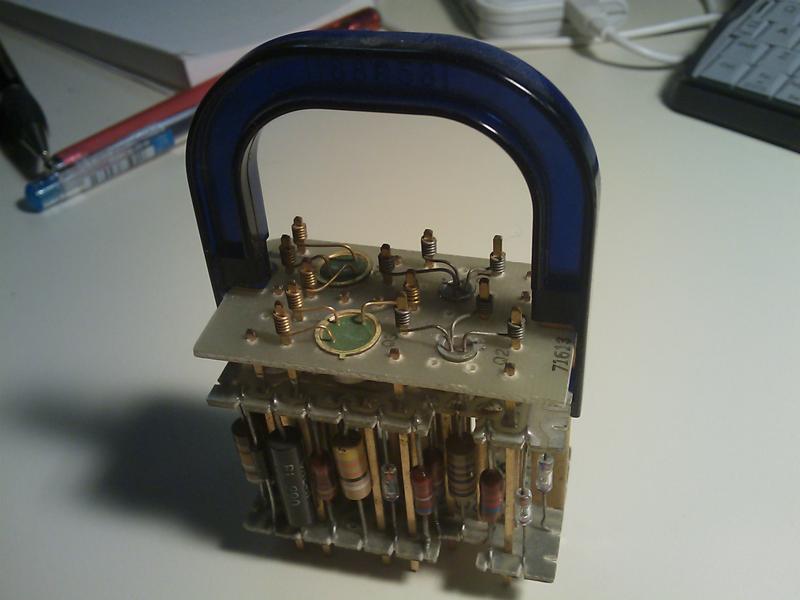
Although I have a fair amount of computer junk (junque, collectibles :-) from or about that period in my stash, the only Athena thing I have is one of those cordwood plug in modules from the B250, I believe a dual flop. From the late 1960's to the late 1970's it hung from the rear view mirror in whatever was my current car. Now, among some R series DEC modules, a single G-15 flop plug in (bought from Boston Computer Museum about 15 years ago) some DDP-516 modules and a few others, once a year it hangs from my Christmas tree :-) Other times it sits on the shelf in my family room among all the other trinkets.
About all I did for the Athena was to write what I believe was the initial "debug monitor" which used the Flexowriter as a console. The best I can describe this is that it was similar in concept to the early "debug ROMS" which came with some of the early micro-processors, like MIKBUG for the Motorola 6800. Anyway I called it "SHE" (somewhat helpful executive) and stealing a bit from the comp center named the associated routines "HER THINGS" (helpful executive routines, to help implement new and greater systems), the "things" part being what was stolen. Charley Putney (and yes, last I heard, he was in Ireland, I traded emails with him some years ago but seem to have lost his email address, he was working for Data Products IIRC at the time.) wrote an editor and assembler for the machine and I believe rewrote or expanded "SHE".
I seem to recall that over time there were sort of two groups, the initial group which included Dave Rogers and Walt Sullivan who installed the machine along with some others and then the later group with which I was more involved.
Remember the Flexowriter was something we added. The machine came with that little waist high box inside of which was what amounted to an adding machine with solenoids over each key. It would just print out numbers on (natch) a strip of adding machine tape. It was just used as a printer, its adding machine functions apparently being crippled or removed for the application.
Yes the Athena was installed in HH55. This was adjacent to HH53 where Gordon Bell had his office and the PDP-8 and G-15 were located.
The department head who tended to collect "junque" and got the Athena was Williams. I'd have to look up his first name. I believe he retired in 68 or 69. His replacement (one or more folks before Jordan) I recall did not like the Athena group and wanted it gone, I believe so he could expand (as was eventually done) the materials labs. Williams was also the one who got the IBM 7090 from Gulf Oil which sat in the halls for some time and whose motor generator set provided some entertainment for a few of us (remember turning it on the first time with the 10 foot pole from behind the HH53 door).
A fond memory I have of the Athena is the start up of the motor generator set. When running it just made a loud rushing air noise but sounded somewhat like a siren when starting up. I remember walking across campus in the middle of the night when things were otherwise quiet and even though the open windows in HH55 faced away from the campus (this was before we "stole" the air conditioner from HH53 after the G-15 had been removed) hearing the thing start up :-)
Ah, those were the days my friends, we thought they'd never end...
J. Chris Hausler
JH37I think this is the insides of the B-250, a Burroughs computer that was interfaced to the Athena. The interface design was was a senior project by Jim Pollock. It actually worked. The claim to fame of this Burroughs computer is that it did decimal arithmetic, not binary. Photo taken about 1971. This was core memory unit that Mark DiVecchio tried to add. It was his senior project. It never worked. The core, I believe, was from the Bogart. Photo taken about 1971. From the Bogart Programmers Manual:
1. Core Storage
× This storage can retain 4096 24-bit words, a total of 98,304 bits of information
× The Magnetic-core storage contains 24 planes. Each 10 inch plane is a 64 by 64 square array of 406 cores. Three of the four wires running through each core write information into the core and the fourth wire senses whether a 1 or a 0 is stored in the core.
× If the core is magnetized in one direction, a 1 is stored in it; and if it is magnetized in the reverse direction, a 0 is stored in it. Information read out by applying a current to the two read-out wires drives the core into its zero state. If a 1 is stored in the core, the magnetic direction-change induces a voltage in the read-out wire. By sensing the voltage on the read-out wire, it is possible to determine the previous magnetic state of the core.
× Since the read-out wire sets the core to the zero state, it is necessary for the memory circuits to restore the core to a one-state. If it contains a 1, this is the regeneration portion of the storage cycle. The total storage cycle of read-out and information regeneration takes 20 microseconds per word.
Date: Sun, 14 Jan 2007 21:09:58 -0500 (EST)
From: Ls28aol.com
Subject: Athena Systems Development Group
To: markdsilogic.com
Hello Mark,
You may not remember me. I was a freshman at CMU in 1968 and left in '69 when my dad died. I was part of the informal ASDG. (I wrote a routine to move code from one part of drum to another.) I was doing a little nostalgic surfing tonight and came across your website with the above e-mail address as well as your resume that states that you own or owned a business by the name, Athena Systems Development Group. Did you partner with or employ any of the others that were in the group at CMU? I see you kept in touch with Pat Stakem. I cannot put a face to the name, but I remember the name. On my last trip home from Pittsburgh, I stopped to see Charlie Putney, who was in a car accident on his way back to campus and was recuperating in a hospital at the time. Last I knew, he was in Texas.
It was interesting to learn that the Athena that was at CMU went to the Smithsonian. I also appreciated the photo you have of the console in your website. I imagined that the machine went for parts or scrap metal and was lost to history. I wonder if it is displayed or stored in DC. I was given the ID, LS28, for access to the other mainframes at CMU. In a field where things can be obsolete in less than 40 minutes, it amuses me to use an ID that is almost 40 years old.
After CMU, I worked for Applied Logic Corporation in Princeton, NJ, for 3 years. It was a time-sharing business with a national phone network. We used DEC PDP-10's for mainframes and PDP-8's for communication nodes. I moved to Vermont in '73 and have worked for a small, family-owned dairy for almost 31 years. When they decided to begin to use computers, I selected the desktop and wrote the applications (Paradox). There just wasn't anything on the market that
exactly fit our needs.
Cindy, my wife of 29 years, and I have four children. Our oldest, Andrew, is stationed at Camp Pendleton. We went to see him before he went to Iraq. We only saw San Diego in the dark because of the schedule for our flights in and out, but it seems like a nice city. Micah, our second, is in Ogden, Utah. Our daughter, Arla, is in Duluth, MN. We have yet to visit either of those places. Our youngest, Tim, is still home. We are a four time zone family.
No doubt this is much more information than you were hoping for when you got up this morning, but since you have much of your own on the Internet, I trust you value such things.
Cordially,
Lauston StephensLauston Stephens wrote:
Dear Mark,
Do you remember the name of the fella that implemented drum read, drum write and the interrupt on the Athena? He was from southern CA and, I believe, class of '69. He knew what he was doing and, as I recall, once did a little soldering without powering down the Athena. Being young and impressionable, I wanted to be just like him. There were some modules in the cabinet near the console on the window side of the room that were designed for I/O, relays or something along that line. Somehow, I was assigned/allowed to do a hardware modification in that area. No doubt, someone else wanted to do something else at the same time and I did some (poor) soldering with power up. Things did not work as expected. No doubt, I blew some components and have regretted my rashness ever since.
It's not like there were replacement parts at Radio Shack and plenty of money in the budget. Foul deed, I betrayed the trust granted me by my superiors and smote the goddess Athena a mortal blow.
Absolve me, Sir, for I am unworthy to speak of things Athenian.
Glenn Sembroski, class of '72, was my roommate for the fall semester of '69. He claimed that he had cracked the code for the Athena communicating with the Titan. I never asked him to show it to me and I don't know how substantial his claim was. There is a Glenn Sembroski at Purdue. It may be the same person. ITaP: Information Technology at Purdue
When a link is ready, as your page develops, there may be some things that come back to mind that I can contribute.
One possible page is the achievements of those in the group. You ran your own business and, if this is the same Glenn Sembroski, he has charted a stellar career. (Yes, pun intended.) There could be an argument here in support of such informal activities on campus. The engineers' answer to the dead poet society.
Lauston
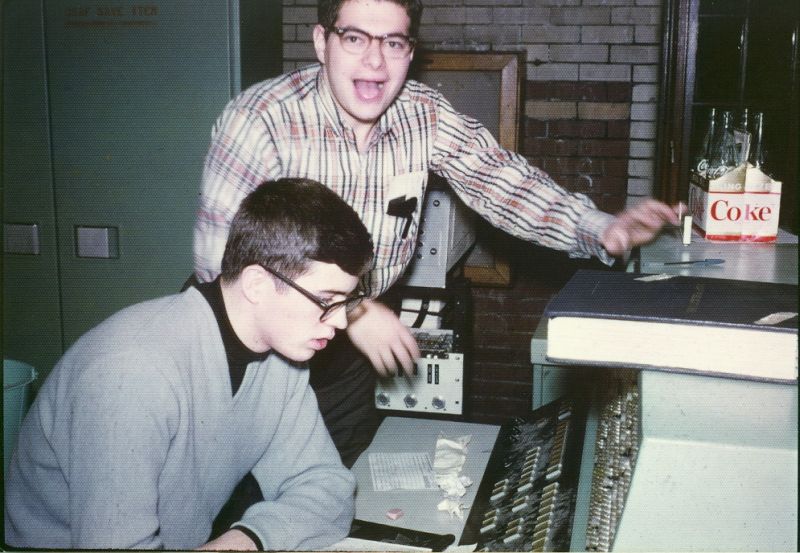
![]() 1967 Joel Platt and Dave Rodgers Dale (who took the above photo) wrote:
The time spent with the Athena was a lot of fun. Every time we walked into the room, something new happened. We often pulled all nighters just because there was a lot to find out about the machine. The picture of Dave and Joel at the console is a good example. This is the first time they actually got a simple program to run. Excited and puzzled all at once. |
| Date: Mon, 17 Sep 2007 18:27:20 -0400 From: Dale Dewey <ded rochester.rr.com>Subject: Athena Missle launch computer Hi Mark, Dave Rodgers just sent me your eMail address and says that you are interested in the Athena computer. I was one of the original EEs at CMU who moved the thing into the lab and started putting it together. Some of the stories I can tell are rather amusing. Like trying to get the 400Hz MG set up and running. They required 440V AC 60 Hz and all we had were some pole pigs and 220. Almost blacked out the entire campus when we put power to the transformers and had two wired incorrectly. Then there was the time it went into "battle lock" thinking a bird was in the air and we had no way of shutting it down without destroying everything. That took some trickery on our part. Anyway, I would be glad to contribute to your work. I have six slides (five good) which need to be scanned into jpeg. I have one which is a poor scan of a print that you might find amusing. This was taken in June of 1967. I know Dave is one of the guys. I think the other guy (mouth open) was named Joel and he ended up teaching at CMU. Not sure about that though. When I get the others, I will send them along as well. Dale |
| Date: Mon, 17 Sep 2007 16:25:44 -0700 From: David Rodgers <dave_rodgers msn.com>Subject: RE: Memories of Athena in pictures To: Dale Dewey <ded rochester.rr.com>Dale, I can see that the six-pack of 12 oz. Coke bottles is empty making the picture authentic! I'm pretty sure the other guy in Dale's photo is Joel Platt. Dave |
| Date: Thu, 20 Sep 2007 15:44:03 -0400 From: Dale Dewey <ded rochester.rr.com>Subject: More on the Athena Hi Mark, Thought I would sit down and capture some of my memories of the Athena. Attached are my ramblings. Feel free to edit and correct. I think this is fairly accurate but then it was 40 years ago. Some things change and others don't. More pictures. These are probably the earliest ones of the Athena when it arrived in early 1967. The date stamped on the slides I have is June 67, so the pictures were taken before then. If you would like the slides, you are welcome to them. Seems you are becoming our archivist. Yes, I also had a set of keys like yours. I remember the long flight of steps leading from the first floor down to the lower entrance. Dale |
My Memories of the Athenaby Dale Dewey, 20 Sep 2007:Wandering back in time to 1967, there were a few senior electrical engineers who had focused on digital electronics (aka computer science) rather than the popular analog/radio/material electronics that was main stream for the day. We were small in number. Who knew then that we were on the verge of a great digital revolution in our careers? Ah well, these seniors needed a project and it seems that the Carnegie Institute of Technology (CIT, not CMU until 1968) had just been given a computer by the USAF. My first memory of the computer was moving the MG set from the delivery truck into the lab. We had to load it on the freight elevator to get from dock to lab. Being seniors, we were foolish and did not pay any attention to the load capacity of the little elevator. The MG set was half way onto the elevator and it started to fall. Fortunately, it stopped after dropping about 4 inches. We then blocked up the end on the elevator (making it level with the floor) so we could finish loading the generator (more ignorance). One of us rode the elevator down three floors to the lab. Fortunately, it stopped level with the floor and we quickly unloaded the MG set. From notes here, the thing weighed in at 2+ tons. Can you say large SUV? We got lucky but then luck was always on our side as we continued to put the Athena back together for the first time. When we started work on our senior project, you could tell that the thing had been in storage for a long time. As seen in some of the pictures, there was dust everywhere. The raised floor was assembled, all of the cabinets were placed on the floor and there were piles of cables and many volumes of manuals and documentation. As a team, we spent a lot of time organizing the manuals. Fortunately, the USAF always numbered everything with sequence numbers. I am not sure we knew what every volume was but once we found the index volume, we could find anything. There were hardware manuals and software manuals. My job was hardware. Get the thing running. When the computer was removed from the silo, all of the power cables in the cabinets were cut with bolt cutters (they were attached with robust screws to large buss strips). Fortunately, the data cables uncoupled from the cabinets quickly. I started sorting out the power cable connections and removing the old screw terminal connectors. We needed to get new terminals and new connections to the power cables. Each wire was labeled and there was a manual with a wiring diagram. This wiring task took about two weeks to complete. Another job was getting the MG set running. It required 440VAC, 60Hz, 3 phase. The only power we had available without going into the distribution cage was 208VAC, 60Hz, 3 phase. Enter our course on “Electro-mechanical energy converters”. Who knew that we could get a quick, practical application of one of our undergrad courses? Using a large number of 1:1 isolation transformers mounted on wheels, we patched together enough transformers to give us the required voltage. When we felt all the cables were properly connected, we threw the breakers with a broom stick and “POW !@#$%”. The entire lab went black. It seems that we missed one of the dot markers on the transformers and effectively created a grand phase short, embarrassing but quickly fixed. We replaced all the fuses and tried again. The lights dimmed but at least we had 440. Learning our lesson, we were now more cautious and created test plans for the MG sets. There were actually two sets, one primary and one backup. We tested each and switched loads back and forth. The MG control cabinets were very large by their own right. These were actually very sophisticated MGs. The frequency could be adjusted. Notice the reed meter in the photograph. There was also a voltage stager. All power supplies had to be brought up in proper order so as to bias the transistor circuits properly. If this was not done, the transistors would be fried. We probably spent a month going through a number of power up and power down sequences manually. We were very cautious and learning all the time. Finally, the big day came when we felt confident that we could let the whole thing go automatic. The MGs came on line, they were up to speed, frequency and voltage were spot on, the sequencer was staging and the power to the cabinets was coming on line, celebration with another Coke. Then the console lit up and we really felt great. It had been a long night. It was time to shut down and get some sleep. Wait, what is this thing called “Battle Lock”? It was apparent that the computer was delivered with a full load of software. When the system started, we essentially did a cold boot and the program on the drum started running. Now we knew why the console fired up. There was no way of shutting down the power sequencer. Remember that it needed to start up in proper sequence? Well it also had to shut down in reverse order. We could not even shut it down manually. Pull the domestic power? Not on your life! Can you imagine the arc you might get under full load? This is when we kick into emergency mode. Where is that manual with the index? Look for “Battle Lock” and find out what is wrong. “Battle Lock” – A bird in the air! Yea, right, we just launched a Titan? Now how in the world would this thing think a bird was in the air? More digging into the wiring diagrams and we quickly found that there was something missing. The feed from the ground tracking radar was missing. The programmed assumption was that it was destroyed and the bird must be maintained regardless! Where was that data input cable anyway? Oh ya, it was under the floor next to the cabinet against the wall with all external interface buffers. There was only one way in, crawl! One of the guys grabbed my ankles and in I went. After about fifteen minutes, I found the connector in a bunch of cables and quickly applied a short to two pins. The radar was back on line, there was no telemetry, no bird in the air, no battle; reset the “Battle Lock”. At last, we could now shut things down in an orderly manner. Now that we had control of the hardware, it was time for the software guys to move in. They played with the registers, wrote simple addition and multiplication routines, played around with the lights on the console and generally had a ball. It was now getting to the end of our year and exams were at hand. Work on the Athena stopped for the summer and my guess is that it started up again in 1968. I had lost track of the project at that time and was now off to cleaning up some courses and getting to work (and money) and Eastman Kodak Company. While that is another story of 38 years of experience, I still remember the long days and nights with good friends. Here are some of the more hardware techie things I remember about the machine:
|
![]() |
| Dale Dewey wrote: The
girl in the photo is a mystery. I remember that she was someone's girl
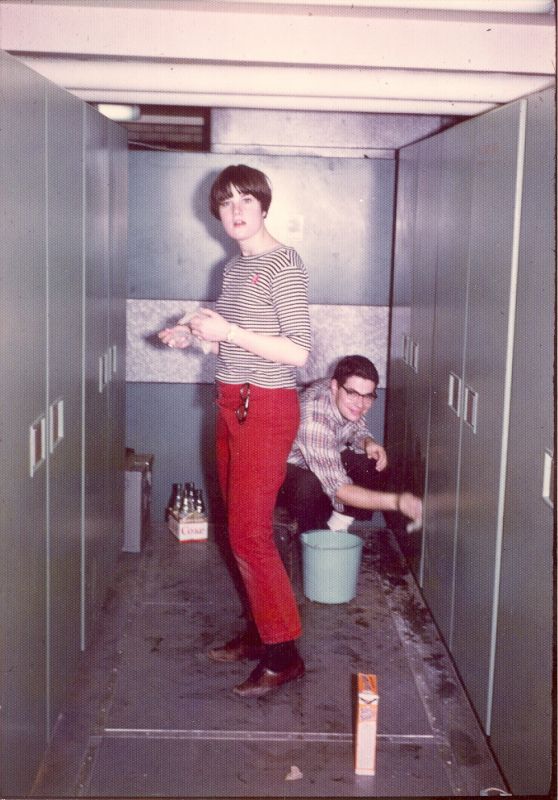
friend. Not mine however. We might get a hit once it is posted on the site. Dave Rodgers might remember. Dave Rogders wrote: The girl in the photo with Joel Platt between the cabinets is Diana Patterson, girlfriend of Walt Sullivan. |
![]() |
![]() |
![]() |
![]() |
![]() |
| OK, I probably should
have turned these in after I graduated but with them, I was able to
access the Athena until it was shipped out to the Smithsonian. Keys are
(I think): 401 - this was the Ham Radio station W3NKI on the top floor of Hamerschlag. 55A - I need help with these three, I think one was for the room where the G-15 was, one was the big lab outside of the Athena Room and the 55A must be for the Athena room itself. HH53 50 MH ENT - Machinery Hall Entrance - this was the 3rd(?) basement door to Hamerschlag which went out to the parking lot toward Scaife Hall. What are the odds that some of these still work! |
| Added Frieden Flexowriter as human I/O device. |
| Added drum read/write via instructions |
| Added interupts |
| Chris wrote: "As received, the Athena paper tape readers would only load programs in an IPL environment. Someone did figure out how to put the paper tape readers under program control and the machine was so modified. All I recall of this is that it used the former "Radar Data Register" to pass tapedata into the machine. " |
| Chris wrote: "Another mod to the machine was to take one of the now useless instructions and model it after the "Group 7" opcode on the PDP-8 . This instruction only referenced the ACC, IIRC, where individual bits in the instruction each had a function and certain ones could be combined (i.e. one bit would cause a one's complement and another bit would cause an increment and combined you got a two's complement "negate". I don't recall who did it ." |
| SHE "Somewhat Helpful Executive" by Chris Hausler |
| Assembler by Dave Vavra He wrote: I wrote the assembler. It ran on one of the Comp Center machines but I can't remember which one. Probably the G-21. Whatever it was, it had a high speed paper tape punch. The tape had to be hand wound onto a reel that the Athena used. I also seem to recall hand entering assembly like code using the Frieden. Don't know who developed that. (Or was that Freiden? There's a German company, BG Frieden, so I used that spelling.) John Yurkon replied: Hi Dave, It's been a long time. I heard from Charlie a number of years ago, to my surprise. I don't know how he tracked me down. Search engines were just starting to mature. When I left CMU the transports on the paper tape drives were working but they were still trying to get them to read properly. I thought that the Bendix G-21 was being decommissioned back then. They were having a difficult time finding replacement germanium transistors and the disk storage looked kind of scary. The platters were bouncing up and down about 1/8" if memory serves. I don't know of another machine that had a paper tape punch though. There was a water cooled monster that I never new the name of and there was an earlier Bendix G series that had vacuum tubes and was about the size and look of a refrigerator. The Bendix G-21 and the Philco display units were what tempted me to get into trouble academically. I survived after a few years in the Air Force and ended up in the Honors Tutorial Program in Physics at Ohio U. Their computer facilities at the time were primitive enough to keep me out of trouble. I know this group is about the Athena, but if anyone has a timeline for the history of the Univac 1108, the IBM 360 (mod 60 I think) and the Bendix G-21 at CMU I'd be very interested in hearing it. Come to think of it, weren't there some PDP-8's that had paper tape drives? Could that be what you used? John Dave replied: Hi, John, Long time indeed! The refrigerator sized machine was the Bendix G-15. Don't remember the water cooled one. The Bogart, maybe? It was in the same room as the G-15 IIRC. That used 6146W tubes in its flip-flops. I had a Drake 180W transmitter that used 6146A's just to give you an idea of the possible power draw. I get the impression from some of the web sites that the Bogart and Athena were somehow cousins. Got me in trouble too. I worked at a market research firm in Pittsburgh run by an ex-GSIA dean for a while and got to do some nifty things unrelated to market research like stadium scoreboards and the passenger signs for BART in San Francisco. Almost became Hausler's competition by working at Union Switch and Signal but took a small sabbatical and visited Southeast Asia instead. Came back in 73 to finish things up. Pat Stakem got me fixed up with a small NASA contractor here so now I'm designing and building flight software systems for spacecraft and coming up on 33 years. Funny how things work out. DAV Date: Sat, 22 Sep 2007 11:57:44 -0400 From: jchausler <jchausler earthlink.net>Subject: Re: Details on Website Hi All, David Vavra wrote: > I wrote the assembler. It ran on one of the Comp Center machines but I > can't remember which one. Probably the G-21. Whatever it was, it had a > high speed paper tape punch. The tape had to be hand wound onto a reel > that the Athena used. Dave, it was the G-21. It had a high speed paper tape reader (optical) and punch unit, the PT-10. Remember, the Athena did not use the common 1 inch 8 level paper tape used by the minis and the comp center teletypes but 7/8 inch tape (7 level but I think the Athena only read 6, three on each side of the feed hole). As a result we had to buy (shudder) our own tape. The PT-10 was adjustable and would punch 5/8 inch 7/8 inch and 1 inch tape. I know this because someone (it must have been you :-) had borrowed the PT-10 Service Manual and it was in the Athena room. One day when I entered the Athena room, after the G-20's had been removed from the comp center, I saw the PT-10 manual in the trash, someone was cleaning up. Dumpster diver that I am, I picked it out. I still have it in my collection of Junque. It includes basic programming instructions for the device (a Digitronics optical reader and a Teletype BRPE punch packaged each with tension arm spoolers.) and I'm assuming that you used that information to set up the device. At the time no one else was using it and you were likely the last user of it. "John E. Yurkon" wrote: > I thought that the Bendix G-21 was being decommissioned back then. They > were having a difficult time finding replacement germanium transistors and > the disk storage looked kind of scary. The platters were bouncing up and > down about 1/8" if memory serves. I'm not 100% sure but I believe the G-20's were removed in summer 68. I started working as a part time operator spring semester 68 and spent several shifts that spring operating them. Those large platter disks were impressive. Remember also the magnetic card memory system, the RCA RACE (anyone recall what RACE stood for?) I remember when working the G-20, stopping the RACE units (there were two "readers" and the controller was an RCA 501) to clean the heads and drum around which the cards were wrapped to read or write them. In 1970 or 71 while working for the CS department engineering lab, I had cause to be pulling floor boards in the room in which the RACE had been installed. In a corner, I found a brand new RACE card, still sealed in its envelope. I'm assuming someone had dropped it and it had gone "flying" and they didn't dig for it. It was in a far corner. The machine recognized which card it was by a pattern of "fingers" cut into the long sides of the card. I believe looking at this one (I opened the envelope :-) that there were 128 individual patterns. I believe this is how the unit would know which card to select out of a specific bin, I'm assuming the "bin address" was coded magnetically on the card. And yes, I still have this card and its envelope too :-) A favorite story of mine about the cards is that one of the Philco CE's told me he would take the used cards and use them as hinges on his "dog door", as they were made of rather stern stuff, necessary for the rough handling the card received. (Remember the debacle IBM had with the "Datacell", the cards for it were too flimsy. And yes I have a couple of Datacells in my stash I picked up in the mid 70's :-) > I don't know of another machine that had a paper tape punch though. There > was a water cooled monster that I never new the name of and there was an > earlier Bendix G series that had vacuum tubes and was about the size and > look of a refrigerator. The earlier Bendix G series was the G-15, the size of a large refrigerator. It used 5 level (5/8 inch) paper tape. There's one, last I looked about 9 years ago, in the Smithsonian. In the early 90's I bought a G-15 plug in module from the then Boston Computer Museum. They were selling them in their gift shop IIRC. The G-15 was one of the most popular mid 50's small machines. I recall reading an article in a late 70's trade publication celebrating 50 years after the introduction of it and calling it the first personal computer :-) Speaking of the G-20's, in the early 90's there was a 25th anniversary of the CS department. I could not attend but was later told by someone who attended that he heard that that the G-20's still existed at that time at least, in private hands. Originally they had been sold to an individual, Carl Lefkowitz (and I may be mangling his name). In fall 1976, Pat Stakem, Russ Moore and I first came back for homecoming. We learned where Carl had the machines (in an old Bank building) and were staring through the front door at the machine when Carl showed up and invited us in. The big disks were there but he was trying to interface the machine to a pack drive which looked much like an IBM 2311 type. I think he was intending to try and sell time on the machine. For the last dozen years or so I have maybe attended about 1/3 of the homecomings and on a couple of these occasions in the late 90's tried to locate Carl or the machine with no luck. Anybody know anything? Someone mentioned Joel Platt. I saw him last at the homecoming in 1997 at the engineering (or maybe it was just the EE dept.) reception. And of course, Pat has already chimed in with "DP". Chris AN GETTO$;DUMP;RUN,ALGOL,TAPE $$ |
| Athena resident assembler Chris wrote: "We've already talked about Jim Pollock's interface between the B250 and the Athena. What with the loss of the G-20 and Dave's program, someone (and I think it was Charlie Putney) wrote a resident assembler for the Athena. But there was still the need to punch tape for the Athena's high speed readers. I don't remember what exactly it was, but on the bench in HH53 were a bunch of small "green things" which were appendages to some kind of I think analog data analyzer. This had been there next to the G-15 and I believe was no longer used when I showed up in fall 66. One of these boxes was a paper tape punch. Someone interfaced it to the B250 and then using Jim's interface, Athena program images couldbe sent to the B250 and then punched. " |
| Date: Wed, 07 Nov 2007 08:23:36 +0000 From: Charles Putney <chputney gmail.com>Subject: Hello from the past To: markd silogic.comHi Mark, Sorry for the long delay. The web page brings back a lot of memories. On the Athena, I remember working on a program for a neural net simulator. It was my project for my course in Cognitive Psychology. The input neurons were connected to the console buttons and the output neurons were connected to the console lights. The intermediate neurons were randomly connected. Then, there was a punishment/reward scheme where if the output pattern was desired, the neurons creating this pattern would be "rewarded" otherwise you could "punish" the net and some of the offending neurons would be randomly scrambled. At the time, this program was a little too hard for me and a lot of it was written by Tom Englesiepen. He used a cross compiler to write this, and the compiler was written by Ken Corbin. I have lost touch with these guys. I'm retired now and my job career was: Texas Instruments -> Becton Dickenson -> Dataproducts -> Hitachi Printing Systems -> Ricoh Printing Systems. Here are some of my recent interests: http://chputney.googlepages.com/mydish http://www.codeproject.com/gadgets/WifiScanner.asp http://www.codeproject.com/cs/internet/DNSTester.asp Charles Putney 18 Quinns Road Shankill Co. Dublin Ireland |
| Mark DiVecchio attempted to add 4K of core memory. Never worked. |
| Jim Pollock interfaced the Athena to a B-250 computer. |
| Date: Thu, 27 Sep 2007 07:22:52 -0500 (CDT) From: "Lowell A. Benson" <labenson usfamily.net>Subject: RE: Athena Mark: Thanks for your feedback about our site. I plan to insert a link to your site when I next update our LEGACY site. I've also forwarded your URL to our committee (includes one of the original Athena hardware design engineers and one of the programmers who was at the Cape during many of the Athena controlled launches.) I'm attaching a copy of a logbook page from an Athena launching site, I'm not sure which one - it shows the last launch as a Delta 8 on 7 March of 1962. This came from one of our field service engineers. A few comments about the 'Battle Short' switches. Beginning in the early 50s and well into the 70s, military computer specifications required over temperature sensors with automatic turnoff to keep equipments from 'melting' if their cooling systems failed. If it was war-time and the system was involved in a battle, an operator could press the the switch to bypass the automatic shut off system. It was more important to continue the war time mission than to save the hardware to fight another day. Lowell A. Benson, see www.usfamily.net/web/labenson for Legacy Pages, AHS '56 page, projects, and photos. |
| Quatse, Jesse T. .Design of the G-21 multi-processing system. Pittsburgh, PA : Carnegie Mellon University, Dept. of Computer Science, 1965, ENGR&SCI 510.7808 C28R 65-5, Pittsburgh, PA Title : DESIGN OF THE G-21 MULTI-PROCESSOR SYSTEM, Corporate Author : CARNEGIE INST OF TECH PITTSBURGH PA Personal Author(s) : Quatse, Jesse T. Report Date : 26 FEB 1965 |
From: Mark DiVecchio <markd silogic.com>Sent: Mar 25, 2008 11:28 AM Subject: RACE Unit http://archive.computerhistory.org/resources/text/RCA/RCA.3301Realcom.1964.102641286.pdf Pg 14 RACE unit?? Model 3488 |
| Date: Wed, 26 Mar 2008 10:31:47 -0500 (GMT-05:00) From: "J. Chris Hausler" <jchausler earthlink.net>Subject: Re: RACE Unit Hi Mark (and All :-), It certainly looks like "Son of RACE" however it is not the units which were at CIT/CMU attached to the G-20's. For one thing the packaging is sexier, but from a distance, the idea is the same. This unit has removable card cartridges. I do not recall that the "bins" on the units at CIT were removable, at least not easily removable, and if they were, we never removed them. And if they were removable I believe it was only for maintenance purposes, not as an interchangable data cartridge. This is likely a later designed unit and may have been competing with the IBM Datacell which did have removable cartridges (and I have a couple :-) CMU did have a Datacell unit attached to the 360/67 when it was still in Scaife but I don't know if it moved to Wean. It had not been there very long, maybe arriving in 1970 or so. Of course the Datacell was a disaster, making the RACE for all its problems look like good solid engineering :-) As to the RACE. The link refers to a 3301 computer but mentions the 301 and the 501. A question for you all (and maybe for Dave Rodgers specifically) is the CS talks mention that the machine at CIT was a 301, however, I remember it being called a 501. Which was it? Another story (or two). I was in the room with the RACE relatively early after I first arrived at CIT, long before I was employed by the Comp Center, watching a demonstration of the RCA 301/501/whatever playing music (and my memory tells me that Dave was "master of ceremonies" :-) This was the typical "playing music on a computer" of the time, you'd tune an AM radio and listen to the RF energy being given off by the computer. This was not unusual, I still have some paper tapes I used on the Hybrid Lab's PDP-9 which would do that. What was unique about the 301/501/whatever demonstration was that in addition to the music coming from the radio, the computer operated its console typewriter to provide percussion :-) I'd never before and never since seen that done. Second story. It was rumored that the two RACE drives that I "cleaned" in spring 68 as a Comp Center operator were the second set of drives at the site. They had replaced an earlier set of drives. Now, just like the photo in the link, the drum around which the cards were wrapped was at one end of the machine covered by a plexiglass cover. To clean the drives one opened this cover to gain access (it was hinged at the back and would flip up). Even with the cover opened on the units I worked with, they would operate correctly. However, correct procedure before opening the cover was to go over to the 301/501/whatever and stop its execution as there was no interlock on the covers. To clean the drum it was necessary to remove the head assembly. The story was that on the earlier drives, there was a deflector plate on the plexiglass cover that as the card came shooting out of the box toward the drum that this deflector plate directed it into the drum. The later units I worked with had this as part of the head assembly. With the cover open on the earlier units, the story was that the card would miss the drum and just fly out into the room. Now, the cards were a stiff plastic. The rumor was that with the earlier drives, someone at CIT forgot to close the cover when restarting the computer and it selected a card and shot it out into the room, the card remaining aerodynamic long enough to hit the side of the 301/501/whatever and leave a small dent in it. True or false? The story is that these units were replaced because this was in fact a safety issue, a flying card could seriously injure someone. (As I recall the process of unbolting the head assembly in the newer units did trip an interlock and so it wouldn't shoot a card out into the room, but the cover was still not interlocked.) Now, while I'm here, a story about the Athena, or actually the B250's, which I have not seen on the web site. If you recall we had quite a number of these machines. The story was that Williams had gotten them from Bank of America and that they had been used on an experimental system for magnetically marking and reading checks, some process that had preceded the now universal MICR markings still on checks today. One problem with the B250 is that we had no way of saving programs written on it so one had to laboriously re-enter them. However, after all, they used core memory. We pulled the core planes from a number of the machines and tested them in the one machine we were using. I specifically remember that we found four planes which would work without any adjustment in our 250. Now I played a lot with the 250, wrote as much code for it if not more than for the Athena. It was a character machine (6 bit words) and instructions were variable length. I recall that an "add" was four words, the op code, the first source, the second source and the destination. This was the first character machine I had ever played with and when I got my first "microprocessor" in 1977, a Motorola 6800 D2 kit, one of those hex keypad engineer's evaluation kits, one of my first thoughts was that programming it was just like the B250 ;-) Anyway, for a month or two, I had my "own" B250 core plane. Before I would start playing I would remove the one in the machine and install "mine" and then when done put the original back. Thus I kept a copy of my programming. There were a number of people involved in this testing of the core planes but whether anyone else used them as much as I did, I don't know (and I only did this for a month or two). Finally, back to the G-20, if you haven't listened to Richard Shoup's talk I suggest you do. He includes several pictures of the G-20's in his talk. And Gorden Bell is, as usual, fun to listen to as well... Chris Hausler, JH37 AN GETTO$;DUMP;RUN,ALGOL,TAPE $$ |
![]() RACE cards.Photo by Chris Hausler, Jan 2009 |
![]() Gordon Bell |
| Date: Wed, 26 Mar 2008 09:42:17 -0700 From: Roy <r.engehausen gmail.com>Subject: Re: RACE Unit Hi guys.. I remember the RACE. The computer as I recall was an RCA 301. I also remember the legend of the card dent. I think the IBM 2321 Datacell showed up in 68. Could have been late 67. It didn't stay very long because it never worked well. IBM would pronounce the box as working and I would run a job I had to stress it and it would break. About a decade later I was transferred by IBM to San Jose. The 3850 MSS was just coming on line (mag tape cartridges) and I mentioned the Datacell. I was informed that the memories were painful and were best forgotten. The Univac 1108 had its Fastrand drum. Not quite as Rube Goldberg as the RACE and datacell Roy I think I was RE01 |
From: "Mark DiVecchio <markd silogic.com>"Sent: Mar 26, 2008 2:15 PM To: Roy <r.engehausen gmail.com>Subject: Re: RACE Unit Roy, I think you were HE01. Mark |
| Date: Thu, 27 Mar 2008 15:22:36 -0500 (GMT-05:00) From: "J. Chris Hausler" <jchausler earthlink.net>Subject: Re: RACE Unit Hi All, Yes, Roy and I are both "first name challenged". Until I was about 10 years old I knew I was Chris Hausler, but I didn't know about this other guy named Jon C. Hausler who was shadowing me (and I've been trying to lose this dude, unsuccessfully, ever since ;-) Of course, we can't forget H. Guyford Stever, so we don't suffer alone... By the way, Roy, I have a brief video of you taken our freshman year during Spring Carnival 1967 as we were tearing down the WRCT field set up after the sorority relay races (as I haven't been to Spring Carnival since I graduated, I wonder if they still do sorority relay races :-) There was also the faculty (read graduate student) egg toss done at the same event... I managed to miss filming the buggy races that year (I have them for the later years, particularly 68) as I had spent both the Thursday night and the Friday night up all night playing with the IBM 7040, not getting to bed until about 6 AM, and although I set my alarm to wake me up in time for the races, I never heard it either day... Regards, J. Chris Hausler (see that dude sneaks in there most every time...) |
From: David Rodgers <dave_rodgers msn.com>Subject: RE: RACE Unit Date: Wed, 26 Mar 2008 11:36:29 -0700 The RCA machine in Scaife Hall was a 301. The two Race units were back to back. Although the magazines were not easily removable, you could instruct the machine to unload a card for replacement since there was a lot of wear on the surface from all the pinch rollers. Depending on factors unknown, sometimes the card would fly out of the front Race and shoot the person sitting at the 301 console in the back. It hurt but was not fatal ;-) |
From "Mark DiVecchio" <markd silogic.com>Date: 03/27/08 8:54 PM Subject: RACE Unit http://www.feb-patrimoine.com/projet/gamma30/rca_301.htm RCA BullRAC http://www.feb-patrimoine.com/english/gamma_30.htm Gamma 30 http://febcm.club.fr/english/corporate/computer_innovation.htm Bull and computer innovation http://febcm.club.fr/english/ge400.htm GE http://www.dvorak.org/blog/?page_id=8215 IBM and the Seven Dwarfs - Dwarf Six: RCA |
| Date: Thu, 27 Mar 2008 23:53:03 -0700 From: Roy <r.engehausen gmail.com>Subject: Re: Other RACE links Mark DiVecchio wrote: > > http://www.dvorak.org/blog/?page_id=8215 > » IBM and the Seven Dwarfs - Dwarf Six: RCA Dvorak Uncensored > Lots of inaccuracies in this one. We all know RACE was Random Access Card Equipment. The Univac Fastrand was simply very large drum memory. One was installed on the 1108. No mention of the IBM datacell. |
| Date: Fri, 28 Mar 2008 00:06:21 -0700 From: Roy <r.engehausen gmail.com>Subject: Re: Other RACE links I also remember RCA having a bunch of IBM 360 Clones. In the early 70s everyone was making them. My brief Army career was spent studying Soviet computers and even they built 360 clones. They even ran OS/360. They stole the software and hardware but bought the books. The Soviet embassy in Washington was the largest customer of IBM manuals in those days. http://shashwatdc.blogspot.com/2007/07/feature-cias-take-on-computer-it.html |
| Date: Fri, 28 Mar 2008 13:28:11 -0400 From: "Patrick Stakem" <pstakem loyola.edu>Subject: Re: Other RACE links and, did I mention I have a copy of the Bogart Programmer's manual? ..p Mark's note: I had found that manual on-line. Click here. |
| Date: Mon, 17 Mar 2008 13:11:20 -0500 (GMT-05:00) From: "J. Chris Hausler" <jchausler earthlink.net>Subject: Re: Jesse Quatse Hi All, Once again, what a trip! I can highly recommend viewing this video. It brought back lots of memories and confirmed a memory of mine that the scopes had three screens. I hadn't been sure whether two or three. And speaking of the scopes, Pat recently sent me a photo of me in front of the scopes, likely taken my sophomore year (67/68). I've included it below. Somewhere I have some slides taken of the G-20's that day in 1976 I previously mentioned when Pat, Russ Moore and I found them in an old bank building being maintained by Carl Lefkowitz (sp?) As I recall Carl was not too happy that I was taking pictures but I did get a few. One of these days I'll have to locate them and get digital copies made. I don't have any photos of the G-20's made while they were at CMU. The talk refers to 2 CPU's. There was actually a third which was kept in Porter Hall in the CS engineering lab and referred to as the "engineering prototype". I believe this was acquired after the other two when Bendix / Control Data abandoned the G-20 line. While at a CMU homecoming some years ago I saw a couple of photos in an exhibit in the Library showing the machine being off loaded from a truck in front of GSIA. This has lead me to believe that the first one might have been installed in GSIA but I'm not sure. Regards, Chris Hausler |
![]() Chris Hausler in the Scopes Room
about 1967-68 |
From: "David Chou" <dchou u.washington.edu>To: "'Mark DiVecchio'" <markd@silogic.com> Subject: RE: CIT/CMU Comp Center Date: Sat, 29 Mar 2008 00:38:51 -0700 Mark, I have included half of the G20 machine manual and sending it since it is a little big. I am scanning the other half now. I hope it makes it to you. I will break it down into fewer pages if needed. You will notice that my user code is on the manual (DC08). I also have the WHAT, THAT, and ALGOL20 manuals. These are a little bigger and may be more difficult to scan. Let me know which you would like me to do first. Do you plan to post these manuals to your web page? I wonder if anyone else is interested in them. I enjoyed reading about Carl Lefkowitz from one of the others. It is interesting that all our rememberances are rather similar about the nature of these devices. Dave |
| Here is Dave's first email to me: -------------------------------- From: "David Chou" <dchou u.washington.edu>Subject: hello Date: Wed, 12 Mar 2008 22:19:22 -0700 Mark, I somehow tripped over your web site looking for articles on the CMU robotic car. Its been many years, like you and Roy Engehausen, I worked at the CMU Comp Center and graduated in 1970 (Chemistry). I am on the faculty of the University of Washington (in Seattle) and supporting computer systems in the hospital/medical school environment. I drifted back to my comfort zone with computers after spending time in medical school. Things really haven't changed much in what I do. But unlike the tech world, the academic environment requires that I still work. Your pictures of the Atlas launch computer brings back memories. Unfortunately, I have tried to get a few pictures of the infamous Bendix G21 computer, but have not had any luck. Again it was nice to see your old pictures and the memories it brings back. David Chou dchou u.washington.edudblchou comcast.net |
From: "David Chou" <dchou u.washington.edu>To: "'Mark DiVecchio'" <markd@silogic.com> Subject: RE: CIT/CMU Comp Center Date: Sat, 29 Mar 2008 12:12:57 -0700 Mark, Here is the THAT manual. I haven't looked at this one for a while. The G20 wasn't really as sophisticated as the 8080. Dave |

From: "David Chou" <dchou u.washington.edu>Subject: RE: CIT/CMU Comp Center Date: Fri, 28 Mar 2008 16:30:03 -0700 Mark, I also worked in the I/O desk, so that it probably where we met. I do not know the people in the picture for the Athena. I actually never worked on the computer even though I saw it many times. I worked on the G15 for a while. The G21 was purchased for very few dollars by, I believe, Carl Lefkowitz(?), who was a director of the Comp Center at one point. CMU tried to sell the machine, but there were no takers (surprise). This is consistent with the comments made by one of the others in your blog on the Athena. There were several others who programmed the G21 who joined him in supporting it and getting it going. I heard that they were trying to sell computer time, but personally I doubt that they made any money and I don't know who would buy time. An old picture of me is on the UW web site (http://myprofile.cos.com/choud2). Dave |
From: "David Chou" <dchou u.washington.edu>Subject: WHAT manual Date: Fri, 11 Apr 2008 20:13:19 -0700 I don't know if this will make it at 21 MB. WHAT was the embedded assembler in ALGOL20. Dave |
| Date: Sat, 12 Apr 2008 12:16:41 -0400 (EDT) From: "J. Chris Hausler" <jchausler earthlink.net>Subject: Re: WHAT Manual Hi Mark, Thanks for posting those manuals from Dave Chou. Looking at the THAT manual, it doesn't seem (at least in the first few pages at which I looked) to explain that THAT is an acronym for "To Help Assemble Translators". The computation center was fond of acronyms, but I don't know for what WHAT stood unless just a play on THAT. The file system AND stood for either "Alpha Numeric Directory" or "Alpha Numeric Director System". They also had THEM THINGS which stood for "Tech's Helpful Executive Monitor" and "To Help Implement New Generalized Systems". Anyway, you can see where I got the idea and encouragement for SHE and HER THINGS ;-) Since Dave is looking for pictures of the G-20's don't forget to tell him to view Richard Shoup's talk as it contains a few pictures of it. I also believe I sent out that photo Pat took of me in front of the scopes if he's interested in those as well. I still haven't dug deep enough to find those photos I took in 1976 of the G-20 at Carl's place and somewhere I believe I have an early photo of the G-20's at Tech which was once part of a slide show provided in the early 1970's by the CMU Alumni office to show to prospective students (haven't yet relocated that slide tray either and that photo may be one of the ones shown in Shoup's talk). Chris AN GETTO$;DUMP;RUN,ALGOL,TAPE $$ |
| Date: Sat, 12 Apr 2008 12:40:30 -0400 From: "David Vavra" <davavra vverizon.net>Subject: RE: WHAT Manual IIRC, "WHAT" stood for "Which Helps ALGOL Translate" or some such. Might even have been recursive: "WHAT Helps ALGOL Translate." It's undoubtedly meant to be a sly reference to THAT. WHAT was the embedded(?) assembler in ALGOL-60. These really bring back some old memories. DAV |
| Date: Sat, 12 Apr 2008 09:53:37 -0700 From: Roy <r.engehausen gmail.com>Subject: Re: WHAT Manual WHAT = Which Harms Algol Terribly When I was working on Algol 67 (the 360 version of Algol 20), we had two great tools: TREWQ and QWERT. I never heard what they stood for except the characters on the upper left of the keyboard. Some other old languages: Formula Algol, COMIT, SCADS(?), and IPLV Roy |
From: "David Chou" <dchou u.washington.edu>Subject: RE: Mark's web page Date: Sun, 13 Apr 2008 00:54:27 -0700 Roy, I looked at the picture in the ECE web site. The tape drives are exactly as I remember. It appears to be an earlier picture of the 4th floor of Scaife for two reasons: (1) The drapes on the windows are missing or open. The G21 was so temp sensitive that we closed the curtains to keep the CPU from high-temping. Being a germanium transistor computer, any temperature over about 68 seemed bad. (2) I remember the two G21 consoles faced the computer and tape drives rather than being perpendicular to them. Dave |
||||
| Date: Sun, 13 Apr 2008 12:07:17 -0400 (GMT-04:00) From: "J. Chris Hausler" <jchausler earthlink.net>Subject: RE: Mark's web page Hi Dave and Roy, I did work as a part time comp center operator starting spring semester 1968 through spring semester 1970 when I went to work for the CS dept engineering lab as a technician and did work a number of shifts that first spring as the G-20 operator (it is my memory that the G-20's were removed during summer vacation in 1968 but it could have been 69). Although I rarely worked as a 360 operator at CMU, Roy, I did spend the summers of 68 and 69 working as a 360 operator at Eastman Kodak on 360/44's, 360/50's and 360/65's running OS/MVT. The 360/65's in addition to their development role were acting as back ups for the older generation (IBM 7080's IIRC) production systems and so had walls of tape drives :-) Anyway, Dave, you are right, the configuration shown on the ECE web site is an early one. The first time I saw the G-20s was when I was a high school senior at Homecoming 1965 when I came down with my parents (my father was a CIT grad) to see the campus. At that time, the G-20's were in their "final configuration" that I could tell, not the one shown in that photo. Speaking of that photo, as I mentioned in a previous post I had an earlier photo of the G-20's which had been part of a 60 slide slide show put out by the Alumni office which our local (Rochester, NY) Carnegie Clan (I'm still a member of the board) used to show the campus to prospective students in the 1970's. Well, I have located that slide tray, and the photo, a Kodachrome color slide, is the same one shown on the web site and also one of the ones shown in Shoup's talk. The slide set is marked September 1968. Shoup does show another picture of the G-20's in his talk which does show the final configuration as I remember it so you might want to check that out (and its a great talk too). I have yet to locate (get to) the slides I took (Ektachrome so I don't know what the color will be like) in 1976 of the G-20's at Carl's. I still have some serious "mining" to do in my utility room to get over to where my collection of slides I took is located :-) Speaking of the G-20 tapes (and I still have my three spools :-) does anyone else remember that they were "blocked" just like DECTAPE. They had directories and you could use them just like a (rather stringy) disk. Of course, floppies wiped out DECTAPE. I've always been curious if this blocking was an inherent capability of the G-20 tapes or just something that CMU developed. Remember with "normal" half inch computer tape once you write to a spot on the tape anything after that point is effectively destroyed. Both G-20 tapes and DECTAPES needed to be formatted just like a disk and I know DECTAPES had a timing track so I assume G-20 tapes did too. Remember that most of the G-20 software was developed at CIT and in many ways was way ahead of the rest of the world of computing. In fact, when the G-20s were replaced by the 1108, the computing environment at CMU in some ways, IMHO, degraded. In the late 1970's I was in a position of hiring quite a number of just out of college engineers as computer programmers. I was shocked at that time how primitive their college computing environments had been as compared to what CMU/CIT had 10 to 15 years previous. I then came to realize what a privileged environment we had at CMU/CIT when we were there. Chris AN GETTO$;DUMP;RUN,ALGOL,TAPE $$ |
||||
| Date: Sun, 13 Apr 2008 04:35:54 -0700 From: Roy <r.engehausen gmail.com>Subject: Re: Mark's web page Hi, I was never a G-21 operator so I didn't deal with the drapes. I recollect one evening being frustrated at all the computers being down due to an A/C failure despite the sub freezing weather outside. I also have a fond memory of smoke pouring out of all the computers due to a fire in the basement next to the A/C intake. I do remember the G21 card reader and console being just in front of the tape drives though. The memory units were on the backside facing the railroad tracks. You got to the G21 area by going through the separate room that held the printers. My days as a computer operator were all on the 360/67. Roy |
||||
| Date: Sun, 13 Apr 2008 13:33:58 -0700 From: Roy <r.engehausen gmail.com>Subject: Re: Mark's web page Hi J :-) I thought the PDP-8's tape drives were blocked. After my Army stint, I started with IBM in Manassas, VA. Our project was some of the software for the Trident submarine. The computers that were to be used on the ship were the Univac AN/UYK-7. The tape drives were blocked as I remember. They held the normal 1/2" tapes. They were ruggedized for shipboard use. Roy |
||||
From: "David Chou" <dchou u.washington.edu>Subject: RE: Mark's web page Date: Sun, 13 Apr 2008 13:46:12 -0700 Chris, You bring back some memories. I did some programming for the G20 tape drives and remember the blocking. There was a timing track on the tape as well as some unusual capabilities to handle skewing, an inherent problem with 1" tapes. I do not know, however, whether CIT wrote programs to take advantage of this or whether the hardware just supported addressable blocks. Of interest is that the blocking design allowed for the mapping out of bad blocks. You could continue to use some really bad tapes, a useful feature by the end-of-life for the G20 when the tapes were no longer being made (thus my job as a student programmer). Reliability was a big problem since the MT10 tape drives used mechanial arms rather than vacuum columns to manage tape slack. During heavy search (and destroy) motions, the tapes really got a workout. I have an old HP 35mm slide reader which I have kept attached to an an old Dell W2k computer. For the most part, I have had pretty good success in adjusting the color on Ektachome slides. Unfortunately, the process is slow. Dave |
||||
| Hi Dave (and All :-) The female operator's name was Mary Noe. She married Joel Bloom who I recall was a physics student (S68) working on a graduate degree, but that's a fuzzy memory. I have a brief video of Mary and Joel (and a few others) at a comp center picnic. Someone had tied some gas filled balloons in her blond hair. If you have any memory of Mary, you can almost imagine her expression. You're right Dave, she was a "pistol". She was a fun person to be around. A 20 year old CMU grad directory has them living down near NYC and he working for Chase. Another incident involving Mary was that she bent over the back of the 1004 printer (on the 1108) to get some output. If you recall at some point they added a "paper puller" to it which used rotating brushes and it caught her hair. They got it stopped but her hair was vary entangled in the brushes. The unit was detached from the printer and she carried it around on her head until they could get a UNIVAC CE there to disassemble it. She said it had quite frightened her, but once again I can still see her wry expression as she carried the thing around... Dave, are you sure it was the 360 which was dropped in through the roof? It is my memory that it was the 1108. I think I told in an earlier post about being one of the folks who disassembled the 1108 processor in summer 1971 for its transfer to Wean. If you recall both the 1108 processor box and its memory box were long cabinets. Very roughly 1/3 of this length was the power supplies and on the processor, this 1/3 was also the piece with the lighted pushbutton maintenance panel on it. These had been delivered whole and thus the need to drop them through the roof, however, it was possible to separate them resulting in pieces which would fit in the elevator but this entailed some rather intricate unwiring of wiring harnesses which ran between the two sections. It was my understanding that UNIVAC wanted more than the school was willing to pay to do this disassembly and so us CS dept engineering lab employee's were drafted. It was my joy to be the one who took the processor box apart. I always recall the older gentleman who was the head UNIVAC CE occasionally coming around behind the box where I was working to see how I was doing. The worried expression was priceless ;-) That same day as we were cleaning up and pulling cables from under the floor I found an old paper box under the floor with two reels of tape in it. These had been the "on the machine" (not the master copies) of the IBSYS operating system and libraries for the tape operating system which ran the 7040. These would wear out and occasionally get replaced, sometimes by shorting the tape beyond the used area and putting a new load mark on the tape and then copying from the master copies. Someone had obviously put them there when the 7040 was removed in 1967 or early 68. Thinking them "historic" I "acquired" them and still have them in my pile of junque to this day. One is labelled S.SLB1 and dated 2/13/67 and the other S.SLB2 and dated 7/13/67. And as to the Scaife elevator, it was quite the toy for certain bored adolescents like me and as I recall some others in this group. We would get on top of it and take manual control of it. But those stories are for another time... J. Chris Hausler, JH37 AN GETTO$;DUMP;RUN,ALGOL,TAPE $$ |
||||
| Hi, I was a G21 operator prior to (and after) the arrival of the 360 and 1108. The fire event brings back a couple of events, many details I heard only second hand, so the details may be embellished. Many of the 360 modules were too big to bring in through the elevator. As a result, a hole was cut into the 4th floor ceiling and the computers were dropped with a crane. In preparation for the 360, the 4th floor I/O desk and programming staff were moved to the third floor. The rest of the 4th floor housed the 7040, located near where the 1108 was finally placed. One day, I noticed that all of the CO2 fire extinguishers had disappeared. These were big units, about 4 feet high and very heavy. One of the staff told me that the wood in contact with the cut steel plate caught fire after the workmen left. The operator on duty was a thin and small 100 pound female (Mary N.) who I assume must have been really fired up with adrenalin. Fortunately, the room was mostly empty. Some years later, I learned that IBM was upset over a roof leaking in one of the 360 CPU modules, resulting in some expensive repairs. Incidentally, the Scaife Hall elevator was never very reliable. I was stuck in it many times, often during campus tours for prospective students when the elevator was full. I should have surveyed to see if any of these attended Carnegie. Dave |
||||
| I remember that practically all the later machines were dropped in Scaife by crane. The elevator was simply inadequate. The 360 CPU unit was rather large and not easily broken down, especially since the 67 had a DAT unit attached as part of the console/CPU. Dave |
||||
| Hi Roy, Certainly PDP-8 dectapes were blocked, as were all dectapes. The first dectape I bought, in fall 1967 IIRC, was for the PDP-8 in HH53, however, when the dectape drives were installed on it that fall, us undergraduate students were told to keep our hands off of the machine. So I eventually used this tape on the Hybrid Lab PDP-9. This tape came in a cardboard box and was labeled "Micro Tape", the dectape name had yet to be assigned. I still have a printed listing of the directory of this tape :-) As I recall it cost me about $15 in the CIT bookstore. A couple years later when the PDP-10 was installed, I bought a few more dectapes for it. Now they came in round blue plastic boxes and the name "dectape" was applied to them. Looking at one of these plastic covers, there are check boxes for two possible formats, 2702(base 8) blocks of 201(base 8)12 bit words per block for PDP-5/8's and 1102(base 8) 400(base 8) 18 bit words per block for PDP-1/4/6/7/9/10/15's. (However, being cheap, I bought them untested and unformatted :-) This was before the PDP-11 came to be which had yet a third format due to it being 16 bits, but I never used a dectape on a PDP-11. But you could format a dectape on the PDP-9 and use it on the 10. These were the only two machines on which I ever used dectapes. When I went out into the "real world", for the first 10 years or so I was using Data General minis so by the time I started using PDP-11's dectapes were long replaced by floppy disks. The dectape was essentially the floppy before floppies were developed but only Digital ever used them to my knowledge. However, I believe they were developed at Lincoln Labs and originally called "Linc Tape". DEC acquired the idea when they built the "Linc 8" which was some kind of extension to the PDP-8. At least so I recall... Regards, Chris |
||||
| Chris, The first PDP-8 I used was located in the room adjacent to the G21 at CMU. This particular one only had a paper tape and a tty at the time, and I found it so frustrating to load everything by PT and have it crash five seconds later. Well nightmares to me, I entered a lab in my first year at Pitt with a DEC LINC-8. Basically, this was a PDP-8 with an A-to-D convertor and some added instructions to handle the analog stuff. It was an awful computer, had lots of timing problems (remember that the PDP8 was an asynchonous logic design without a central clock), and everytime the unit heated up, it crashed. If I remember right, the DECtapes were on the PDP side of the computer (there wasn't much intelligence on the LINC side). I did see some pictures of the original LINC which was even more primitive. DEC basically viewed the LINC-8 as an opportunity to enter the real time lab business and modified the PDP8 to act like a LINC. About 3-4 years later, I worked on the PDP12, the successor to the LINC-8 which was stable and a workhorse. Dave |
||||
| Hi Dave, Are you sure about a PDP-8 near the G-20's? What time frame was this? To my knowledge, the first PDP-8 on campus was the one in HH53. Remember HH53 was Gordon Bell's anteoffice and he was supposedly the principal developer of the 8, so this makes sense. This was also the room in which the G-15 was located. Are you sure you aren't thinking of the G-15 in this case. (I have 8x10 B&W prints of myself of photos, taken by Pat Stakem, sitting at the consoles of both the G-15 and the PDP-8 in HH53 in fall 66 :-) At least beginning in fall 1966 there was no PDP-8 in Scaife and none appeared until that aborted attempt to use one as an RJE front end to the 1108 was started and I don't think that happened until about 1969 or late 68. Maybe Bell's 8 was in Scaife before fall 66 but certainly not for long as they weren't first delivered until well into 1965. That PDP-8 which did appear in Scaife in 69 was located in the northeast corner of Scaife behind the 1108 tape drives, about as far as one could get on the fourth floor from the G-20's (but the G-20's were gone by that time and the CS PDP-10 was where they once stood). When I first arrived in fall 66 the PDP-8 in HH53 only had the ASR33 for paper tape I/O but some time that fall a high speed paper tape reader and punch unit was acquired for it. The next fall, 67, the dectapes were added and so was a single platter disk drive. That system became a graduate student project and thus us undergrads were refused access. By this time too, the G-15 had started to fail regularly and I don't believe I tried to use it more that once that fall and that would have been the last time I used it. I've also got to argue about your memory of the 360 coming through the roof. I know the 1108 did as I recall watching it. When I arrived in fall 66 the I/O desk had already been moved to the third floor (directly underneath where I had seen it on the fourth floor during my visit in fall 65) and the walls in the area where the 360 was to be installed on the forth floor were already being torn down and false floor installed, but the machine was not there yet. The machine was moved in, up in the elevator, later that fall. When the 360 was moved to Wean in 1971, the same time as the 1108 and PDP-10's were, all went down the elevator. Only UNIVAC had been "stupid" enough to build a machine which wouldn't fit in an elevator without some significant unwiring. As I recall a little better use of plug connectors would have made this easy, but the 1108 had multipoint wiring harnesses running between the two sides of the machine, some breaking out into individual wires tied to individual screw points (says he who unscrewed them all :-). But of course, my brain cells have been atrophying for a number of years and all the above may be false memories, or nightmares, as the case may be... Regards, Chris AN GETTO$;DUMP;RUN,ALGOL,TAPE $$ |
||||
From Chris Hausler: Jan 2009Well, Attached are three photos, one of me in front of G-15 in HH53 and one of me in front of PDP-8 in HH53. Both of these were taken by Pat in the fall of 1966. These are digital photos of the actual 8x10 prints I have. If I find the negative strip from which they came, I know it has similar photos of Pat. The third photo is of the two RACE cards I have, one just recently found. Enjoy! More photos will be coming eventually but probably slowly. I'm going to be in Birmingham, AL a lot this spring and may not have time to put much together. I'm also going to likely be in Cumberland, MD a week in February. I've already told Pat. CSX hump yards in both places. This web mail only allows three attachments per mail so that's why three pictures for now. ![]() |
||||
![]() |
||||
| The 8 in Scaife was definitely there late probably in the time frame you mentioned - and the area was behind the 1108. It did not initially have DECtape, but did have one later and was intended for use as a front end for the 1108. The area I was referring to is approximately the same as you describe - it depended on how you travelled. I did not have much access to HH. I started school in 1966, but was in the CC starting as a high school student in 1964. dc |
||||
| Hi Chris, I tend to agree with you. The first PDP-8 showed up in the G-15 room when Bell arrived. 1967 as I remember. The 360 was installed in late 66. I used it enough that I was able to get a job during summer 67 as a 360 assembler language programmer. The 1008 Fastrand drum was the box that had to come through the roof. It may have been able to fit in the elevator but it weighed too much Found a picture of the CIT job card : http://www.cs.uiowa.edu/~jones/cards/collection/i-logo.html Roy |
||||
|
||||
| Hi All, My memories of the Fastrand II are somewhat vague. What I do know, however, is that it did not show up until quite some time after the rest of the 1108 was installed. And it the processor and memory did come in through the roof. The hole in the roof had been somewhere near where the processor ended up and I don't believe it wouldn't have been possible to open it up again without moving everything. Remember the Fastrand was installed back in the area where the 7040 had been and the 7040 remained in service for a while after the 1108 was installed. Eventually the wall between the two areas was taken down and the 1108 stuff expanded into that area (although it never filled it up). The Fastrand came after this wall was removed IIRC, but I don't recall exactly how long after or when. If they dropped it through the roof I certainly don't recall it. Further everything was removed in 1971 by the elevator including the Fastrand. The Fastrand was a long cabinet more or less like the processor and memory but I'm assuming it too came apart or it wasn't THAT long. The elevator was (is) somewhat deep. However I had nothing to do with either installing it in the first place or moving it in 1971 so my memories, once again, are vague and I could be wrong... I also don't know what was wrong with and what happened to that PDP-8 RJE front end. I recall rumors of hardware problems but that's about all and that memory too is vague. Another 1108 oddity was the DCT100 (I think that was the number). One of these was installed over in the Hybrid lab and I recall submitting a job to the 1108 through it once or twice. The printer part was sort of a one column drum printer and definitely somewhat Rube Goldberg. So there was some kind of RJE on the 1108 other than the PDP-8. There was also some leased line modems (202's ?) there which linked it to some company which apparently occasionally rented time on the 1108. I recall hearing that there was a 1004 on the other end but don't recall the company name. If anybody knows anything more about this, please speak up. As the ad says, Inquiring minds want to know... Chris |
||||
| I can't speak to 1971 or the remote job entry but the card reader/punch for the 1108 was the 1004. There was one installed for years in the room next to the RACE and it was used for card listing and duplication. Programmed by punch board. When the 1108 was installed, the 1004 was used for it too. I think there may have been other printers for the 1008 and the 1004 was only used for card operations. Roy PS.. I thought it was the 1040 but the Wikipedia says 1004 |
||||
| Hi Roy, When first installed, the 1004 which combined a card reader and printer in one unit was used as the sole hard copy I/O device for the 1108. That had been the unit that together with its UNISERVO VI tape drive had been an offline lister/reader for the IBM 7040 before the 1108 had arrived. I never saw anyone else use it for such as the 7040 did have its own reader, punch and printer, but one night, just for the hell of it, I did :-) This 1004 ended up being the unit on the fourth floor with the 1108. At the time the 1108 was acquired, a separate UNIVAC card punch unit was purchased and also connected to this 1004. There were two plug boards for it, the one which configured it as a printer / card reader / punch on the 1108 and the one which connected it to the Calcomp plotter such that "plot tapes" mounted on its tape drive would plot to the plotter. When the 1108 was first installed, the default object option was DECK so every time you compiled a program, an object deck would be punched. This was quickly changed to NODECK :-) Exec II was a pretty lean OS, basically a batch system with spooling. The 1108 rapidly would get way ahead of this one 1004. Eventually a second 1004 and in addition a "high speed printer" was purchased and installed on the third floor and the 1108 could keep them all going at the same time, three print streams and two card streams. As the I/O clerks were now reading in some of the cards, the operator's job was made a little easier (Although again, with the typical student job, "compile, load, crash", the machine could frequently keep ahead even with both readers going full out and the machine itself would go "idle" but the printers would all rattle on for some time emptying the spool.) That high speed printer was a "trip". It was so fast that paper jams were a mess to clean up. It was a drum printer like the 1004's printer but vertical registration was very poor and sometimes a particular column would end up in the next row or go missing altogether. This unit had its own small motor generator set to power it. Roy, as to the 1040, its a vague memory, but although there wasn't one at Tech, I believe such a unit did come into existence, a "new design" 1004. I'm not sure about the number and never saw one but I do recall reading about such a follow-on product. Chris |
| I wrote: During the summer of 1965 Roy and I were enrolled in an NSF summer program at CIT. As an option, we got to take a programming class in Algol. Roy, do you recall if the instructor was Jan Fierst? (Interesting Algol link: http://archive.computerhistory.org/resources/text/algol/algol_bulletin/ ) I recall the I/O desk on the 4th floor of Scaife Hall in 1965. Chris remembered that the I/O Desk had aready been moved to the 3rd floor by the fall of 1966 (also Roy's and my freshman year). My memory is not clear on that move. As part of my financial package to attend CIT, I got a part time job washing dishes in the cafeteria. That lasted about two weeks until I was able to land a job behind the I/O Desk. I never worked as an operator (I worked as a programmer for a professor in the History department) but I remember Roy letting me follow him around many times on the 4th floor. Mark |
| Hi all, I remember the I/O desk on the third floor but I don't remember much from the summer of 65. I worked as an I/O clerk beginning the school year 1966-1967. I then got a job as a programmer working on the Algol-67 compiler (the one for the 360). We used TREWQ and QWERT to build/run the compiler. QWERT was the compiler compiler and TREWQ was the runtime libraries. The criteria for Algol-67 was to pass the man-boy problem : http://en.wikipedia.org/wiki/Man_or_boy_test After Algol, I was switched to APL for TSS on the 67. I spent a number of weeks bracketed around ROTC summer camp in 1969 installing APL on the IBM computers in Yorktown Heights, NY. I also got to work as an operator on the 360/67. I had Midnight to 8AM on Saturday and Sundays for a few years. Anyone remember the big analog computer in the basement of HH? Roy |
![]() Photo taken by either Pat Stakem or Chris Hausler. The arm is either Ray Carson or Ron Herold. In a letter that I received from Dean Williams in 1966, he described "a special computer laboratory with a G-15D digital computer, TR-10 analog computers and a DDA-20 digital differential analyzer". Which one was this one?
Here is a link to a TR-10 web site. Is it the computer we had?It was made by a company named Electronic Associates Incorporated. |
Subject: RE: Your ArmDate: Sat, 27 Dec 2008 20:29:54 -0500 From: "Ron Herold" <ronsolve rrr.org>Mark, Pat says near the picture of the setup Athena at CMU that he can't remember the name of the dept head before Jordan. It was Everett Williams. I see others have answered that. RACE is correctly detailed as Random Access Card Equipment. They were built by RCA and driven by a 301 or 501 computer. There were only 5 501s built - and CMU had a 301. The only 501 I ever saw was at RCA Labs where I worked after graduation and that one was actually doing billing for NJ Ma Bell. Looking at the physique of the arm in the picture you refer to - I don't think its mine. It is in much too fine a physical shape. I am in physical shape... Just remember Round is a shape. I am in Plant City (near Tampa) Florida w/the kids at a friend's house for the 26th to 28th. I was in Blacksburg, VA on the 24th and 25th where Virginia Tech is located at my son's house/frat (actually - I bought the house for him and roommates - and much to no one's surprise it is their home and a frat house.) Tomorrow we go to Boynton Beach, near Palm Beach, to visit my folks and the kid's grandparents. We will fly from LNA (Lantana airport near PBI) to BCB (Blacksburg) on Friday and then home to HEF (Manassas - Roy's old stomping ground) on Friday. If you are curious - you can see some of my flights at: http://flightaware.com/live/flight/N62732. The airplane can be seen at http://n72jp.com. The site is full of pix and memories. Glad you have them down and visualized - as our memories fade. College is so far in the past. Best wishes to you and Sally for the holidays and coming year. Thanks for keeping in touch and find time to come visit. Ron |
Date: Wed, 14 Jan 2009 10:00:01 -0800Subject: Analog computer photo From: Al Kossow <kossow computerhistory.org>Hi, I hadn't stopped by the Athena site for a while, and came upon the photo in front of an analog computer "1969 Mark DiVecchio - Carnegie-Mellon University". It is a GPS unit. Very distinctive looking, and is similar in appearance to the unit we have at the Computer History Museum. http://www.computerhistory.org/collections/accession/X42.79 Note the company logos match.. I'm not sure of the exact model, guessing one of their last units from the 60's. If someone comes across documentation from GPS, please let me know since we have almost nothing in the archives on the company. |
| From: Mark DiVecchio <markd@silogic.com> Sent: Apr 22, 2008 1:14 AM Subject: RJE on the G-21 See attached scan from 1965. IIRC there was a room on the 3rd floor of Scaife, middle in the back of the building, containing several different models of teletypes. These must have been connected to one of the RJE boxes on the G-21. Mark |
| Hi Mark, There were two 35ASR's and two 35KSR's in that room, all with built in modems so to connect you would dial into the G-20. You did this with a "dial card" (remember those :-) as the actual dials (remember those too ;-) were disabled to keep students from using them to "phone home". Once the 360 was installed with its RJE system, dial cards were provided for it too. For the G-20, however, the teletypes had to be in "full duplex" mode whereas for the 360, "half duplex" was required. It seemed to me that IBM never did quite figure out how to properly do RJE terminal interfaces. There was usually a backlog of folks wanting to use one of these four TTY's and so you would put your name on the "blackboard" at the bottom of the list and as folks would finish (only one edit and run allowed per turn) your turn would eventually come up. I use the word "edit" loosely as even though this was an RJE system it was batch. The only interactive thing I recall available on the TTY's was "Desk Calc" (remember that :-) You would enter batch commands to edit your AND file and then do a compile, load, and go and then had to wait for your job to come up in the job queue and run. If you hung up the teletype, since the G-20 knew from which TTY you had dialed in, the "here is" drum was coded with its ID, i.e. "CIT Remote 20" and some "magic" characters, it would call it up and print out the results, usually a quick printout unless you asked it for a full one as you would still get line printer output. Until your job ran, that TTY was unavailable for use by anyone else. Adjacent (left) to that room was a larger "user room" with some tables and chairs for working and the user consultant's desk in the far corner and he had a 33ASR. All of these teletypes and the others around the campus were leased from AT&T. On the other side (right) of the TTY room along the same outside wall of Scaife (facing Panther Hollow) were a couple of additional rooms with keypunches in them and a duplicator and interpreter. A couple years later or so, the walls separating these areas were torn out and that became the enlarged I/O desk with both the UNIVAC high speed printer and one of the 1004's installed. The user area was then moved (several configurations and I forget them all) to the other side of Scaife. Up until some time in the late 90's, you could still see all the "damage" done by all these changes on the third floor even though Mech E had taken back the building after the comp center vacated it in 1971. However, sometime in the last dozen years or so it looks like they finally rebuilt the interior, both the third and fourth floors, to its (more or less, I couldn't access all areas) original configuration. So all "memories" of the comp center are now gone. Regards, Chris If you were editing an Algol source on the TTY's your last two lines typed in would be: AN GETTO$;DUMP;RUN,ALGOL,TAPE $$ |
![]() |
Photo from the
Bogart Programmers Manual.
The computer was supposedly named after John B. Bogart, city editor of
The (New York) Sun. This was a reference to the Bogart's primary
function - "data editing", what is now called data mining.
|
From: oz att.netTo: markd@silogic.com Subject: Great Athena site Date: Fri, 19 Dec 2008 07:35:48 +0000 Hey Mark, Just wanted to drop a quick note of thanks for your Athena site -- it brought back some fond memories of the installation we had at CalPoly, San Luis Obispo, CA, in the early 70s. Ours had a huge backlit plotter that had both a pen and an alphanumeric print head on it. The print wheel anticipated those to appear later from Diablo/Xerox. I've attached a photo of our console. Thanks again, fun times! Charles Osborne, Portland, Oregon www.RCASelectron.com |
| Here is an excerpt from the CalPoly web site: The next computer was a Univac missile guidance computer.
It, too, was solid state and cost the U.S. tax payer over $5M (in 1998
dollars). It was an unusual machine in a number of aspects.
It had two consoles, the one located with the tracking equipment and used
to guide the missile and another maintenance console where every flip-flop
and register could be viewed and set or reset manually. We only got
the maintenance console which was very useful in teaching computer architecture.
It was extremely reliable (no failures in the time we had it) and it ought
to have been with gold plated contacts and with the PC boards hermetically
sealed in stainless steel cans. It also had a "battle short" button
which we, evenetually, learned was pressed 5 seconds before a missile was
launched - it bypassed all the fuses and circuit breakers in the machine
- the machine would melt down before it would quit!
|
| Charles, Thanks for your email. You are first person to contact me that had one of the Athenas. I really appreciate the photos. Our web site is fairly new. I got an email from one of the guys and then some photos and then other emails and the web site just grew. May I use your email and photos on our web page? Do you have any more that you can share. It would be really interesting to see how other Athenas were "used" by students. Mark |
| Hi Mark, Yes, you have my unrestricted permission to use my letter, photo, and any communications we have. For the record, I am the creator of the photos. (I'll upload them to WikiCommons when I get a chance.) I may have some class notes, but most of my paperwork was lost in a basement flood long ago. More later.... Thanks again. Charles |
|
![]() |
![]() |
From: "Vern" <garmco cox.net>Subject: Athena Date: Sun, 11 May 2008 15:46:06 -0700 Hi Mark, Hope this gets to you. I just ran across the website www.silogic.com/athena.html and saw that it was just updated last month. My name is Vern Gaman and I live in Las Vegas, NV. When I got my BSEE degree from Iowa State University in 1961 my first job was as a field service engineer at Remington Rand Univac in St. Paul, MN. I spend from June through December in St. Paul going to school on the Athena and then working on the Athena factory test stands. In January of 1962 I went to Denver and worked there until May working at the Titan sites on the old bombing range East of Denver. That May the Air Force took over the site and I was transfered to the Sperry Gyroscope division of Remington Rand to work on Polaris Submarine computers Your web site and the pictures brought back a lot of memories. Thanks for preserving this stuff. Isn't it amazing to compare the capabilities of the old Athena to the PC sitting on your desk now. Vern Garman Las Vegas, NV |
| From: "Vern" Subject: Re: Athena Date: Mon, 12 May 2008 17:00:44 -0700 Hi Mark, Thanks for the note. First, no problem with my email on your website. Should be interesting to hear from other "Athena People". Second, I've attached some thoughts about 1961 and the first part of 1962. Vern Garman |
| As
a senior EE student at Iowa State, I got my first taste of the computer
world. Iowa State built a copy of he U of Illinois Illiac computer and
it came on line in early 1961. They had to build an addition to the
building for it, and it had some interesting hardware. For RAM memory
they used 'Williams tubes'. Should be something on the web about them.
The senior EE students taking some of the logic courses ended up
writing some simple software to run on the 'Cyclone', the name chosen
for the ISU version of the ILLIAC. That got me started in the computer world and I spent the next 35 years working with computers. We moved to St. Paul in June of 1961 and I started the ATHENA school. The school was 3 months long and as I remember, there were 5 of us in the class. Covered all parts of the system in great detail. Down to the individual gate level in the processing and IO sections. Spend a lot of time on the control console and the tape unit. And went through the power system and all of its relay sequencing until I could visualize it my sleep. Had an excellent instructor and I credit those 3 months with giving me a solid understanding of computer systems that helped throughout my career. After the school, the other 4 students were shipped off to Titan I sites around the country. My wife and I were expecting our first child in late 1961 so the company kept me in St. Paul until after the baby was born. I got sent to work on the Athena's factory test stands. As components came out of manufacturing a system was installed in one of several secure rooms. The school facility was in building south of the center of St. Paul, right on the river, while the manufacturing area was in the center of town I think on University. I worked with several of the factory test techs in getting the new Athena up and running and ready to ship to a site. Don't remember any particular problems. This was getting toward the end of production and things were running smoothly. Just before Christmas of 1961 we left St. Paul and went to our folks house in Iowa where I left my family and reported to the Univac office at the Buckly Air National Guard facility on the East side of Denver. From January until early May I drove about 50 miles out onto the old bombing range east of Denver 5 or 6 days a week to one of the five Titan I complexes. I'm not sure when work started on those sites, but all of them were pretty well completed and all the equipment was in them when I got there. When I went in to start my shift, I would fire up the Athena and run the diagnostics to make sure everything was ready for the days testing. Most days were spent getting ready to run Air Force acceptance tests, and many test attempts were made. The test that was required before acceptance included: Getting the launch alert.
Fill the missiles with LOX. The kerosene was already on board. Raise one of the missiles up on the elevator Raise one of the radar antennas and lock on Simulate a launch and run a simulated guidance program on the Athena Raise a second missile on the elevator Lower the first radar antenna and raise the second and lock on Simulate a launch and run the guidance simulation, Raise the third missile Raise the first radar antenna again and lock on Simulate the launch and run the guidance simulation. This test was attempted at least once a week and sometimes several times in a week, but there was always something wrong. The biggest problem was in the LOX fueling system. Typically the probes going into the birds tanks would freeze up and not retract. I don't remember ever having a problem with the Westinghouse Radar or with the Athena. But most of the tests didn't make it to the point where we were involved. When the tests were actually run the entire complex was sealed up. All of the blast doors were closed, we had parked a couple of miles away and hauled in on busses. I didn't think much about it at the time, but if they would have had a failure that caused the missile to fall (as I think one did at Vandenberg), it could have gotten interesting in the control center. Finally one day in late April, 1962, the test was successful and the Air Force said "we'll take it". I'm glad that there was never a call for a real launch, I'm not sure it would have worked. I was transferred in May to the Sperry Gyroscope Division of Remington Rand in Syosset, Long Island, New York, There I went to school for 3 months to learn about the Polaris Submarine navigation computer before going to the shipyard in Newport News, VA to work on new Polaris boat construction. But that's another story. An interesting note though. After going through sea trials of the USS James Monroe, SSB(N) 622, I took a job in engineering with the AC Spark Plug Division of GM in Milwaukee, WI. At AC I ended up working on the guidance computers for the Titan II ICBM and the Titan IIIC space launch vehicle. These computers were built by IBM in Owego, NY and were airborne units. They were about 2 feet square and a foot tall. Had a drum memory about the same capacity as the Athena's drum. But no ram. All of the intermediate data was stored on "revolver tracks" on the drum. That's where the accumulator was also. Programming was a nightmare. Look up 'revolvers' sometime. |
From: J. Chris Hausler <jchausler earthlink.net>Subject: Re: Happy New Year Athenians Date: Fri, Jan 2, 2009 at 12:53 PM Hi Mark, Happy New Year to you too! I'm attaching a Christmas photo I recently sent out to some of my railroad and telegraph friends. It shows my Christmas tree and the model railroad I put around it each year (called the BF&R, "ballast free and roundabout", carpet makes a terrible road bed). (And you'll probably recognize the big Santa dude in the back :-) However, you might note some interesting things in the photo. Hanging from the tree more or less dead center down low is a G-15 flip flop module. There's also one of those B250 cordwood modules hanging from the tree but obscured by branches. To the right of the tree on top of some books is my G-20 tape 88. Surrounding it is some CMU homecoming junk I've collected over the last 15 or so years. Also hanging on the tree is an ornament made for me back in the late 60's by the comp center secretary, Linda Hammond and a souvenir ornament of the Duquesne incline acquired in the mid 1990's. Those are the only things I believe to be CMU or Pittsburgh in photo. Anyway I could take photos of the modules and the tape if you want and email to you. I still haven't located those G-20 photos (slides) I mentioned some time ago and even if I did I have no way of making copies of them. I've been meaning to investigate how to get this done locally but with work and dealing with the cancers the last two years (One of my New Year's hopes is that I won't have to renew my membership in the cancer of the year club this coming year :-) have just not allowed me the time. I also believe I have an 8x10 B&W photo of me sitting in front of the G-15 in HH53. As I recall it as taken by Pat with my camera. I've seen the 8x10 sometime in the last 10 years (and I likely have the original negative somewhere too but haven't seen that in decades ;-) which once located I could probably get a copy of and email it to you. Let me know if you are interested. You can see a lot of other computer (and telegraph) junque in the photo. My pack rat inclinations come naturally and are probably genetic. Although my father died in 2000 and my mother in 2004, my sister and I are still going through their stuff (we both doubt we will live long enough to complete the task). I bring this up because just a couple of weeks ago while we were looking through some of my father's stuff I came across another RACE card. Now I had that one, the story of which I already told, but have no memory of this one. Since I don't know why or where my father would have gotten it all I can assume is that I must have purloined it earlier and then forgotten it. So anyway, I could take a photo of the two RACE cards and send it to you as well. If you really want it I could send you the Comp Center "Red book" users manual from the mid 1960's if you want to scan and copy it. I would eventually want it back. I think I have a scopes manual around here somewhere too which I could mail to you under the same arrangement. At the moment I don't know of any other G-20 stuff I have. Now I do have other 1108/360/7040/PDP8/PDP9/PDP10 stuff, mostly manuals from back then. There's also some DECTAPES and those last two system tapes from the 7040 in my stash. It goes on... 73, Chris Hausler |
![]() |
email : markd@silogic.com