|
 |
 |
 |
| Click here for another article about the Augat wirewrap panels. |
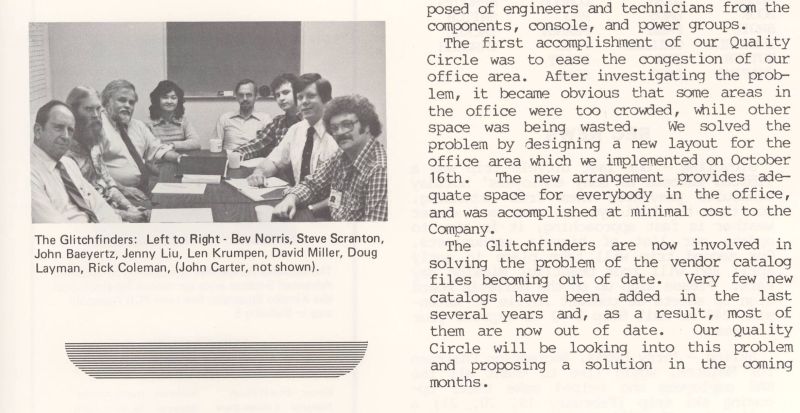 |
| I'm still in touch with Len Krumpen. We went skiing together for 20 years. Bev Norris died in 1985, shortly after NAS closed down. I don't know what happened to the rest of these people. |

 |
 |
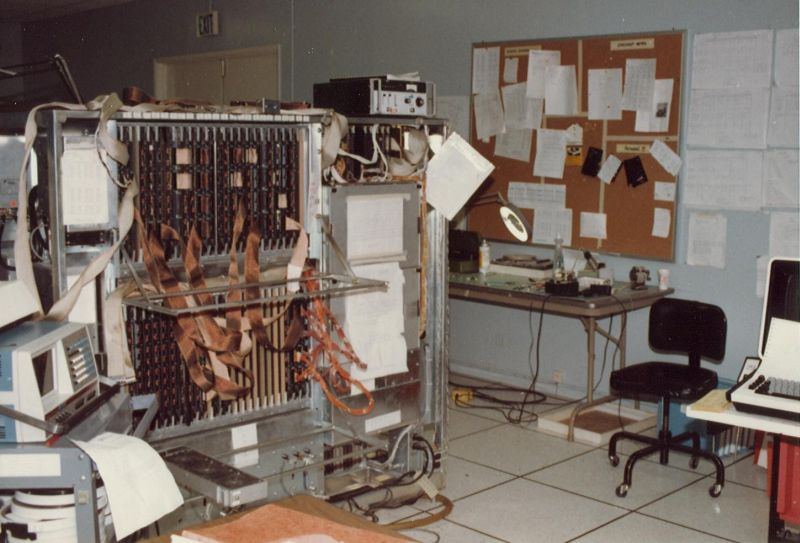
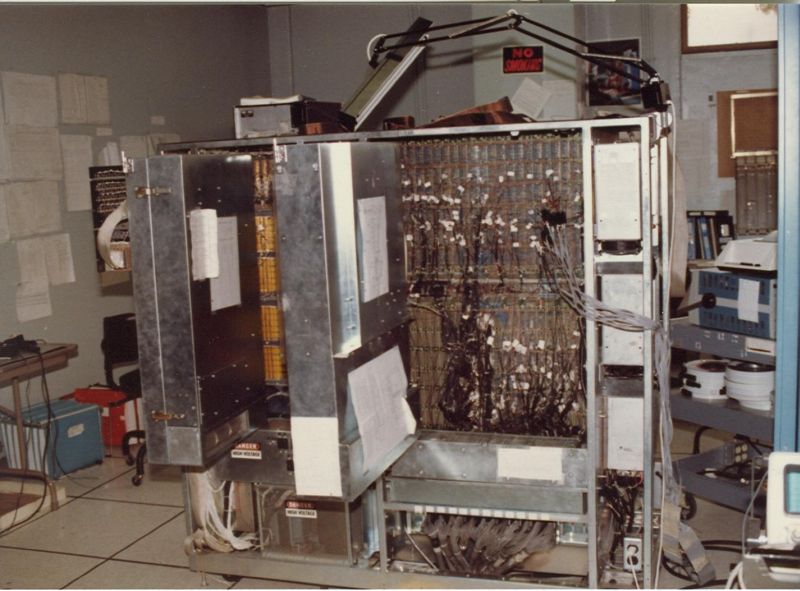
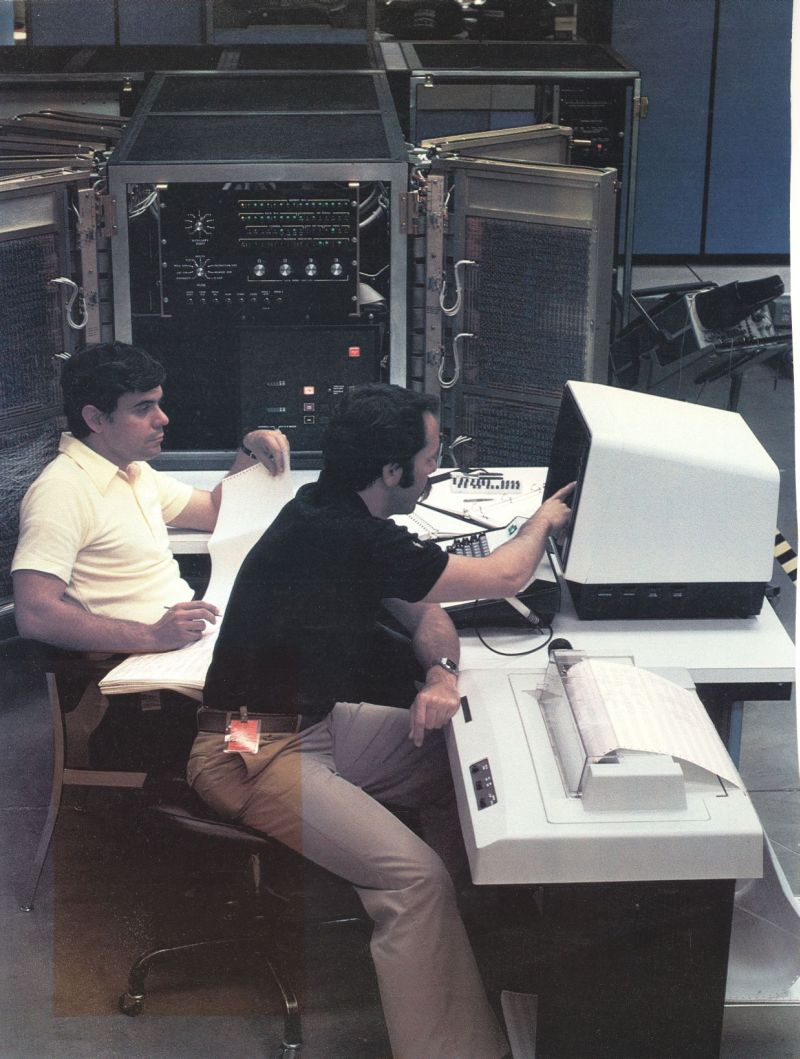 You can see the 2x3 foot wirewrap panels which were the circuit boards. If I recall correctly, my XAR was the bottom board on the first door on the right side of the computer. IBM had designed, and we duplicated, an ingenious serializer which read out hundreds of internal signals and displayed them on the CRT. Left: Charlie Zapata, Right: Rick Hetherington |
Charlie Zapata got his15 minutes of fame and a photo with the boss in the local NAS newsletter. |
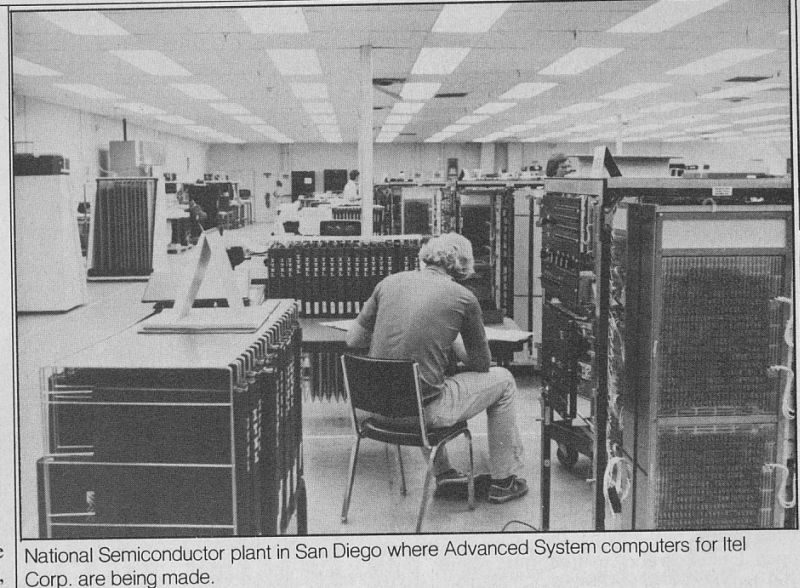 |
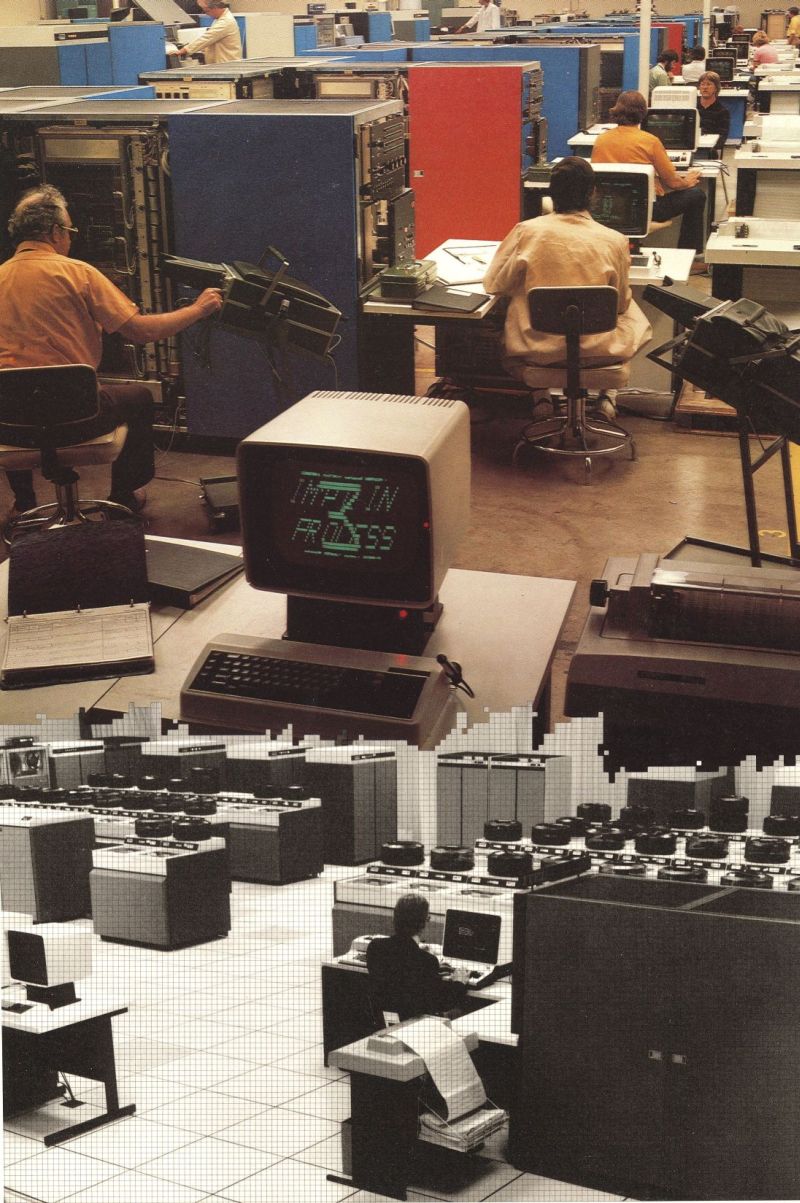
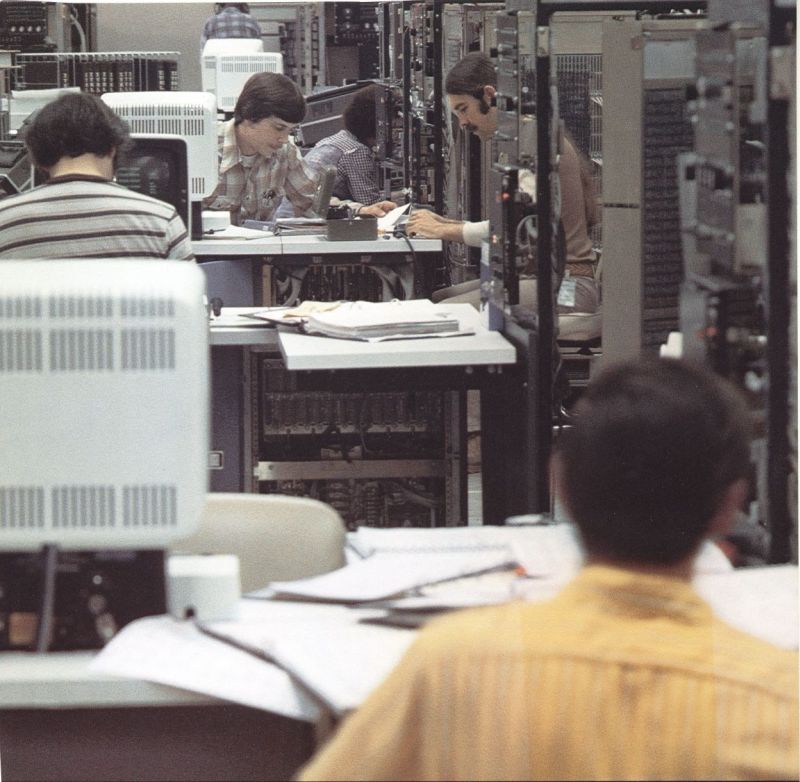
| Another test floor shot. Ed Davis tells me that this is him. See his email below. |

This was my cubicle in building 1 in 1981.
|
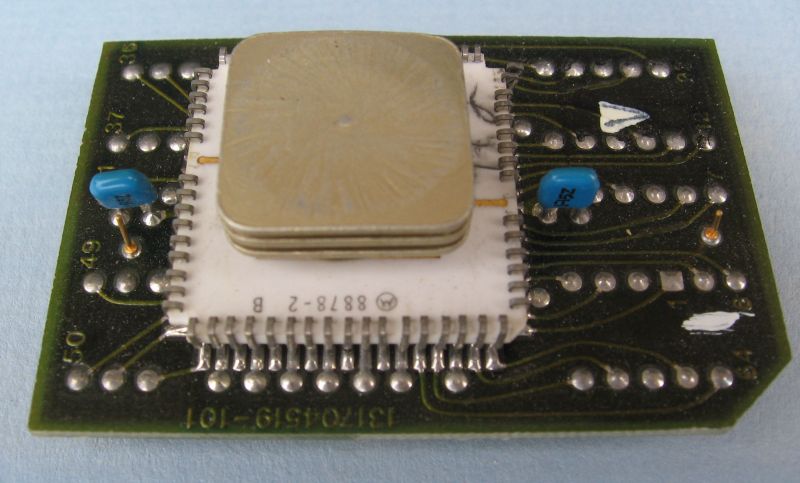
Each gate array was mounted on a carrier board.
|
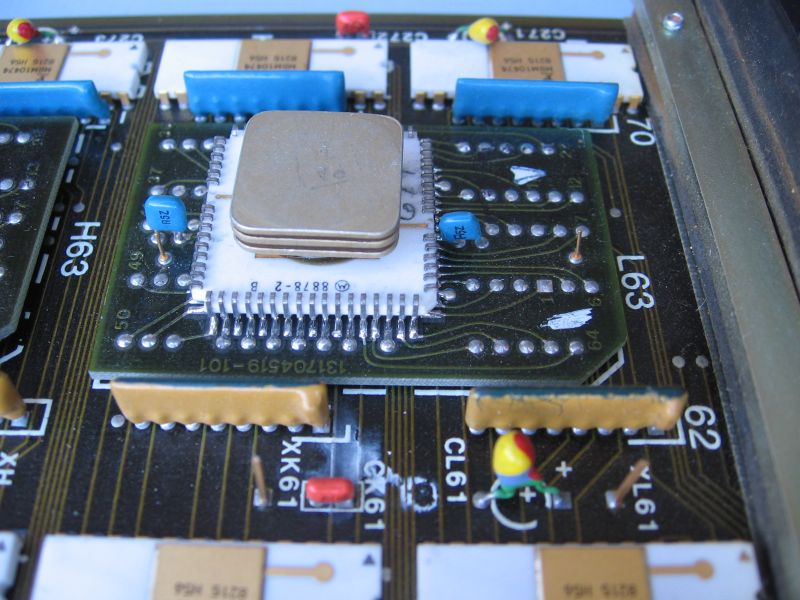 |
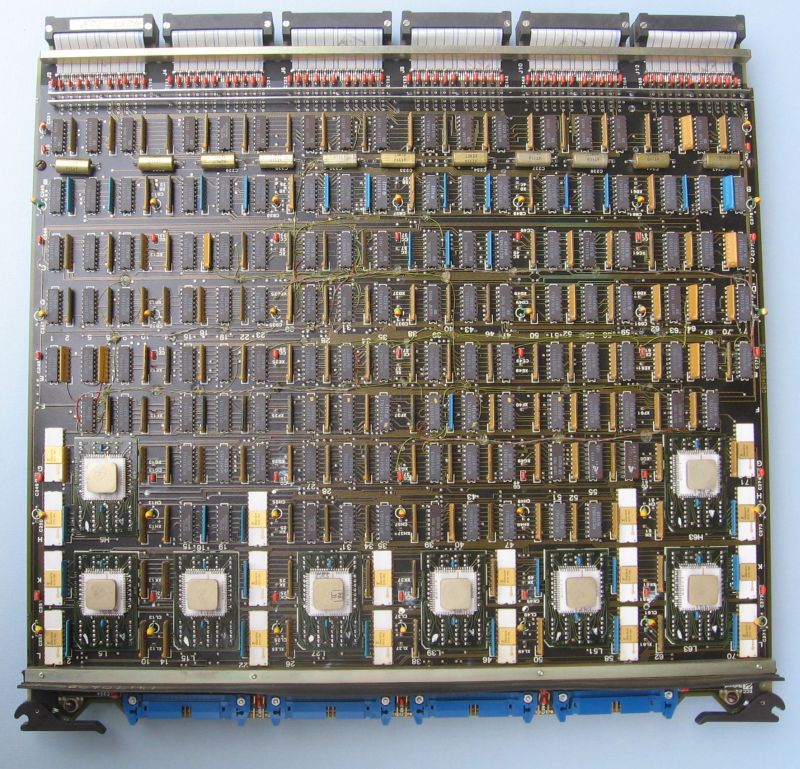
This is the main memory ECC board for the system.
Each gate array processed 8 bits of a 64 bit word. All 8 gate arrays on this board were identical. Jerry Falkman (in the group photo below) was the design engineer on the ECC gate array. |
 |
 |
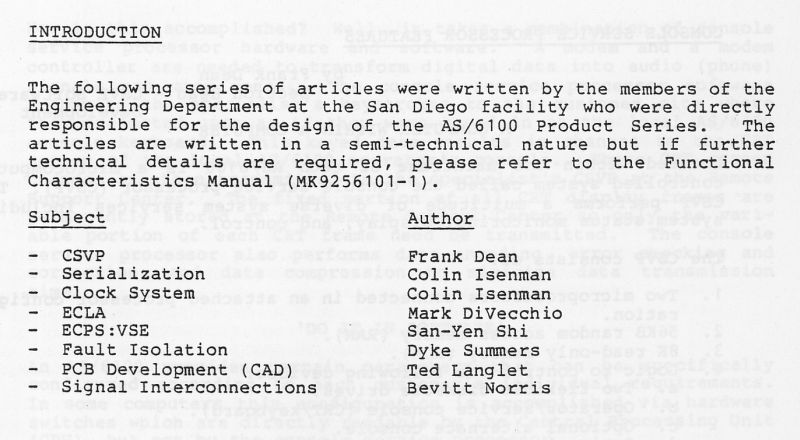
 AS/6130 Technical Documentation - this is still sitting in my garage. |
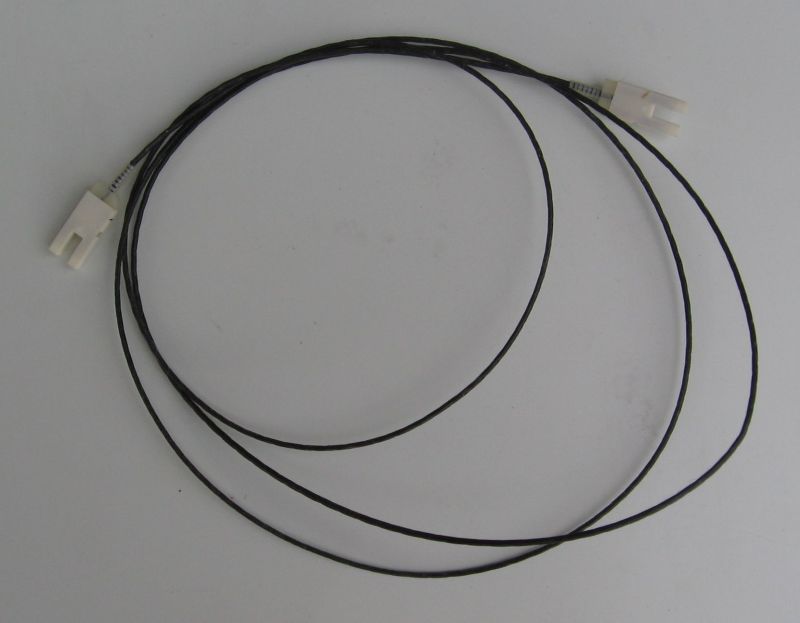 Clock distribution coax cable |
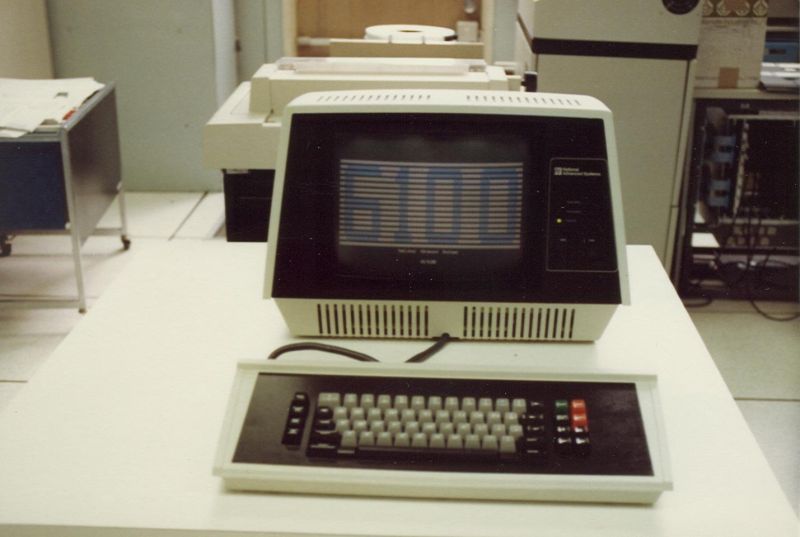
The control console showing the boot up screen.
|
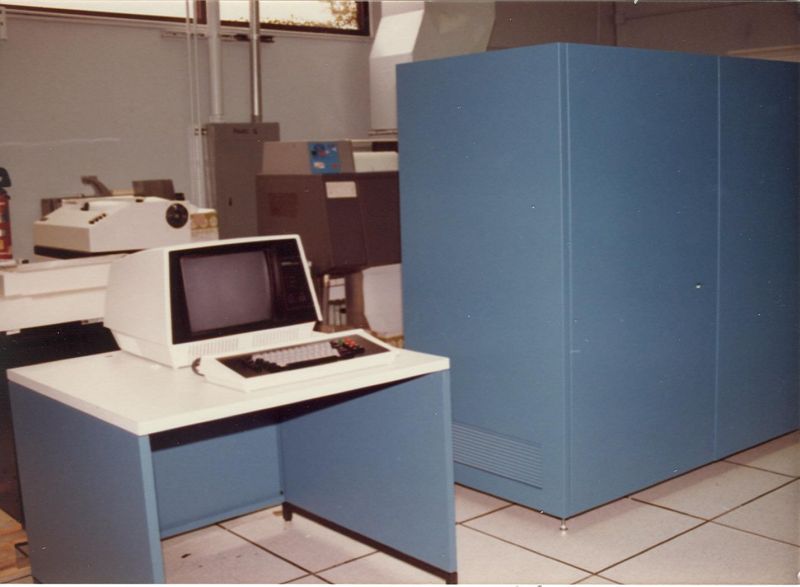
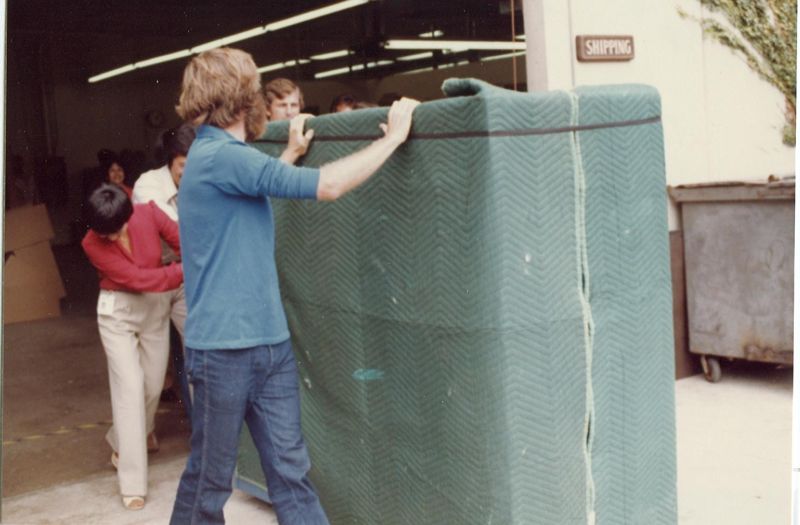
This is the first machine we shipped. Its the big blue box. The AS/6130.
|
 |
 |
 |
 |
 |
 |
 |
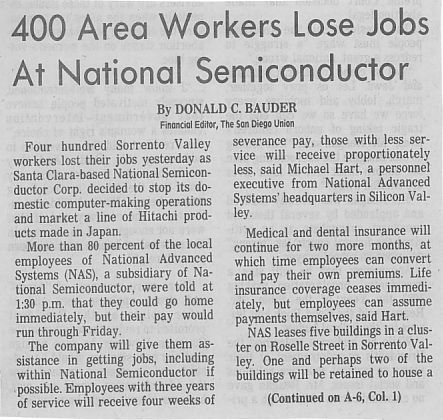
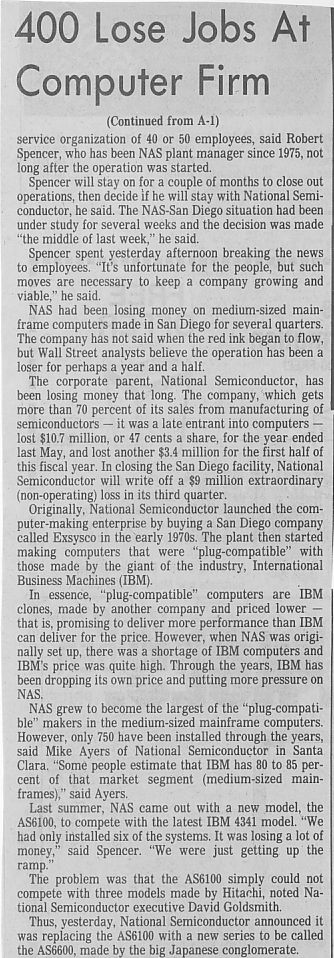
| Kvamme ended up as a big shot in the computer business in the Bay Area working at Kleiner Perkins Caufield & Byers. |
 |
 |
 |
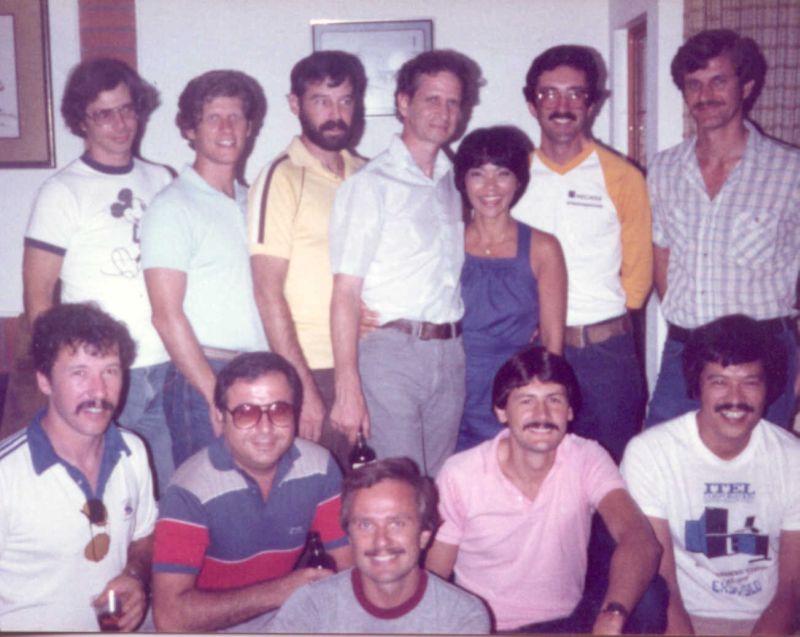 |
| 1983 - Here is part of the design engineering
group. Taken at a get-together sometime after the layoff. Back row (left to right):
Jerry Falkman, Gary Griffin, Dave Bilak, Chuck Stead, Julie Lilly Clauss, Mark DiVecchio, Kirby Spalding Front row (left to right): Buck Titherington, Sarkis Artinian, Tom Sarnowski, John Petry, Chun Lee (back then not a gray hair in the bunch but you should see us now) Buck Titherington passed away in 2010. Dave Bilak died in 2014. Gary Griffin died in 2019. I've lost touch with Sarkis but still talk to the rest. Missing: Stu Kroll, Colin Isenman, Ralph Mullins, Steve Getz, Clay Dahlberg, Chien Nguyen, Dae Woo Lee, Amir Asvadi, Ken Randery, Shen Wang, Tony Valenzuela, Mike Fowler, Jay Wheeler, and Yee Lee. |
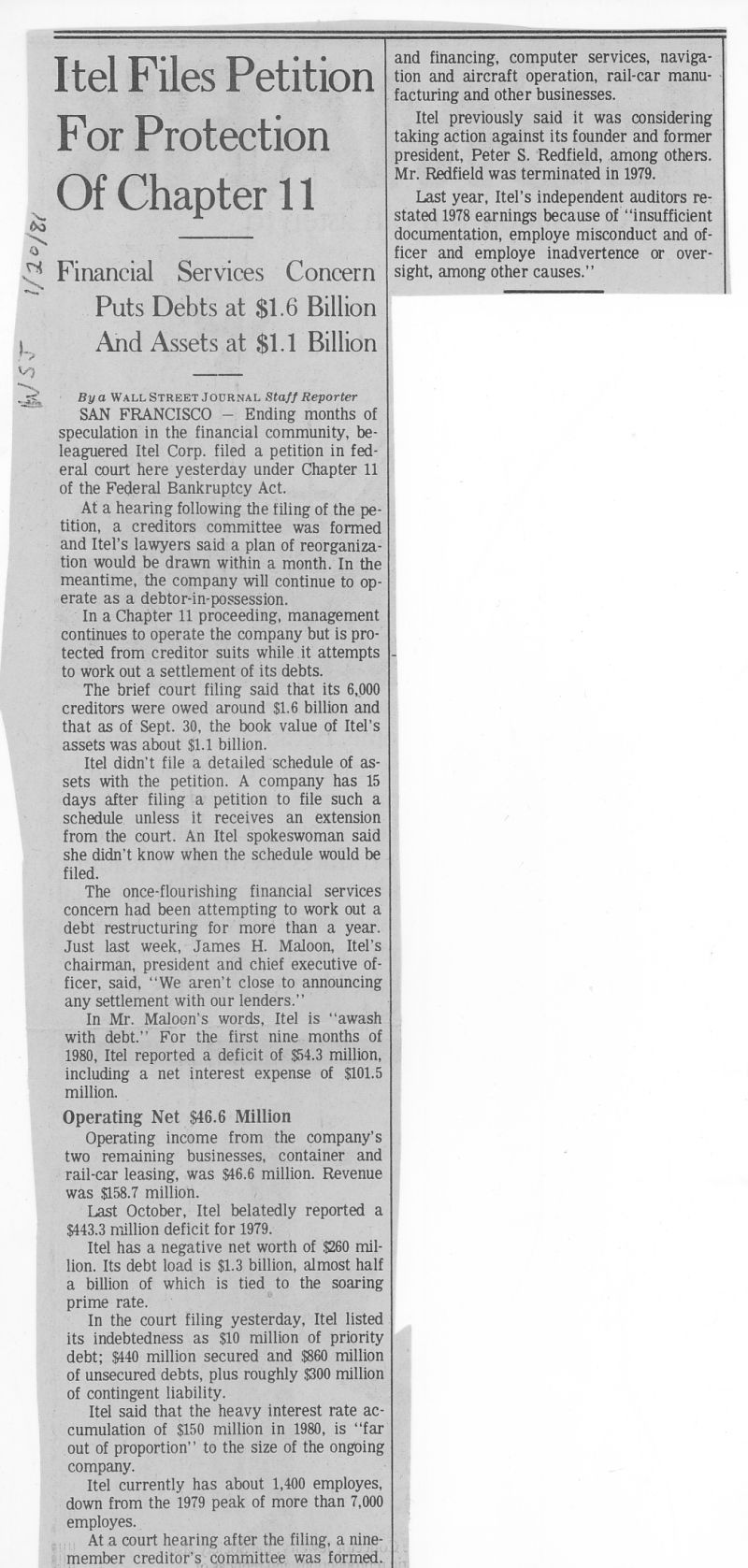
| Date: Thu, 18 Sep 2008 19:16:56 -0400 From: "William \"Buck\" Titherington" Subject: How ya doin' Hi Mark, Just happened to run across your web page. Thought I could fix the fact that we lost touch. I've been here and there since NAS & Megatek, and finally back to the east coast, Rhode Island (EMC & LTX), Conn. (to care for my in laws), and now moving to Maine. Divorced again, married again (to my high school sweetheart) for about 20 years now. Like you, I'm "between jobs", would like to have a bit more fun before I hang it up forever. Things are disgustingly quiet so I joined a Volunteer Fire Dept. to stay a little busy. That's about it, stay in touch, -- Buck Titherington |
| Buck, Wow. Good to hear from you. It has been a long time. As you could probably tell from my web pages, I've 'toughed' it out in SD all these years. After NAS, it was a short stint working again and then I went off on my own. I had a small (usually 1 person) company named Silogic Systems for about 20 years. I did engineering consulting and logic design. In the early 2000's I went to work for one of my clients, AMCC, worked there for 3 years and then retired. About half of the people in the old NAS photo are still in SD. The rest - who knows. Chun, John, Dave, Chuck. Gary and Julie are still around SD. Kirby and Ralph are up in the bay area. I worked with Gary at AMCC . I see Dave Bilak at a Star Party that I do once a year. If you want any emails of these people, I have a few. I will forward you an email that I received in 2006 from a Tammy D'Imperio. She wrote me looking for you and I've been saving her email with the faint hope that you would surface - and you did. Mark |
| I learned in 2011 from Joe Militello that Buck Titherington passed away in 2010. SKOWHEGAN -- William Kent "Buck" Titherington Jr., 67, died Sunday, July 4, 2010, at his home in Skowhegan. He was born July 24, 1942, in Trenton, N.J., the son of William K. and Mary V. (Booton) Titherington Sr. He attended the University of Connecticut, Storrs and Dutchess Community College. He was a veteran of the Vietnam War, serving in the Army. On Aug. 18, 2009, William married Karen Cuatto in Skowhegan. He worked for EMC, Massachusetts; LTX; Jet Propulsion Lab; National Semiconductor; and IBM, Poughkeepsie, N.Y. He was a volunteer firefighter in Torringford, Conn., from 2006 to 2008. William enjoyed fishing, boating, riding motorcycles, and driving in rallies. He is survived by his wife Karen Titherington of Skowhegan; his children, Mary Titherington-Carey and her husband, Paavo Carey, of Skowhegan, Kate LaVoie of Salt Lake City, William Kent Titherington III and his wife, Nina Palmieri, of Lake Katrine, N.Y., Heather McKney and her husband, Michael, of Meriden, Conn., Abigail DeSesa and her husband, George Ordway, of Val Verde, Calif., and Rebecca Haverkamp of Cumberland, R.I.; three sisters, Anne Whyte and her husband, Nick, of Berkeley, Calif., Susan Martin and her husband, Bill, of Massachusetts and Elizabeth Titherington of Berkeley; a brother, John Titherington and his wife, Bonnie, of Litchfield, Conn.; nine grandchildren, Cecil, Wyatt, William, Michael, Karina, Justin, Christopher, Kayla and MacKenzie; several nieces, nephews, and cousins. Memorial services will be held at 11 a.m. Saturday, July 10, at Christ Episcopal Church, Gardiner. Friends wishing may make donations in William's memory to Hospice Volunteers of Somerset County Inc., P.O. Box 3069, Skowhegan, ME 04976 or to the New England Division, 1 Bowdoin Mill Island, Suite 300, Topsham, ME 04086-1240. Arrangements under the care and direction of Dan & Scott's Cremation and Funeral Service, 445 Waterville Road, Skowhegan.
Published in Central Maine on July 8, 2010
Legacy.com. You will be in our memories, Buck. |
| Subject: RE: Buck Titherington 1942-2010 Date: Mon, 16 May 2011 16:07:44 -0700 From: "Falkman, Jerry (ETS-Elec)" <Jerry.Falkman  Honeywell.com> Honeywell.com>Mark, Sorry to hear about Buck. He was a good guy. Thanks for the update, Jerry Falkman Sr. Engr., ETS Engineering Tucson, Honeywell Aerospace |
| Subject: Re: Buck Titherington 1942-2010 From: Gary Griffin <whenslunch cox.net>Date: Mon, 16 May 2011 18:27:54 -0700 I remember traveling with Buck to Raytheon in Boston to work on cross-talk issues with those old wire-wrapped boards at National. He was a fun guy to have around. --Gary |
| From: w.bonneauatt.net Subject: Been A long Time Date: Sun, 07 Jun 2009 23:37:43 +0000 Mark, I was searching for an old reference for EXSYSCO/NAS in San Diego and came across your web-site. I do not think that you will remember me but here goes; I am Walt Bonneau and was a Associate Engineer/Control Console Tech while at NAS from 1977-1980. As with you, I moved to Megatek in 1980 and remained there until 1984. I left San Diego for Texas where I worked for Texas Instruments for over 10 years. From there worked for Sony Corp for nearly 4 years. Created my own company which I sold, and joined Cubic Corp for the last 11 years. I was simply amazed to see your web site and the family history as well. I took notice of the visit you took to Idyllwild in 1999. My wife and I have land up there and plan to build on it next year. I just remembered when I was a very young engineer that you were always very helpful. Anyway, just wanted to say hi, Walt Bonneau Escondido, CA. |
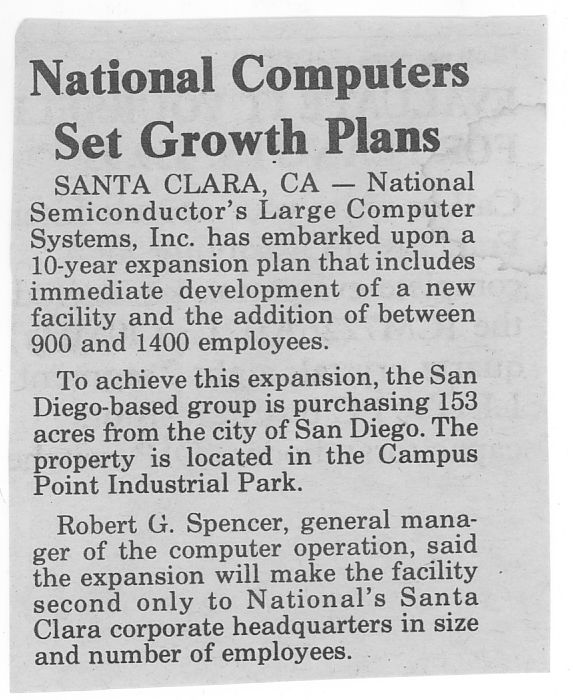
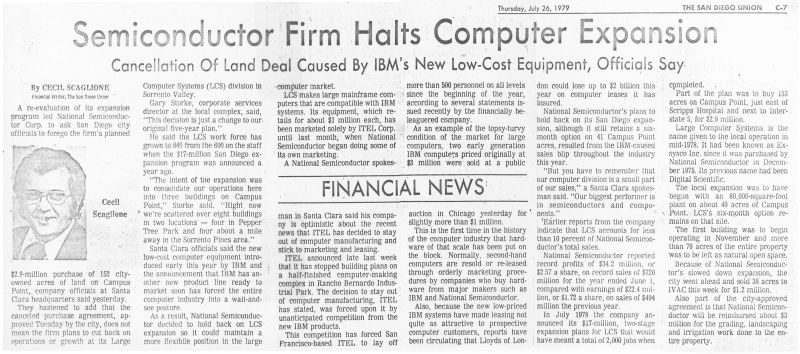
| Subject: Exsysco Date: Wed, 8 Jul 2009 03:00:35 -0700 From: "Moyer, Jack" <jmoyer49 sbcglobal.net>Mark, I decided for some reason to Google "Exsysco" and see what I would find. Imagine my surprise to get your website and crawl through those memories from so long ago. I was the Jack Moyer you responded to in the advertisement and signed your original offer letter. Yes, NCR hated us and used to call Floyd Kvamme to tell us to stop hiring their people (especially the test floor which was virtually all ex-NCR) - Floyd would call me and I'd stop for a week or two then back at it. I still keep in touch with Bob Spencer from time to time and with Tim Harris who followed me to San Diego after I returned to Santa Clara for another HR role. Great web page - thanks for the memories. Regards, Jack Moyer |
| Jack, Thanks for the email. You really are a voice from my distant past. As young engineers at NAS, we had a chance to work in an exciting industry. I'm amazed at how young everyone was (at the time). For about 20 years after the layoff, we did a mini-reunion every January for anyone who worked at NAS. I'm still in touch with many of the engineers and technicans that I worked with. May I use your email on my web page? I can leave your email address off or use a home email address if you prefer. If you like, you can expound on your memories as well. It would be interesting to hear how HR operated to staff the company. Mark |
| Subject: RE: Exsysco Date: Wed, 8 Jul 2009 18:23:35 -0700 From: "Moyer, Jack" <jmoyer49 sbcglobal.net>Mark, Feel free to use my email in your website. HR was primarily recruitment focused during my time. I was transferred to Exsysco in November '76 and returned to Santa Clara for NSC in February of '79. We would grow from 50 to 1100 people during my time and zero to $100 million in revenue - a real wild ride. As you can imagine we were hiring at an unbelievable pace and totally focused on getting people on board. In early '77 HR was Debbie Watson and me - I added Terry Mick in late '77 and then grew to a total of 7 or so people by the time I went back to Santa Clara. Randy Bresee who was our controller after Mike Woodward left and I are still friends and often reflect on the hard work and great fun. We were all young, energetic and at a great time in our lives. We worked and played hard. There were organizational and performance issues, and our share of drama, but all in all the experience survived the test of time. I forwarded your site to Bob Spencer and he is going to go through some of his old material and forward anything that is of additive value. Thanks for the note back. Regards, Jack Moyer |
| From: "Ed" <davis9580verizon.net> [email address not good anymore] Subject: Excellent Exsysco Website!!! Date: Sat, 20 Mar 2010 09:15:02 -0700 Mark, I think I remember you. I left Exsysco in 1978, but I stayed in touch with the people. That unknown Tech in your photographs is me. I worked with Paul Hastings, Bill O'Neal, Dennis Daniels, Buck Titherington et al in the back of the Digital Scientific building before it was sold (given) to Exsysco. Here's what I looked like back then: 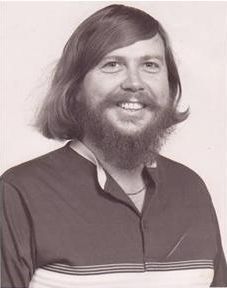 I talk to Buck Titherington once in awhile. He moved to Boston. I spoke to Hanan Potash a few times after he started his Cray clone type company with George Kenoshita. I also worked with Chuck Laustrup a couple years here at Intel in Oregon. He remembers working with all those guys too. Old Bob Hinkle shot a guy in a bar in Arizona. And crazy Bob Shows! What a flood of Memories! EXCELLENT WEBSITE!!! Thanks, Ed Davis Chief Architect (retired) Intel Corporation |
| To: "Ed" <davis9580verizon.net> Sent: Saturday, March 20, 2010 9:33 PM Subject: Re: Excellent Exsysco Website!!! Ed, Thanks for your email. I'm not sure that I remember you. I started at EXSYSCO in May of 78. Which group did you work for? I got an email from Buck a year or so ago. I just added it to the web page. I still hear from Dyke Summers every once in awhile. I remember Bob Shows. I haven't heard the names Hanan Potash and George Kenoshita in 25 years. After the layoff in 1983, we got together on the aniversary of the layoff. This happened for almost 20 years but we haven't had a reunion in a while. A lot of the guys in Field Engineering ended up working for what remained of EXSYSCO which became Hatachi Data Systems so we saw them occasionally at the reunions. I've added your email to the web page. Let me know if that is OK with you. Mark |
| From: <davis9580verizon.net> Subject: Re: Excellent Exsysco Website!!! Date: Sun, 21 Mar 2010 10:00:18 -0700 Mark, I noticed I forgot to answer your question and I also noticed in my email that I had said "Brad" Daniels, I believe his name was Dennis. He was Manager of Field Service, Paul Hastings worked for him. I worked for Stu Kroll and Bill O'Neal. I was a lowly Tech back then still going to San Diego State and UCSD. I joined Digital Scientific, Dave Ahlgren, et al on the Meta 4/370 project around Oct./Nov. 1975. I really enjoyed working in the back of Digital Scientific in a small group of only 5 or 10 people. When we transitioned into Exsysco and moved to Roselle St. the company exploded to over 1000 people, and the fun was gone so I left in early 1978 just before you arrived, but I remember your name vividly, because a Stock Broker friend of mine was Michael DelVecchio and I remember telling him about you and how your names were so similar. One other thing regarding that email. I recently retired from Intel, so you may want to put an (ret.) after my title. Here's a presentation http://bt.pa.msu.edu/TM/BocaRaton2006/talks/davis.pdf I left for Michigan State, where I did my PhD work in high energy Particle Physics. We had just gotten 80 processors to run on a single die when I did this presentation in Boca Raton.(The Polaris project) Thanks very much, Ed Davis |
| From: "jclauss04@cox.net" <jclauss04cox.net> Date: Thu, 1 Apr 2010 14:51:34 -0700 Subject: A voice from the past.... Wow, love your website. Reading about National Advanced Systems surely brought back a lot of memories...thank you so much! I was also very skinny then! I think the last time I heard from you was about Derek May...anyway, glad to see you and Sally are still enjoying retirement as I would like to someday. Have you gotten all traveled out? Anyway, after I left AMCC, went to Brooktree (2 yrs) then to Schumacher (3 yrs) then to Cymer (7 yrs) and at present I am with Qualcomm and tomorrow I will celebrate my 3rd year anniversary. Needless to say I will be here till I retire which hopefully will be next year. Of course, my tax guy thinks I am crazy. Both my sons also work here at Qualcomm, they've been here 25 years, collectively. I lost those photos you sent me the last time we had a get-together with Ralph, Allen, John and Gary. The hard drive on my computer crashed and everything was lost. I was keeping in touch with Ralph for awhile but lost his email. Keep in touch, Julie Clauss (formerly Lilly) |
| Date: Sat, 07 May 2011 18:21:51 -0700 From: "Chips Etc." <info chipsetc.com>Subject: AS/6100 processor question (pics attached) Hi Mark, We enjoyed your website, lots of great computer history and photographs! We are researching a piece of NAS AS/6100 computer memorabilia in our chip collection. It is a LGA ceramic processor we believe is from around 1982. Was this type of processor made by Hitachi or Motorola? (picture of the item is attached). It looks similiar in style to some of our Amdahl air-cooled processors. Thanks in advance for your help in identifying this processor, we want to make sure we get our description correct on our site. regards, Jane (Chipsetc.com) |
| Jane, The chip that you have does appear to one from the AS/6100 that I worked on in the early 1980's. If you look on my web page for the AS/6100, you can see several photos of the chip. We mounted the chip on a daughter board. The chip was a gate-array and was fabricated by Motorola using their MECL 10K Emitter Coupled Logic Circuitry. I may have a data book from Motorola on the gate-array family. Mark |
| Thanks
for all the help identifying this as Motorola, now im wondering - why
wouldn't NAS use a chip manufactured by National Semiconductor?
Was it due to patents or did national semiconductor not have anything
like the MECL to offer it's NAS folks at the time? Great hobby, learning alot from folks like yourself, I will defintely check out that data book...thanks for offering that to all to see... Jane |
| Jane, Motorola was the only source for the high speed ECL circuitry. Signetics was a second source (I think they had a sourcing agreement with Motorola). When you get the photos on your website, let me know and I will add a link to them from my web page. Mark |
| We do have some pictures up now including close-up's of the chip, they can be found here <http://www.chipsetc.com/national-semiconductor.html>. thanks again Jane |
| From: "Militello, Joseph G" <joseph.g.militellointel.com> Date: Mon, 16 May 2011 11:09:56 -0600 Subject: Hi Mark! Hi Mark, Hey, long time no see! I found your website and I'm so jazzed to see all the familiar faces once again. I worked at NAS under Dave Adams, in CAD as a 23 year old pcb designer, and also did gate array layout. Remember those 133x enlarged cell maps on mylar, and especially the 'beast' that I was able to squeak by with the last 3 hook-ups - "The Mover"? I remember the bottle of champagne and t-shirt that engineering gave me for completing it. I have so many great memories of working with great people there at NAS. That place at the time with that select group of people was one in a million! I'm working for Intel now outside of Portland, OR. Wish you the best, Joe Militello Enclosed a pic to jog your memory. I looked more like Barry Gibb in those days ... ;^) 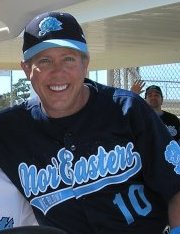 |
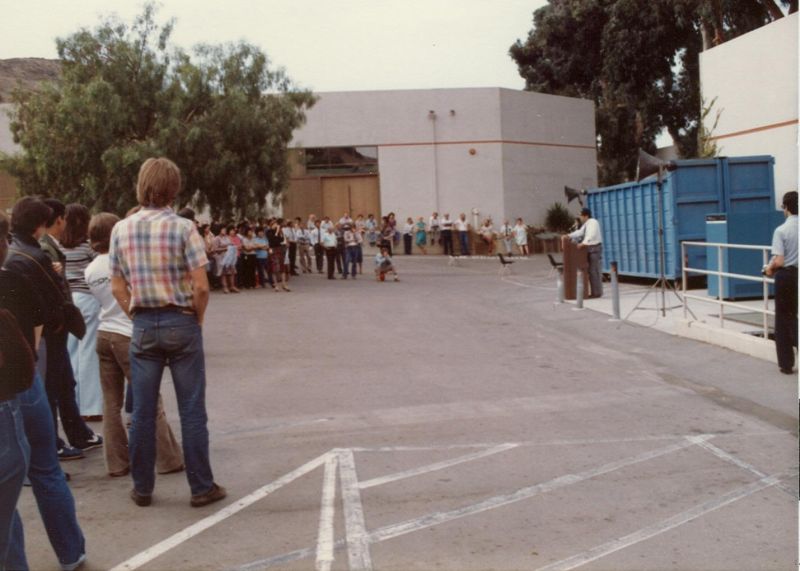
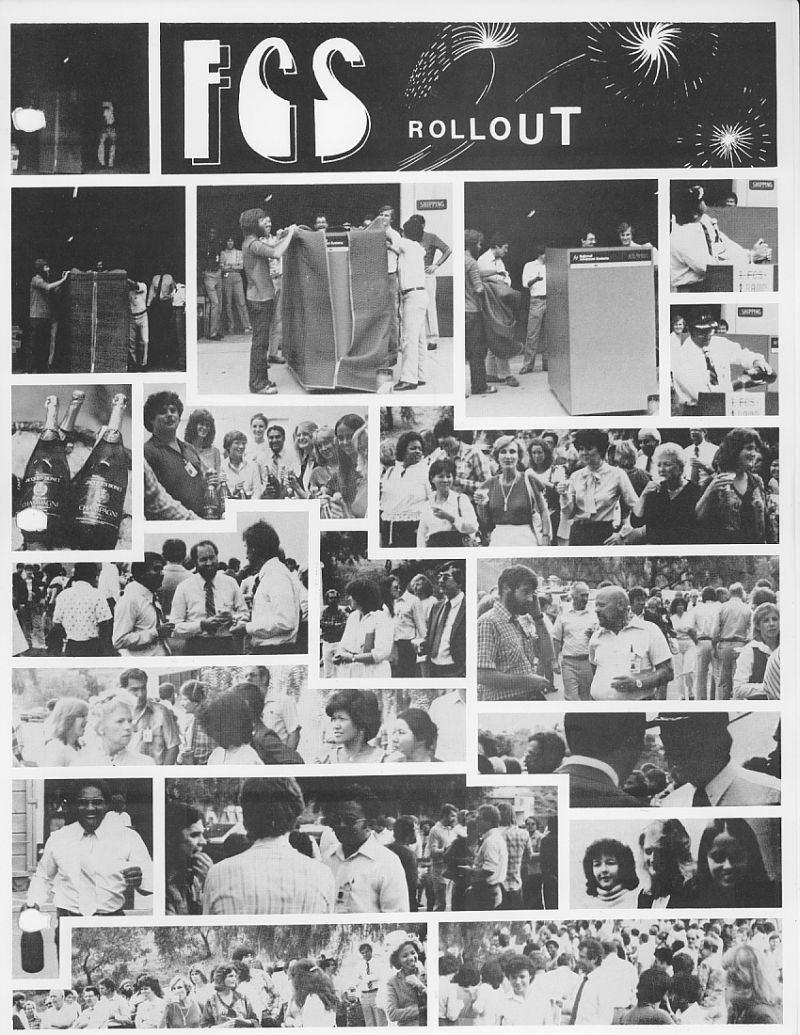
| Date: Wed, 20 Jul 2011 16:55:20 -0700 From: <techtrain cox.net>Subject: NAS website, memories Hi Mark- About 6 months ago I found your great NAS website. You did a fantastic job! I worked there from July 1981-Layoff. My first job was in the memory dept. and later on the AS6100. It was an amazing experience, and at one point I actually believed the company would be around for a long time--an old fashioned job! Here are a few memories: To prep for the AS6100, we had one INTENSE month of training on theory of ops and troubleshooting of the wirewrap predecessor. I remember dreaming about the logic diagrams. Do you have any in your book--the ones with gates rendered with ASCII symbols in rows and columns, all kind of looking the same? I'd love to see one of those on your site. Before going to the system debug dept., I brought up the service processor and power system--lots and lots of Amperes! Occasionally exciting! The ID tag in your photo is 35A at 208V = 7KW+. As one of our trainers said, a bad programmer could turn it into a $500K room heater! BOARDS: The great fire: In early 1982, 2 boardsets ($100K+) were destroyed by a burn-in chamber failure. One giant step backward. Many of the devices were not layed out on std.on 1/10 in. centers, so automated testing was difficult. In the summer of '82, they used brute force and hired dozens of temps to ohm out every node connection. The defects were passed to techs to sort out due to the rework wires and cuts and drills! We spent hrs. looking through layers of artwork to track these down. Business Stuff: At one of our monthly meetings I asked why we didn't use National ICs (as did a previous poster on your site). They were right there in those beautiful data books--why not use "vertical integration"? The response was that our chips didn't meet engineering req'ts! At these same meetings, there were charts that showed us losing money, but at a lesser rate than they anticipated, so it was o.k.! National had a great stock program for the common worker. The only thing that really worked out--I bought in at $19 in 1982 and sold for $57 in May of 1983! FCS The first production units were very difficult to bring up--huge amount of rework on boards and backplanes, not always done right! It seemed like we were way behind. I recall the original clock speed goal was around 56nS, but ended 10-20% slower. Seemed like we were in trouble. I worked the 2nd shift (4 day week thing) and when I came to work on FCS day, from the view of the parking lot from the I-5 freeway ramp, I thought the crowd was there because of a layoff meeting! As soon as I saw the champagne glasses, I knew it couldn't be that. You might say, as a 2nd shifters we were kept in the dark. Once the boards were cleaned up, it went pretty smoothly, but little did I know that it was too late! Hitachi Right after I started in in the memory department, they started building Hitachi memories. The most striking difference was that they soldered the memory chips (vs. socket them for replacement, anticipating failures). Also, the poor smokers had to step outside. Names- Gary Griffin and Ken Davis were a great help in production. Later, I worked with Dyke Summers (Celerity Computing) and Chuck Stead (Overland Data). I still meet people who worked at NAS. It was a privilege to be near the cutting edge so long ago--it gives me a perspective that makes the new developments in technology so mind blowing--the "youngsters" simply take it for granted! Thanks again, Dane Tovey |
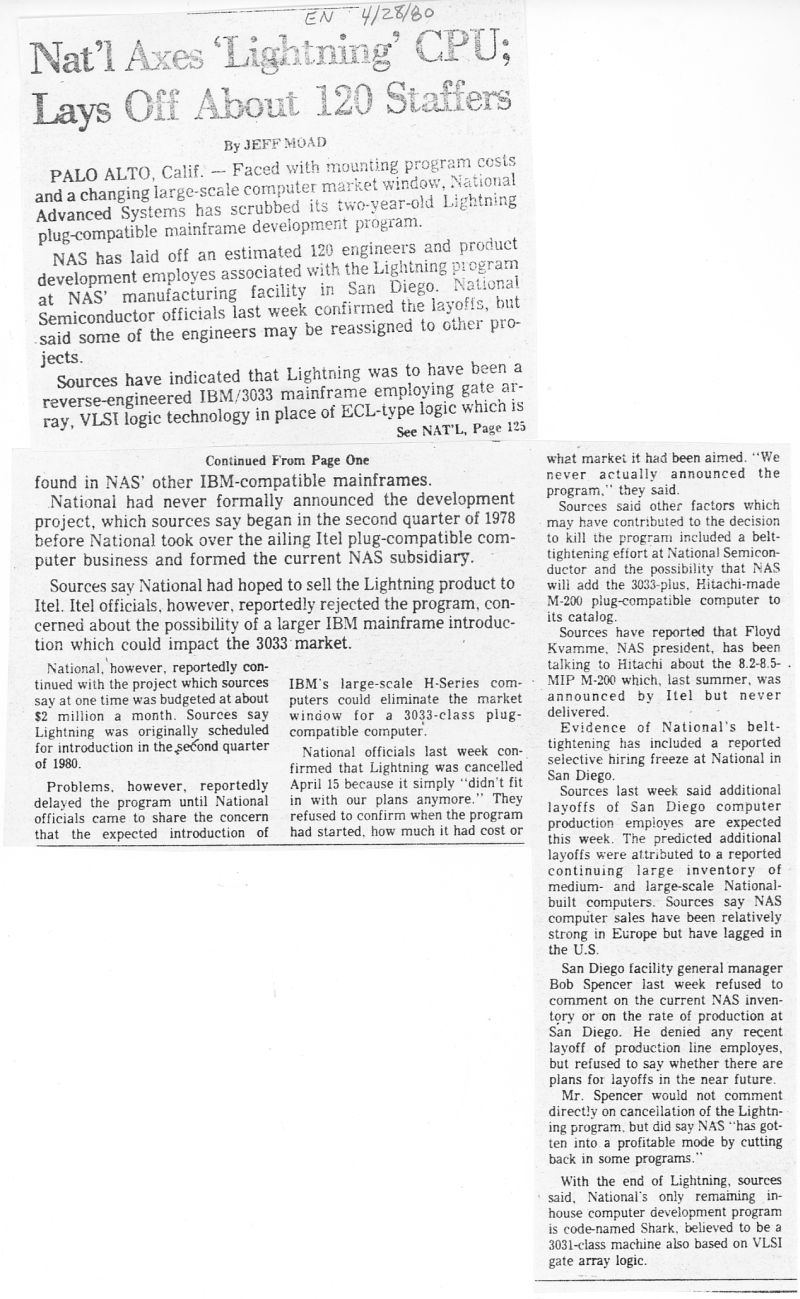
| Subject: NAS Date: Fri, 16 Dec 2011 15:54:34 -0500 From: "Harry, April" <April.Harry integralife.com>Hi Mark, I doubt that you would remember me, but I started at NAS probably around 1976 or 1977 on the Lightning project working for George Kinoshita. After Lightning failed I ended up in Mfg Engineering working for Bill Hess, almost until the end...Your site brought back many memories...Sorry to hear about Buck, worked with him, Tony Harrison, Jim Perley and many other X-NASites at Scientific Computer Systems through the 80's. Then moved into medical devices and am now living in Salt Lake. The site is wonderful. April |
| From: Dana Gillis <Dana.Gillishds.com> [email address not good anymore] Date: Thu, 28 Jun 2012 21:57:26 -0400 Subject: Exsysco Hi Mark, I was forwarded your Exsysco site today and found it quite interesting. I doubt you remember me but I was in tech support at that time. I started with NSC in 1976 in Sunnyvale working with add-on memories for IBM mainframes in both engineering and then tech support and in 1980 moved down to San Diego when that function (along with only 4 or 5 of us) consolidated with the mainframe products over in Sorrento Valley. I ended up working in tech support for AS-5s as well and ended up parallel scoping bugs on them for many people in the field. I also installed one of the handful of 6100 systems you mentioned. I can't remember the customer but it was in San Diego - I believe also in Sorrento Valley. I was in various building locations but one of them was in the same building where the 'Lightning' was being developed. One look at that system and the way they were developing it and the issues it had and I said 'no way it'll work' and of course they ended up cancelling that one. By then Hitachi had some very solid mainframe clones including in the 3033 class that Lightning was targeting. I remember the various layoffs including the first big one when the AS5 line was shut down and then again when they shut the Lightning project down. That building got mighty quiet after that. The company transitioned to NAS and then HDS. As you can see from my email address I'm still at HDS - one of the long termers. Nowadays I head up a software development group but I remember the days of working with the IBM mainframes, add-on memories, AS5s, 6100, being in the same building as the Lightning (I didn't work with it), and then working with the Hitachi products - mainframes, storage, etc. I forwarded your link to a few others who may remember those days - Leon Helms, Joe Richards, Ed McElearney, Hub Gayle, Dale Hoberg. Some of these people were in the field but worked on the AS5s. The guys I just mentioned are all still working at HDS with the exception of Leon who retired a couple of years ago after being in my group for quite a long time as a software developer. We're still in San Diego but have changed locations a few times and are no longer in Sorrento Valley - we're sort of northeast of there along I-15 in the Carmel Mountain area. Again, I really enjoyed reading through your site - it brought back memories (no pun intended). |
| Dana, I should remember you as I probably knew you. In the years after the big layoff in 1983, I saw Leon and other HDS people at the reunions that we used to have every year. (I actually lived in Scripps Ranch, not too far from the HDS office that used to be there.) Its certain that we just couldn't compete with Hitatchi. May I use your email on the web page? Mark |
| Hi Mark, Sure - you can post it there if you want. In thinking about it I guess I might be the last one still working for the company in San Diego who was also working for the company in the AS5 days. Kind of weird to think of it that way. Btw - I heard back from Leon after forwarding your site to him. He forwarded it to Fred Kokaska but heard the sad news back from Fred's wife that Fred passed away last September. Fred was with NSC for a while after the factory shutdown and then went to Qualcomm and then I think to Sony Ericsson. He seemed to always be working on his go-fast airplane to make it go faster. For quite awhile he kept a propeller in a lab at work. He was quite an interesting guy. |
| Dana added this: I need to add a postscript to my message - in thinking about it some more I realized I didn't know when Ed Castro started so I asked him today. He said he started with Exsysco in 1978. I started with NSC in Sunnyvale (in the group doing add-on memories for IBM mainframes) in 1976 and transferred to San Diego in 1980 so I think both Ed and I are now the last people in San Diego who worked here as well in the AS5 days but Ed has me beat as far as the length of time in San Diego. Somehow we both seem to have lighter colored hair than we had back then. |
| Date: Thu, 3 Oct 2013 09:54:32 -0700 (PDT) From: Rich Pizzo <iamhe999 yahoo.com>Subject: NAS Hey Mark! It's me Rich Pizzo (RMAP), I just found your NAS site. So cool! I haven't gone through it yet, But I will. What brought me to it was a search I was doing for a "10KMECL Trouble Shooting Guide self teach manual, that I did while there. I do not know how many the Publications Department printed, but a bunch were printed, handed out and circulated. I am trying to find one. I would love to have one, even if only a PDF copy. I did some interesting things at NAS with diagnostics, using various analysis algorithms -and later accessing design files- to predict failing FRU probabilities....and expressed the analysis within an -AID- Analysis Indicator an AID looked like this ". . . . . . 6 . . . . 3 . . . . . 1 . . . . . . ." each dot represented a FRU and the numbers indicate the total number of diagnostic algorithm votes for that FRU. The algorithms were rather interesting... because no one of them was perfect they made sense sometimes and did not make sense at other times..... but when all were aggregated together, They did pretty darned good identifying the FRU... It was a case of aggregated fuzzy logic.. A form of Expert System. Later, after National closed down, -that was so sad- Tran and I developed this idea further at STC Computer Research Corporation to include accessing design files, . I really enjoyed working at National.. and later at STC CRC. The software Tran and I developed at STC CRC, identified many problems it the STC CRC prototype check out. I loved doing that kind of work..... I am sad to hear about Fred and Buck's passing. We are all getting older. I will be 70 next year. I am wondering about Dyke Summers, I very much enjoyed working for him and with all you folks.. Rich (RMAP) |
| Rich, Good to hear from you after all these years. I never saw the manual that you are trying to find. Sorry. As far as I know, Dyke Summers is still living in San Diego. I don't have an email address. You could try emailing some of the other guys whose email addresses are on the page. If you get an address, let me know. I looked back at my 1979 Exsysco phone list and there you are! (but your name was a little longer back then) I've copied a few other ex-NAS folks on this email so one of them might be able to help you. Mark |
| From: Ed Castro <Ed.Castrohds.com> To: Rich Pizzo <iamhe999 yahoo.com>Subject: RE: NAS Date: Mon, 7 Oct 2013 23:22:34 +0000 Hi Rich, After the factory shutdown, most, if not all documentation was packed up and delivered to NSC for archiving. Nothing was left at the Roselle street facility with the exception of some of the AS/5 documentation we needed for support. I remember taking the AS/5 course for CPU troubleshooting and using various 10K ECL documents to understand the functions of all the chips used in the processor. Sorry to say that I do not have access to any of the archives from NAS any more. After NAS, we became HDS, Hitachi Data Systems, the joint venture between Hitachi and EDS. Eventually Hitachi bought out EDS's share and we became a fully owned subsidiary. Today we continue under the 'Hitachi Data Systems' formal name. We no longer market IBM compatible processors but continue to market and support Enterprise Disk Arrays. I am one of the very few remaining employees in our San Diego facility with Exsysco/NSC-LCS/NAS ties. Dana Gillis is still here as well. Many others have long retired. We continue to use Mark DiVecchio's site as a central collection point of Exsysco/NSC-LCS/NAS things.. Good to hear from you. Tell Tran I said 'Hi' .. Best Regards. Sergio E. Castro Hitachi Data Systems |
| Date sent: Sun, 31 May 2020 15:23:56 +0000 (UTC) From: Rich Pizzo <iamhe999@yahoo.com> To: "markd@silogic.com" <markd@silogic.com>, iamhe <iamhe999@yahoo.com> Subject: NAS Hi Mark I hope you and yours are all doing well during this pandemic. If you remember I was looking to find a ECL Troubleshooting Publication I made while working for National Semiconductor/NAS. I happened to see a page from it via a google search (images) see attached. I was very happy to find it, and got excited that mabe the other pages were there somewhere. Someone scanned it or took a picture of the page, which passed over the internet, and google picked it up, Wow! I thought maybe I would find the rest of the pages. I tracked down the source of the page and was surprised it came from one of your websites... So I thought I would contact you again, to see if you had any additional info. You can see on the graphic my Initials "RMAP" Any thoughts? Rich |
| Rich, Good to hear from you. Sally and I are well. I had scanned that page and put it on my web site about NAS/EXSYSCO. I got my box of NAS stuff and looked through it but I only have that one page of the document. It was such a great ECL summary sheet that I carried around with me all of the time. Its too bad that much good documentation has been lost. Mark |
| Mark, I can not thank you enough. To see that document after all these years, almost 40 years, I felt reunited with a long lost friend. Needless to say it brought great joy to my heart.. I just wanted you to know that! The publication it was part of, taught every point, condensed onto that single page......... I had also prepared a similar page for the TTL logic family.... long gone now... So thank you again. I am going to frame it and hang it on the wall to remind me of that time.... it was a good time for me. except for the plant closing.... Rich Rich Pizzoferrato, K1RSU. |
| Date: Tue, 21 Apr 2015 02:51:10 +0000 (UTC) From: Chris Grant <chris.grant att.net>Subject: Exsysco Mark, Very interesting stuff. I was a Field Engineer with Itel in San Diego in the late 70's, we had a field office on Balboa Avenue. Exsysco was one of our customer sites, we used to maintain the disks in the computer room there. At the time I think we had one AS5 installed at a financial services customer in downtown San Diego. I don't recognize many of the names apart from Paul Hastings and Dana Gilles. There was also a chap.....Larry.....worked with Paul, handlebar moustache. I left HDS in 1995 and now implement Oracle software for my sins. A really excellent write up, all the best. I like the photo of the machine undergoing an 'IMPL'. I seem to recall quite a few of those. :-) All the best. Chris |
| From: "James A. Singer" <jsingerjas-technologies.com> Subject: Saw your page on EXSYSCO Date: Thu, 8 Oct 2015 15:00:05 -0700 I started working there in 1977 just after getting out of the Navy. I was on the main floor (technician) and spent about 2.5 years there until the layoff started. We just got in an IBM 3033 to reverse engineer and shortly after that the company went under. I got transferred to DataChecker ( another division of National Semiconductor) in Tampa, Florida and about three weeks there I got a strange call from my boss asking me to go down to one of the banks and see if I could repair their mainframe. The tech had been onsite for over 4 hours and California was standing by to fly in David (one of the engineers) to Tampa. So I talked to him on the phone. His first comment was 'what the hell you doing in Tampa"? I told him I moved here and then asked him to let me get to work since I had not looked at the problem yet. It was failing an H disk routine and after about 15 minutes I replaced a SIP and the machine was up and running. Then ITEL down in Miami tried to hire me and I stayed where I was. I worked for Stu Kroll and Bill O'Neal on both the first and second shifts. A lot of the time I worked on Saturday and Sunday. Was young and needed the money. Left National Semiconductor and worked for NASA for eight years as an engineer at the Marshall Space Flight Center. Started my own corporation in 1998 and am somewhat retired now. I don't know if you remember a guy name Jack Peters who was killed in a motorcycle accident, but we were supposed to be renting an apartment together. There was also one guy Coleman (David I believe) long brown hair and looked like jesus. Barbara Reeves also worked there. Later James A. Singer PMP President/CEO J.A.S. Technologies, Inc. |
| James, Thanks for your email about NAS. My web page dredges up someone every couple of years. Good story about the computer in Tampa. You saved the day. I suppose that was an AS-5. I don't remember you but I do remember Stu and Bill. Stu ended up working with me in Engineering when the division finally closed down. We were all young and worked way too much. But that is what you do when you are young. I don't recall the names Jack Peters or Dave Coleman either. But I do remember several hirsute test floor techs. Can you put your email on my web page? Might be of interest some of our former co-workers. Mark |
| From: "James A. Singer" <jsingerjas-technologies.com> Subject: RE: Saw your page on EXSYSCO Date: Fri, 9 Oct 2015 01:33:30 -0700 I just remembered it was Dennis Coleman and one of my good friend I stay in touch with is Sherry Coleman (they are not related). She worked on the morning shift with either Bill or Stu and got hurt. I was on workers comp for about 10 weeks when I stepped off the raised floor onto an IO cable (bus and tag) and broke my left foot in five places. Hopped over to Bill and he looked at me and goes 'Shit what did you do?" Not sure if you were on the fishing boat for one outing, but Jack hooked me with a fish hook in the leg and I found out who had the booze and drugs that day. I worked on machine 100 and we all signed the inside of the door. I was part of the second round of layoffs in 1979. Those machines, wired wrapped and all, were pretty amazing. Remember the add on memory unit and the XAR? One small wire enabled the executable array. Had to go to a client one day and Bill told me to make it look hard when I had to enable it. Right. Less than 1 minute and I was done. Also went to the Christmas parties they use to have. There was a little place about two block away we all went to eat from work. How do I add to your web page? I will put a lot of info on that someone may remember. Jim Singer |
| Jim, If you send me emails with your stories, I will make sure that they get on the web page. Mark |
| Was cleaning out some
old boxes and found one of the 8" floppy disks used for testing.
I think it is the H disk. Also found an old pay stub dated
6-10-79 with EXSYSCO on it. Somewhere in this house I know I have
an old tape from there and some programs we made to test memory and
some other stuff. One tape had STS370 on it that was
a program we ran in the final test phase I think. Jim |
| From: "Jim Matthews" <jim2001charter.net> [email address not good anymore] Subject: Exsyco and NAS Date: Mon, 1 Feb 2016 10:55:45 -0700 Hello, I worked at Exsyco on the test floor then moved to supporting the test floor system programs and in the national support center for VM. I found my name in the phone book, Matthews, Jim Ext 367 Bldg 4 M/S 9. When I went on the interview at Exsysco everybody in the room were people I knew from NCR. Eisenhauer, David Ext 496 Bldg 4 M/S 9 was my manager and when he moved to Dallas, Tx, to setup a support center for Four Phase in 1981, he asked me to join him. I joined him in Dallas on Jan 4, 1982 after graduating from college with my Programming degree. I remember when we were in line to turn in our Exsysco badges and get our NAS badges, the guy in front of me, refused his badge since it said Bob instead of Robert! I do not remember his last name, but he moved to Dallas, Tx, also. When I was still on the test floor, I came into work and was told to go to the loading dock. I asked why and he said just be happy you are going to the loading dock. The people who went to the cafeteria were laid off. I worked second shift on the test floor and in 1980 I switched over to supporting the programs on the test floor from midnight to noon. The problem that gave us the most trouble were pieces of solder, little balls, that would move around when you were trying to trouble shoot the problem. When we finally figured out the problem, we would sent the panel back to have the wiring removed and rewired. After a while we figured out that they were not rewiring the panels, so we started tracking the serial numbers. When a back panel showed up with the same type of problem and serial number, it would be ACCIDENTLY dropped and broken. When I was supporting programs on the test floor and VM/SP in the support center, I called over to operations to have them mount a disk drive for me. After a while, I called back because the disk had not been mounted. She said the disk was mounted. I asked her to doubled check and she said it was mounted. I went over to the operations center and there was the disk setting on TOP of the disk drive. She thought it was mounted because it was setting on top of the drive.. Jim Matthews |
| From: Wesley Whittaker <wesleywhittakergmail.com> Date sent: Fri, 22 Jul 2016 23:23:51 -0400 Subject: NSC - Sorrento Valley Mark, Thank you for the page you put up about the Large Business Computers division of National Semiconductor. I was there in 1979. I started in the R&D lab working for Al Casper. I and a guy named Bill built the APU prototype that worked the first time it was fired up! All I remember was that there were a ton of fabric cables interconnecting a butt load of wired boards. As a reward, John Conti, offered me a drafting position where I worked with a wonderful Vietnamese fellow named Ton Bui. I remember having a lot of interface with Bev. Sorry to hear he passed. He was an exceptional man. It was one of the best places that I ever worked. Everyone was laid back and doing what they enjoyed, but we always seemed to get the work done. Thanks for the memories. Wesley circa 1979 -- Wesley A. Whittaker Ghostwriter - Author http://wesleywhittaker.com |
| From: "Jeff Lindskoog" <xcodemeistergmail.com> Subject: Supercomputer Architects Reunion Date sent: Tue, 14 Feb 2017 14:49:03 -0800 Hi Mark, Long time, no talk! I stumbled upon your nice history piece on Exsysco. I also worked there first for Tim Brehm on the Multi-Processor Attached-Processor system. I designed the interprocessor switch including memory switch, cache coherency, etc. and also designed the 4 Megabyte (ha ha ha!) memory box which I remember as about 4' x 3' by 5'. The memory cost $75,000 per megabyte as I remember. I then went on to be the first engineer on the Lightning project where I did the first architectural logic organization and design translation for the project. I think I worked for Howard Sachs but I can't remember if he was the one in charge of Lightning. Thanks from all of us for doing such a nice job on the Exsysco history! A lot of water has gone under the bridge since we talked last, too much for one email. I worked at Megatek on the Sigma 70 and then went to Ball Aerospace when Ball bought the Sigma70. We did a lot of flight simulator math engine accelerators at Ball. After my stint in Minnesota at Control Data Supercomputers. I went on to do a couple of small projects designing mathematics sets and architectures for specific high-speed number cruncher applications. Now I am at Cybortronics where I do Phase Change cooling systems and electronic/electrical design for environmental test chambers. Our customers include Cisco, Western Digital, Jabil, Foxconn, etc.. I do remember doing some design work for you. I cant remember your partner's name. The job was for Dr. Design as I remember. Its nice to remember the good old days and all the cool people that we worked with for all those years. RIP Buck Titherington. Lets get together sometime for lunch and catch up. Jeff Lindskoog Sr. Staff Engineer Cybortronics, Inc. |
| Jeff, Ah! A voice from the past. I remember you and the memory boxes that Exsysco/NAS did. Geeesh, I threw out a gigbyte memory that cost me a couple of dollars yesterday. Those where the days when we worked really hard and had a lot of fun although many of the products never saw the light of day - like the NAS AS-6100. Doctory Design (run by Marco Thompson) was bought out many years ago but he is still running around San Diego. Megatek, as you probably know, is long gone. Mark |
| Hi Mark, There is another guy from EXSYSCO that you may remember, Randy Parrish. He was in the Attached Processor group. I am planning on directing him to your NAS site, I'm sure he'll get a kick out of it. Also, we must remember another member of our group, Ellen Maskell, who was tragically killed in a car wreck right on Sorrento Valley Road, or thereabouts, by the old NAS plant. I think I read that you are retired now. I am 59 and still cranking full speed, I'm planning on backing off a bit on the workload soon and retiring at 66 unless I win the lottery. Cybortronics is a nice little company to work for and will probably be my last employer before retiring unless something happens that changes my plans. I was reading some of the info in your NAS site about the demise of the Plug Compatible Mainframe industry. At the time, someone at NAS described the demise of NAS and the other PCM companies to me in a way ill never forget. He said that IBM was very smart in the way they got rid of those pesky PCM companies: The story was something like this: For a mainframe computer IBM would sell the hardware for $750 K and the software for $250 K. This allowed NAS to come in and undercut their hardware by selling NAS mainframes at something less than $750 K like $500-600 K. In order to wipe out NAS and other PCM companies in one easy move, IBM simply changed the pricing on a mainframe to $250 K hardware and $750 K software. Checkmate without even breaking a sweat. Have a good one, Jeff |
| Jeff, I looked at the November 1979 NAS/Exsysco phone list and did not find Ellen (or you for that matter). The last name on the list was Sandor Zoboki who was later written up in this article: http://www.upi.com/Archives/1983/03/31/A-Hungarian-fighter-pilot-who-became-a-successful-businessman/2072417934800/ Mark |
| Hi Mark, Yes on including my emails. I would be honored to be included amongst our colleagues on your NAS page. I am not sure why neither Ellen or myself are in the phone list. I read the thing on Sandor. I remember him and his VERY colorful past. He was a cool guy as I remember. Speaking of colorful past. I just remembered a guy named Stan Rifkin who worked at NAS if I'm not mistaken. One day Stan didn't show up for work and if you google his name, you will find a number of articles on why. I won't go into detail here... Ill be getting ahold of Randy Parrish later this week when I get a moment, I'm sure he'll want to get in touch with you. I'm not good with dates... I left NAS when the Lightning program was scrapped if I remember correctly. I wasn't involved in the layoff. I don't remember when Randy left. As I think back, EXSYSCO/NAS was really a great pool of high-end computer people. The atmosphere was great and the machines were fun. The people at EXSYSCO/NAS remind me a lot of the engineers at CDC Supercomputers/Star Technologies in Minnesota. There were a lot of high-end computer engineers in Minnesota working at the various supercomputer companies. There was a Mensa Supercomputer sub-group that was pretty wild. Have a good one. Jeff |
| From: Ed Castro <Ed.Castrohds.com> Date sent: Mon, 17 Jul 2017 16:41:55 +0000 Hi Mark, Paul M. Hastings, one of our CPU support engineers who worked on the AS/5, passed away last month. Best Regards. Sergio E. Castro Hitachi Data Systems |
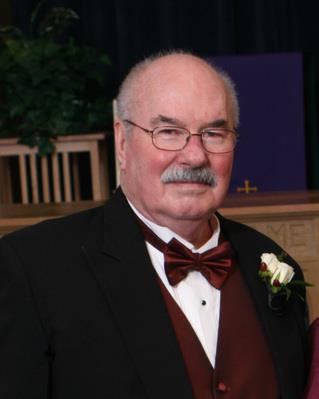
Hastings, Paul Milton Age 81 Coon Rapids, MN Passed away at home on June 25, 2017. He was born in Des Moines,IA to Lawrence and Jesse Hastings on November 16, 1935. Preceded in death by his parents; sisters, Rose Adams, Arlene Stang, and Rita Oline. Survived by wife, Kay and her daughters, Julie and Jodie; his children Warren (Althea), Wes (Tricia), Roberta, and Alan (Denise) from his marriage to Carol Hastings; grandchildren, Firmino, Rosana, Alex (Erin), Llewellyn, Rhys, Cooper, Ari, Austyn, Dallas, Emma, and Angela; many nieces and nephews. Paul's love for family, music, and friends will be long remembered. Join us for a celebration of Paul's life at Moes Restaurant on Friday, July 7th, 5-8pm, 2400 County Hwy 10, Mounds View, MN or Felix and Oscars Pizza on Saturday, July 8th, 5-8pm, 4050 Merle Hay Rd., Des Moines, IA. http://www.startribune.com/obituaries/detail/205446/?fullname=paul-milton-hastings |
| Guest Book entry at the Star Tribune: Although
I hadn't heard from Paul for a while he was always in my thoughts since
we worked together in NAS's war room in San Diego shortly after I
joined NAS European Tech Support from being a large systems specialist
of IBM way back in the early 80's. Rest assured that he will live in so many hearts for just being the incomparable Paul 'Magoo' Hastings. I was proud to have known him. He was a prince among so many techy legends and I have so many happy memories. From a grateful friend, July 03, 2017 | London England |
| From: Robert Gilmore <inscalegmail.com> Date sent: Sun, 28 Apr 2019 21:22:45 -0400 Subject: EXSYSCO AS5 Hi Mark !! I really enjoyed reading about the EXSYSCO AS5 !! Great job !! BTW, I am Bob Gilmore, I was working at NCR, Rancho Bernardo on their Century II ecl computer as a Sr Sys Tech, bringing up the system from power up, diags, T/S -repair to QA ... In 1976, I got a call from a head hunter to work at EXSYSCO as a System Tech Eng to bring up the very first AS5 .... my boss was Jerry Beres, mgr of Sys Test. During the next 6 months, we recruited many of the NCR techs as I new who were the best for the System Test floor. Later in 1979, I left EXSYSCO and went to work for ITEL in Germany as a Tech Support Specialist working on all the AS5s in Europe. After a couple of months, I was again working for National Semiconductor as they took over from ITEL .... After the 2 years in Germany I came back to San Diego and worked in the Field Engineering Tech Support group. After a year, I left to join Pacific Southwest Airlines as a Field Engineer. That is my story !! Bob |
| Bob, Thanks for your email. I think I remember your name but I can't put a face to it. I was at NAS from May 1978 until it shutdown in Jan of 1983. NAS was one of most interesting places that I worked. I remember Jerry Beres in test and a lot of the guys in Field Engineering. That group, had a continuing life as Hitachi Data Systems after NAS closed down. May I use your email on my NAS web page? |
| Hi Mark, great to hear from you and yes, you can post my comments. Also, it was very challenging working on the AS5 troubleshooting each problem down to the bad IC chip or tight wire wrap defect. Overall, the AS5 was very dependable and required little maintenance at the customer site. Robert |
| From: John McFall <johnmcfallgmail.com> Date sent: Tue, 21 Apr 2020 22:14:40 -0400 Subject: when they found out that SYSCO was taken, they named it EXSYSCO Thanks for keeping so much NAS/Exsysco stuff, Mark. I am grateful to have it during this period of luxurious confinement. Many muttered to themselves that one of these days they were going to write a book about this damned place, but you actually did keep the pertinent records. I remember the stories I've told to others about the happenings in Sorrento Valley and those are the ones I remember. I have forgotten so much. I no longer remember how many bits were in the 158 or the AS/3 microcode word but I remember the day Ron Silva was locked in the bldg 1 vestibule because the brand new badge security system malfunctioned. He opened the door and then let it close while he zipped his jacket and then was not allowed to exit or enter. I can't remember the name of the manager of the Lightning project (from England) but I do remember the serious meeting the managers had on the day Avram's dog left a soft pile in his office. Given the unpopularity of the project, they thought it was a political statement but it was just a yellow lab. I noticed a note on Jerry Foster's desk early one morning. It was ALL CAPS from building maintenance and said the UNAPPROVED extension cord between credenza and desk must go. I thought, that we might have a laugh about that someday, so I made a copy and returned the original and waited. Soon, Jerry was in and complaining that the lighting was inadequate and that he had brought a lamp from home but there was no convenient plug. He complained to me, then to his manager, then to his. ... it escalated all the way up to, perhaps, Spencer and the orders came back down to let him have light. It took most of the day. The next day before Jerry came in, I put my copy of the memo on his desk! I had to tackle him from behind to keep him from losing it. I really thought he would complain to me first. He forgave me after a week or two. I do remember when the building administration decided to ease the burden of mail delivery by sending out an edict that we all change the address of our technical publications to our homes instead of the office. When Bill deForrest, the best MVS specialist we had in our firmware group, told them in his exit interview that his wife read the job ads and found him a job in Switzerland, there were, nonetheless, no policy changes made. We tested tri-residence microcode in Palo Alto and I don't remember who owned the machines but it was the size of an arena. There was a short deadline and it was a grind. One week we had trouble finding a hotel. We searched out in all directions on a map with Palo Alto in the center and found an opening in Half Moon Bay. When Howard Sachs found out where we were staying, he made us move, PRONTO, to a closer place that had opened up. I was glad for it but Craig Morgan, an avid off road jeep driver, missed driving the rental car on the fire roads through the hills between Stanford and the beach. I don't remember all 3 of the operating system assists that made up tri-residence firmware but I remember walking over to building 2 with Bob Knopp and Yee Lee for a company announcement on the day the TV trucks were there. I didn't know how to react to being laid off for the first time in my life so I went home and took a nap. Bob Knopp came to the house before dark and hired me back. I do remember that we leased a very fast mini-computer, but not the name or model or what group needed it but when they were done, I set it up to monitor I-fetch and ran all the system tests and then found out which 4341 or AS/6100 firmware instructions were missed so Stan Gerrity could, at least, devise a unit test for each. I think that was what got me into firmware maintenance after the shut down and into Hitachi Main Frame diagnostics later on. I was 64 when HDS, it was called by then, wanted me to work in a diagnostic group testing disks. I retired and moved back to Hoosierland to attend reunions and funerals and listen to the locals tell me how I should have been here when Larry Bird was playing. I noticed the other day that my finger nails are striated. I looked it up and they have a picture of MY fingernail. They say that "develops in older adults, possibly due to a slowing of cell turnover." No cure for it. I can't tell you how much fun it is to talk to you like this when you aren't answering back. Thanks again for remembering to keep . ... wait remember when they sold the 100th mainframe and gave us all a T-shirt and the kid who dumped one of them when trying to move it from building 4 to 3 for testing crossed out 100 on his shirt and marked it down to 99? There is no end to it. Good Luck, Mark. j |
| Date sent: Tue, 24 Aug 2021 12:23:50 +1200 Subject: NAS From: Tony Krzyżewski <tony tonyk.nz>Mark, I just came across your Silogic website and it brought back many memories. I was an ITEL/NAS Field Engineer in New Zealand from 1978 – 1983. This was my first field engineering job having previously been a computer operator on an IBM 370/145 DOS/VS machine. The AS5/3 and 783X training course was long and arduous though we were lucky(!) in that our initial customer in New Zealand gave us their CPU from 9pm to midnight which meant that the day was classroom training and after dinner we all got to go and troubleshoot bugs that had been introduced into the CPU. The AS series wire wrap machines certainly kept me well entertained once I got out into the field with my first posting being at a timber mill in the centre of the North Island. Perhaps my most memorable experience with that AS/3-5 CPU was it developed a problem that would see it drop out of the translation lookaside process on one virtual DOS/VS instance every 10 days or so. The EREP showed a clear parity check error but for the life of me I couldn’t solve it. We dragged Fred Kokaska out of San Diego and on the two hour drive down to the site from Auckland Fred mentally walked through the TLB circuitry and declared that he though he knew where the problem might lie. We were give the machine at 6am the next morning and Fred rigged up a small dead stop on parity error circuit and we sat back and waited. A few hours later the CPU obligingly came to a dead halt and we could see that one section of the TLB was clocking a few nanoseconds early. This was where I discovered that you could actually fix CPU timing with wire wrap wire as Fred simply grabbed a roll, measured out 36 inches, inserted it into the gating clock line and informed me that the problem was fixed. He was right, that CPU never again had a TLB error and I neatly updated the ALD with a new line showing the "Kokaska�" clock fix. While the Augat panels may have made construction simpler they were a challenge in the field as it meant that just about every CPU problem ended up having to be scoped down to the failing gate where our IBM counterparts could simply replace a failing logic board. I learnt an awful lot about troubleshooting and gate logic in that job. With your work on the XAR I probably have you to blame for the fact that I still remember LOP-HOP-SUM and CARRY! I have a bunch of ITEL/NAS marketing documents together with an IBM 370 Instruction Set Card and Theory of Operations manual - which was my goto book for working out where to start troubleshooting. When I left the company in 1983 I was given the Tektronix scope from my toolkit and it’s still doing its job today. Best Regards Tony |
 |
| Tony, Thanks for your email. I have always been amazed at how the Field Engineers, like Fred, knew those computers inside and out. And other guys who worked out of San Diego FE like Leon Helms and Ed Castro. As a design engineer, I would spend months or years working on one small section. If you asked me about the Translation Lookaside Buffer, I would stare back with a blank look on my face. As you saw, Fred could picture its circuitry in his mind and guess at the problem before even seeing it. (Fred, as you might have read on the web page, passed away a few years ago.) When I redesigned the XAR, I cut the number of clocks from who knows how many down to 2 but each of those had a few sub-clocks of different timing. See the attached drawing that I saved all these years. Adjusting the clocks by lengthening wires was a standard fix. It really reflected the poor design of AS/5. At least when we went on to design the AS-6100, we cleaned up the clocking so that almost all clocks were timed exactly the same. I'd like to use your email on my web page if that is OK with you. I'll be happy to add any more memories that you might want to add. Mark |
| Hi Mark, Feel free to post my email on your web page. Most of what I have is the old Itel marketing material but I’ll ferret through my boxes and see if I have any mechnical stuff left. When we switched over from Itel we had a problem in New Zealand because we couldn’t register a company with the name “National” in it at that time. We ended up being Natsemi Advanced Systems (New Zealand) Ltd as the registered company name. I immediately discovered one other benefit from the change of ownership as an electronics hobbyist. From that point on the local National Semiconductor distributor would happily supply me all the chips I needed as manufacturing samples and as more specialised chips came out of the plant, a full tube would land on my desk. I still have stacks sitting in my shed today and I feed them out to the vintage computer restorers from time to time. Working on the NAS boxes was a real experience. When I show people today the sort of thing that I used to fix right down to the failing logic gate, all they can do is stare in wonder. A few ex-IBM mainframe guys reckon that our troubleshooting skills had to exceed theirs because they were board jockeys whereas we didn’t have a choice but to dig out the H disk, unpack the scope and go hunting. For my remote site field kit I had four of each ECL chip type used in the AS, a small box of SIP terminators, 16 RAM chips, light bulbs, a few switches and three PSU’s. We had one XAR PROM set to cover the whole country and I only ever had to troubleshoot an XAR problem once which ended up being a dead PROM bit. Once the Hitachi AS7000 came out I could see that I was going to end up spending my time fixing printers and disk drives rather than doing what I really enjoyed and decided that it was time to leave and I got into the fledgling microcomputer industry. Tony |
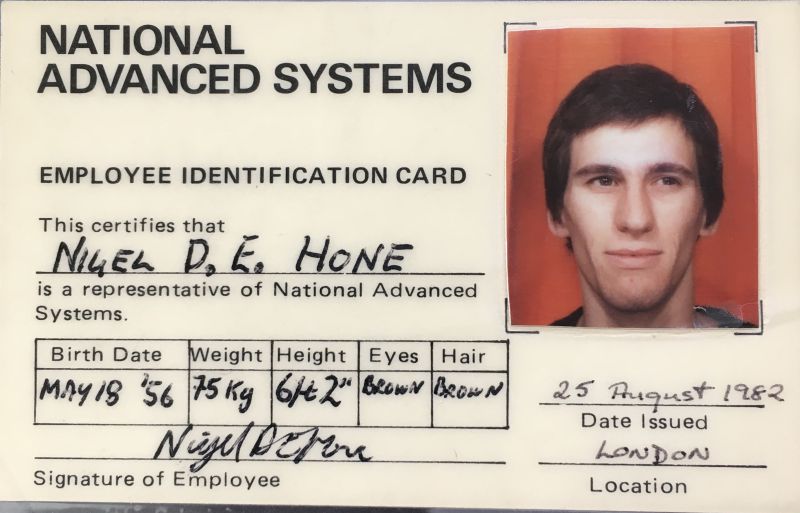
| From: Nigel Hone <nhschafti.de> Subject: ITEL - NAS - HDS - Hitachi Vantara Date sent: Tue, 7 Dec 2021 02:54:54 +0000 Great site. Best memories. I have been "here" since 1979. I made a few excursions but I always came back. Anyone who knows me is welcome to contact me. Incidentally, I wrote a machine code diagnostic to help AS5000 XAR diagnostics. It worked very well. I think I still have a floppy disk in the shed, but I have no reader. If you want, I can add a few good stories. Please tell me if you are still active. Nigel |
| Nigel, Thanks for your email. Yes, I'm still here and I always appreciate stories/photos/scans or any other info. I will add whatever you send to the web page. Mark |
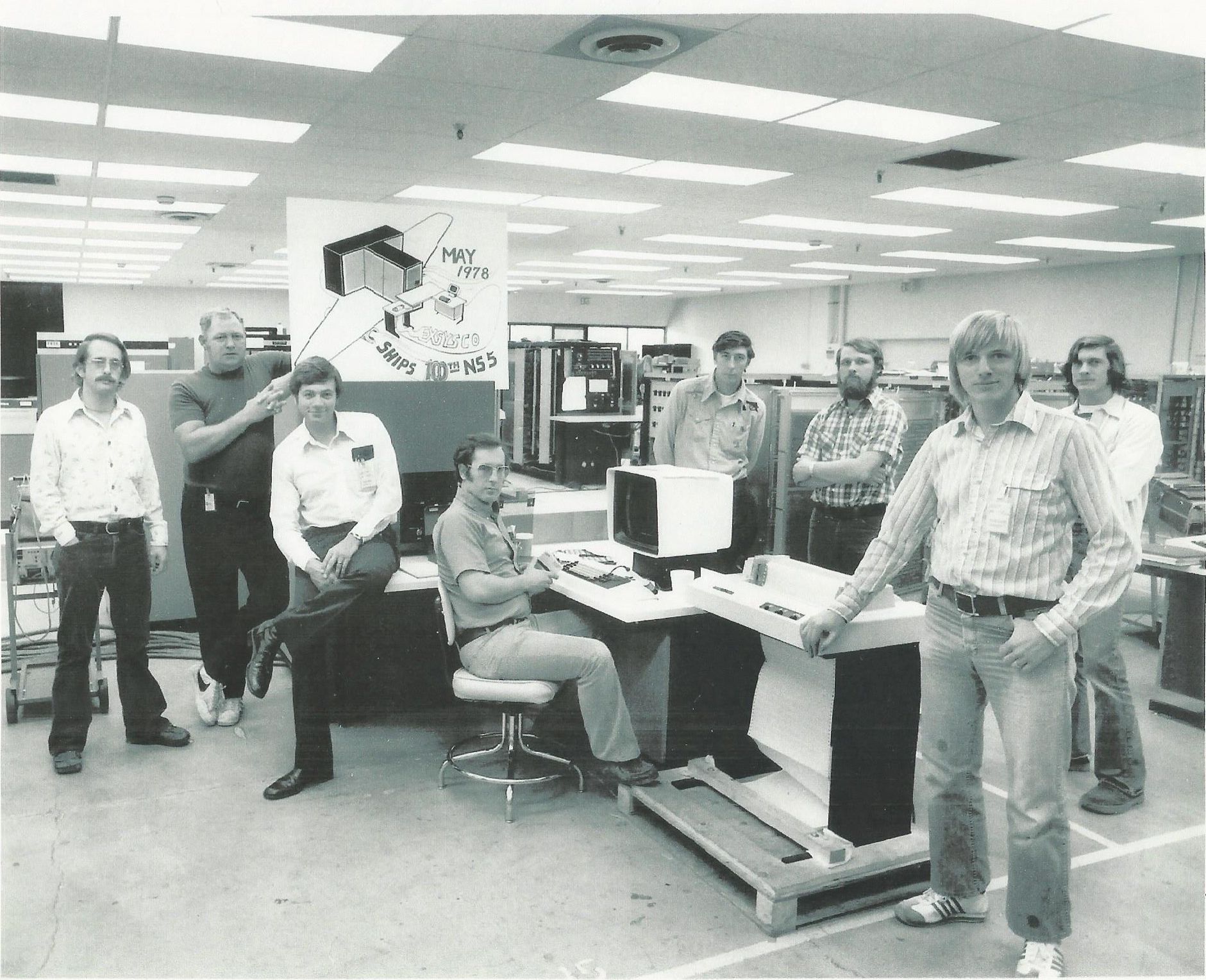 1978 May AS5 100th Computer Shipped - Test Floor Crew ID's so far from Bob Grosdider and Robert Gilmore. left to right: Jan Camping, ?? , Bob Golwitzer, Gary Crowningshield, ?? , ?? , Jeff ?? , Bob Grosdider Email me if you know the other guys. (click on image for full resolution version) |
 From: Robert Grosdidier <robert.grosdidierhitachivantara.com> From: Robert Grosdidier <robert.grosdidierhitachivantara.com>Subject: Exsysco-NSLCS-NAS-etc. Date sent: Thu, 25 Aug 2022 13:41:13 +0000 Hi Mark, Ed Castro pointed me to the website from the old days at Exsysco. I worked on the AS5 test floor from 1978 to 1980, I was on 3rd shift and remember working with Bob Gollwitzer. I transferred to the field when there were hints of the impending layoffs, I am still with Hitachi, now called Hitachi Vantara and currently living in Florida. I attached a picture that Bob shared with me several years ago, we ran into each other by accident because my wife and his wife became friends when we moved back to San Diego in the late 90's, small world. Bob is sitting to the left, Jan Camping is all the way to the left & I am all the way to the right in the back, unfortunately I can't remember the names of the other guys in the pic. Regards, Bob Grosdidier Escalation Support Hitachi Vantara San Diego, CA USA |
| Bob, Wow that brings back memories from over 40 years ago! I'm going to add that photo and your comments to the web page if that is ok with you. I remember many of the faces but not the names... I started at Exsysco about the middle of May in 1978 right about the time of the photo. I'll let the people on my mailing list know about the photo and I'll bet that we will be able to id everyone. Mark |
| Date sent: Fri, 26 Aug 2022 14:15:11 +1200 Subject: Re: (Fwd) Exsysco-NSLCS-NAS-etc. From: Tony Krzyzewski <tony tonyk.nz>Thanks for making the biggest kitset computer I have ever assembled. Unpacking AS5’s and assembling them in the field was a lot of fun and there was always a moment of holding your breath when you hit the power on button the first time! Then the joys of running diagnostics, and I don’t think I am ever going to forget LOP HOP SUM and CARRY, or the pain of hunting down an intermittent fault caused by a bent pin on an ECL chip. When I left NAS the company gave me my oscilloscope as a leaving present .. and it’s still being used to this day. We, I should note, did not leave console printers sitting on their pallet base as shown in this photo. ☺ All the best Tony |
| From: Nigel Hone <nhschafti.de> Subject: RE: (Fwd) Exsysco-NSLCS-NAS-etc. Date sent: Fri, 26 Aug 2022 11:03:45 +0000 Hi folks, Thanks for inserting me in this loop. I started with Itel in 1979 and just retired from Hitachi Vantara in March this year. I will create an online folder with all my relevant photos in a while and send it out. If anyone remembers me, shout out. Cheers Nigel Hone |
| Robert Gilmore added some id's to the guys in the photo. His web page - https://www.vintagevolkswagenmodels.com |
| Nigel posted photos. He wrote: As promised : a bunch
of photos. Most of them seem to be of parked cars. I do not know why but I
guess my wife took all the interesting ones.
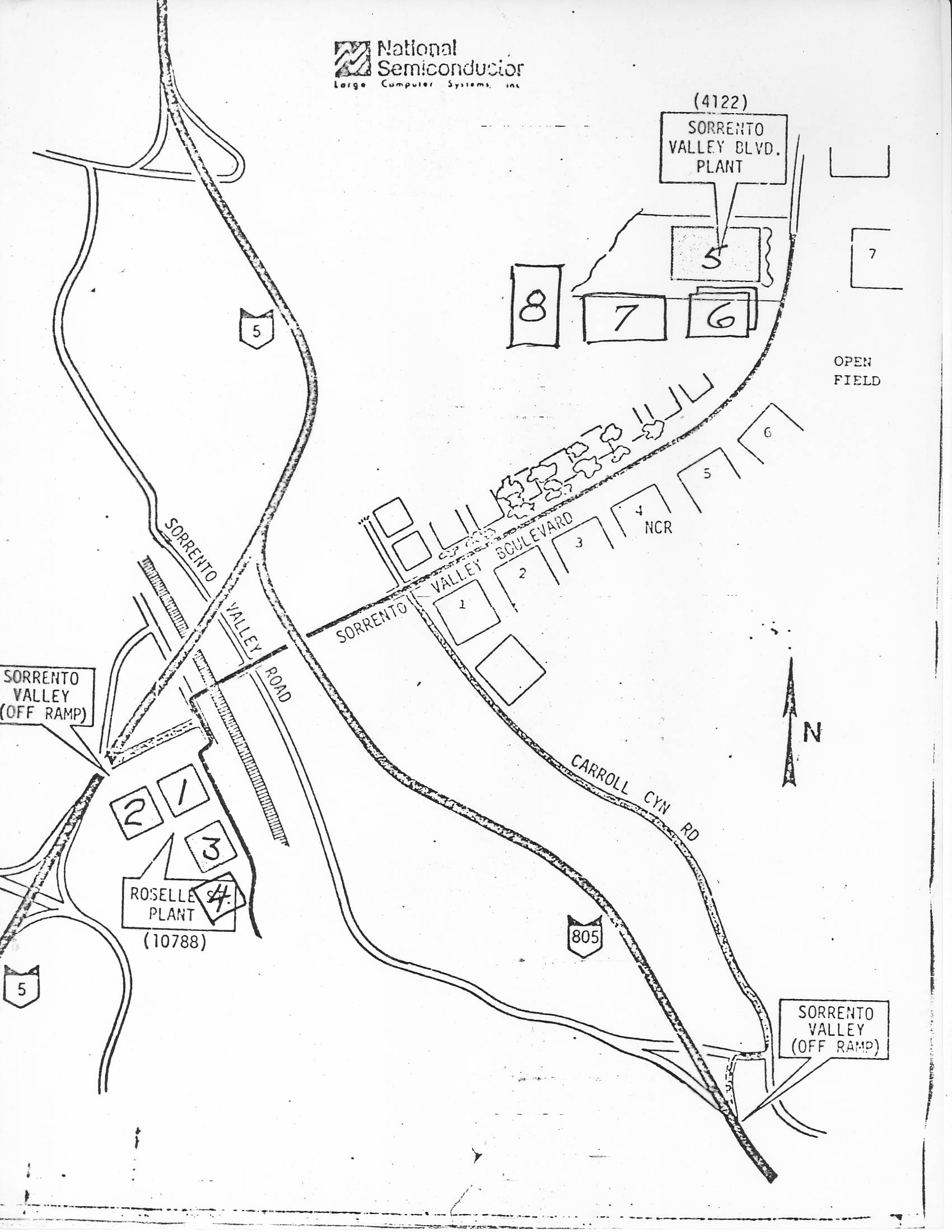
Tell us if you recognise a car. Here is a link: NAS I've used some of them below. I'm not certain any more which building was #1, #2, #3, or #4. Click here for a map. |
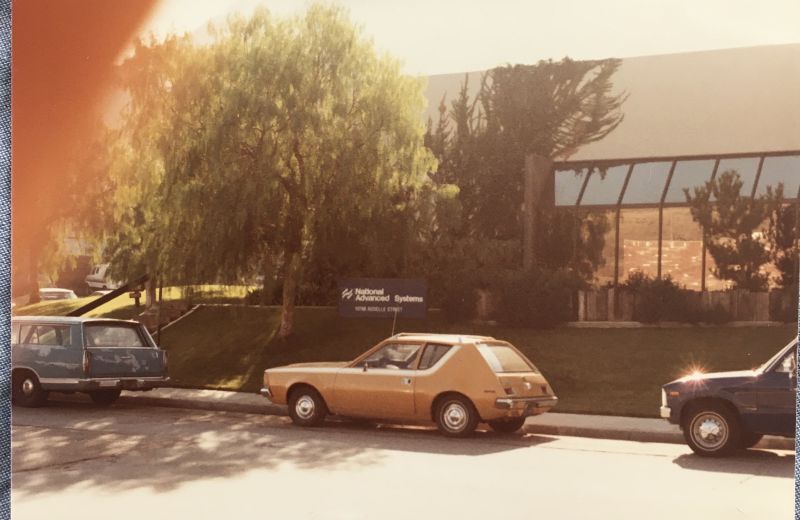 Building 1 ? |
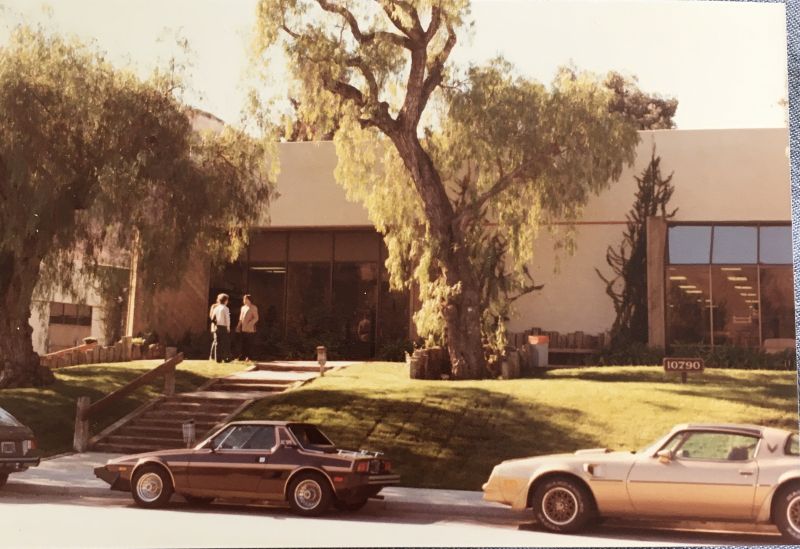 Building 2? |
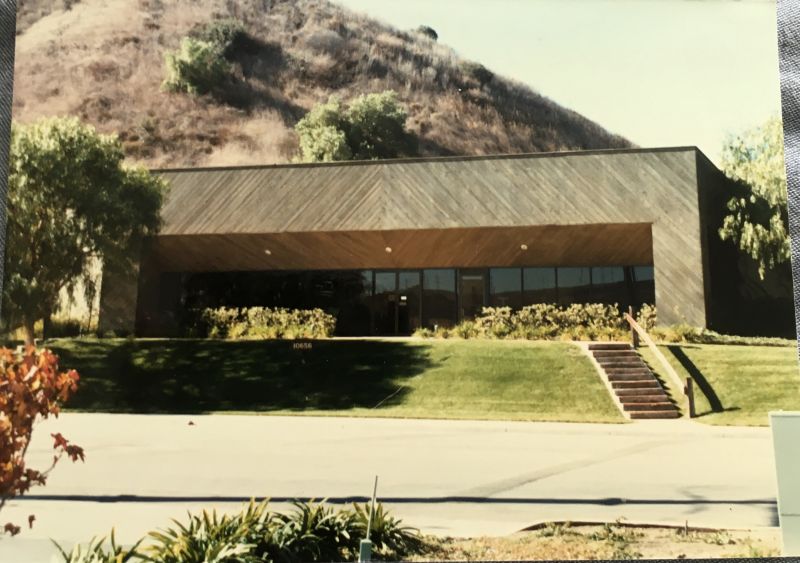 Building 4? |
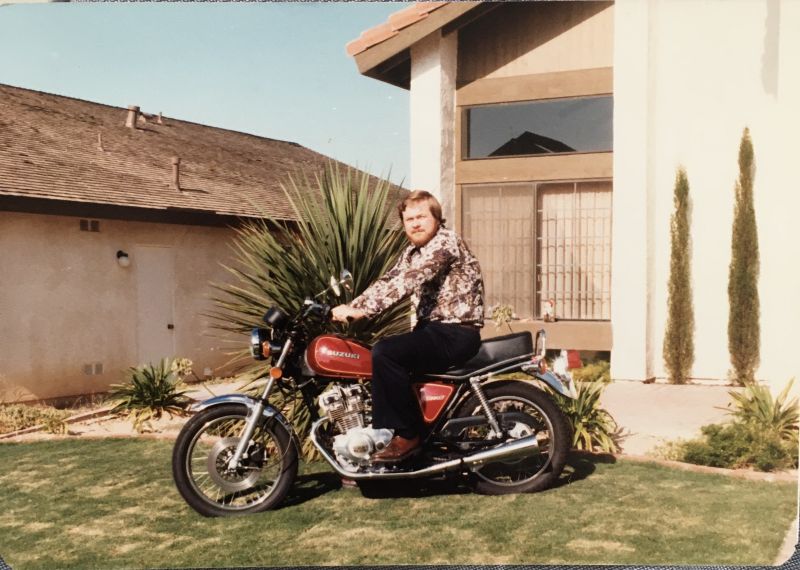 Bob Gilmore |
 |
| From: Stan Sisson <sdsisson62373gmail.com> Date sent: Wed, 31 Aug 2022 21:44:32 -0700 Subject: Exsysco site Hi Mark! I was sent the link to your excellent site by Robert Gilmore, who I am still in contact with after all these years, and have visited. I was a tech on the AS/5 test floor, working with Stu Kroll, Gary Crowningshield, and Sandor Z, among others. Like many other techs, I was recruited from NCR in Rancho Bernardo. I moved to PSA, in 1979 IIRC, eventually supporting their Amdahl mainframes, until PSA was sold to USAir. Those were good times, I have many pleasant memories of working there. Stan Sisson |
| Stan, Thanks for the email. Do you have any photos, etc that you can share? Mark |
| Hi Mark If I do they are buried in a box of old photos. If I come across any, I will be sure to let you know. BTW, if you have any contact info for Gary Crowningshield, I would appreciate getting that. Sorry to see that Paul Hastings passed, he was quite the guy. Stan |
| I do not know of Gary's contact information. I'll put your request on my web page and maybe someone will know and respond. |
email : markd@silogic.com